Astroscale’s ELSA-d demos repeated magnetic capture
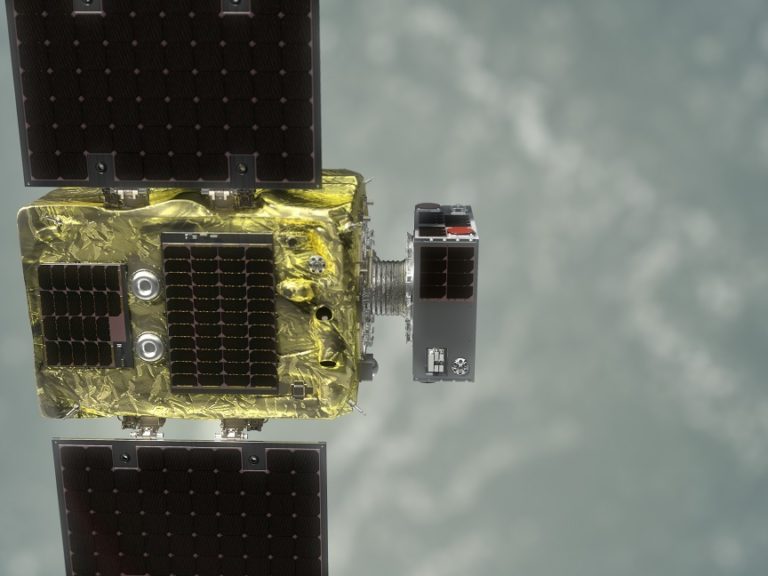
Image courtesy Astroscale
A major challenge of debris removal and on-orbit servicing in general, is docking with or capturing a client object; this test demonstration served as a successful validation of ELSA-d’s ability to dock with a client, such as a defunct satellite.
When ELSA-d was launched and commissioned, a mechanical locking mechanism held its servicer and client spacecraft together. The first step of this demonstration was to unlock this mechanism. Once unlocked, the magnetic capture system alone held the client to the servicer, preparing ELSA-d to repeatedly capture and release the client in future demonstrations.

The client was then separated from the servicer for the first time and captured to validate the magnetic capture system. During the release and capture period, Astroscale’s Mission Operations and Ground Segment teams checked out and calibrated the rendezvous sensors and verified relevant ground system infrastructure and operational procedures.
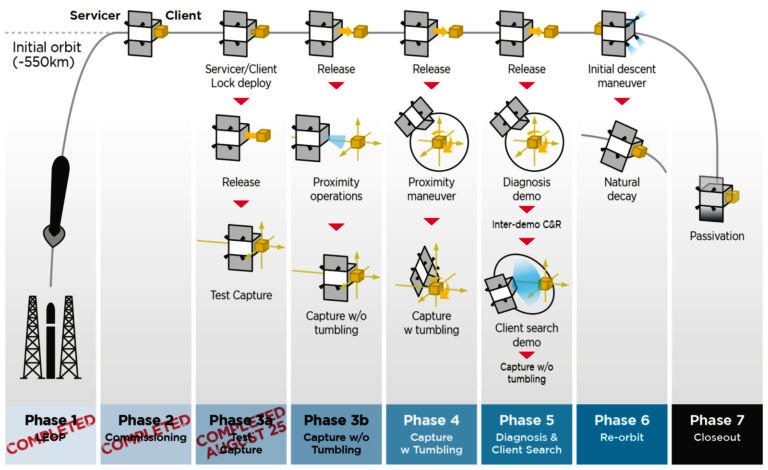
The successful completion of this phase paves the way for the remainder of Astroscale’s pioneering demonstrations of space debris removal. The Engineering and Mission Control teams are now preparing for “capture without tumbling,” where the client will be separated to a greater distance, and the method of rendezvous and docking will rely on a combination of on-board autonomous software and advanced ground processing of telemetry and commands. This demonstration is expected to be completed in the coming months and will be followed by the “capture with tumbling” phase, in which the client will simulate an uncontrolled, tumbling space object. The final capture demonstration will be “diagnosis and client search,” in which the servicer will inspect the client, withdraw to simulate a far-range search, then approach and recapture the client.
“This has been a fantastic first step in validating all the key technologies for rendezvous and proximity operations and capture in space,” said Nobu Okada, Founder & CEO of Astroscale. “We are proud to have proven our magnetic capture capabilities and excited to drive on-orbit servicing forward with ELSA-d.”
The Harwell Space Cluster, in Oxfordshire, is home to the Astroscale Operations Centre.
ELSA-d Demonstrations Phase by Phase
Volodymyr Levykin, CEO and founder of Skyrora, commented: "Following on from the uncontrolled re-entry to Earth of the Chinese Long March-5b vehicle as an 18 tonne piece of space junk and the orbital debris that recently struck the International Space Station, we’re encouraged by the developments made by Astroscale’s ELSA-d mission.
"There are around 26,000 objects currently orbiting the planet and new constellations of satellites being launched among debris from 60 years of space missions. With this amount of low earth orbiting satellites increasing weekly and the frequent deployment of satellite constellations adding to the overload in orbital space, companies such as Astroscale and Skyrora are leading the efforts to tackle the ever-growing issue of ‘space junk’.
"Orbital Transfer Vehicles (OTV), or space tugs, can also help safely deorbit space debris or transport it to a disposal orbit. We believe every launch, regardless of who is behind it or where it's launching from, should now include some sort of OTV to address the ‘space junk’ issue and prevent uncontrolled re-entries going forward.
"It is our hope that, alongside companies such as Astroscale, we can help pave the way towards clearing up Earth’s orbit, protecting future satellite missions and furthering environmental efforts concerning the skies above. Clearing space debris shouldn’t be a suggestion, it needs to be a necessity."