Advancing UK Aerospace, Defence, Security & Space Solutions Worldwide
  • Home
  • /
  • Space
  • /
  • BAE Systems completes testing of Roman Space Telescope's WFI

Space

BAE Systems completes testing of Roman Space Telescope's WFI
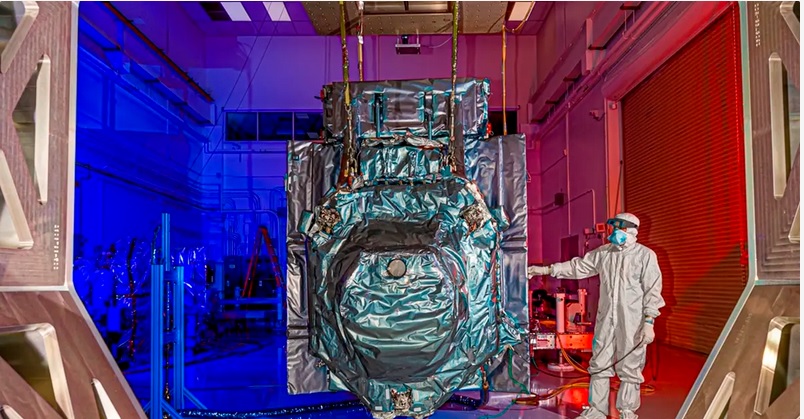
BAE Systems has successfully shipped the Nancy Grace Roman Space Telescope’s Wide Field Instrument (WFI) to NASA’s Goddard Space Flight Center in Greenbelt, Maryland, signalling the completion of integration and testing of the instrument.

Image courtesy BAE Systems

The WFI is the primary scientific instrument for the Roman Space Telescope, NASA’s next flagship astrophysics mission. The instrument is an advanced visible-to-near-infrared imager with additional spectral capabilities that will capture highly detailed images over wide swaths of the sky, offering a field of view at least 100 times greater than its predecessor, the Hubble Space Telescope, with a similar resolution. This instrument will dramatically improve the speed and scale of astronomical surveys, unlocking new insights into the mysteries of dark matter and dark energy, discovering distant galaxies and exoplanets and studying how the structure of the universe has formed over billions of years.

Advertisement
ODU RT

BAE Systems designed and built the instrument’s opto-mechanical assembly, which includes the optical bench, element wheel, thermal control system, alignment compensation mechanism and associated subsystem control electronics. NASA Goddard build the instrument’s focal plane system, relative calibration system, diffraction elements for the element wheel and the instrument command and data handling electronics. BAE Systems also led the integration of the WFI’s components, along with environmental testing to ensure it can withstand the stresses of a launch and the conditions it will face in space.  
 
“The Wide Field Instrument is one of the most sophisticated instruments ever constructed and once it’s on orbit it will provide the scientific community with the most comprehensive surveys of the sky we’ve ever captured,” said Bonnie Patterson, senior director of civil space programs for BAE Systems Space & Mission Systems. “Our team is proud to support such an ambitious mission and we look forward to seeing what amazing discoveries this instrument will help to make throughout the universe.”
 
With the instrument delivered, the Goddard team will lead the effort to integrate the WFI into the instrument carrier and mate it to the spacecraft bus later this year. The Roman Space Telescope is scheduled to launch by May 2027.

Advertisement
Leonardo animated rectangle

The work on the Roman Space Telescope continues the BAE Systems Space & Mission Systems’ legacy of contributing to all of NASA’s flagship astrophysics missions, including the James Webb Space Telescope and the Great Observatories: the Hubble Space Telescope, Spitzer Space Telescope, Chandra X-ray Observatory, and the Compton Gamma-Ray Observatory. BAE Systems was also recently selected to conduct a research effort for NASA’s planned Habitable Worlds Observatory, called the Ultra-stable Large Telescope Research and Analysis Program – Critical Technologies (ULTRA-CT).

Advertisement
General Atomics LB
BAE Systems to advance autonomous space-based surveillance tech for DARPA

Defence Space

BAE Systems to advance autonomous space-based surveillance tech for DARPA

15 December 2025

The US Defense Advanced Research Projects Agency (DARPA) has awarded BAE Systems’ FAST Labs research, development and production organisation a $16 million Phase 2 contract for the Oversight programme.

Spaceport Cornwall and National Drone Hub launch UAS project

Aerospace Defence Security Space

Spaceport Cornwall and National Drone Hub launch UAS project

15 December 2025

The UK's first licensed spaceport, Spaceport Cornwall, has commenced work on a groundbreaking project with the National Drone Hub to establish a unique testing environment for uncrewed aerial systems (UAS).

GMV UK advances resilient satellite navigation with BEACON

Space

GMV UK advances resilient satellite navigation with BEACON

15 December 2025

GMV, through its subsidiaries in the UK and Portugal, in partnership with Loughborough University, has been awarded a contract under the European Space Agency’s NAVISP programme to develop BEACON, an advanced beamforming antenna and receiver system designed to improve the resilience of C-band radionavigation signals from Low Earth Orbit (LEO) ...

Viasat’s rocket telemetry service selected by INNOSPACE

Space

Viasat’s rocket telemetry service selected by INNOSPACE

12 December 2025

Korean launch provider INNOSPACE has selected Viasat’s rocket telemetry service for its first ever commercial launch, marking the first time this service will be used in a commercial mission carrying satellite payloads.

Advertisement
Leonardo animated rectangle
ITA Airways adopts Iris tech

Aerospace Space

ITA Airways adopts Iris tech

11 December 2025

Viasat has announced that ITA Airways is being equipped with Iris technology, paving the way to trajectory-based operations which can cut emissions and enhance airline efficiency.

Pilot programme to advance UK space ecosystem

Space

Pilot programme to advance UK space ecosystem

10 December 2025

Eighteen space businesses across the UK will receive funding and support from their local space cluster to accelerate their commercial growth, as part of a pilot initiative designed to strengthen the UK's space sector supply chain.

Advertisement
ODU RT