BAE Systems introduces RAD510 SDU
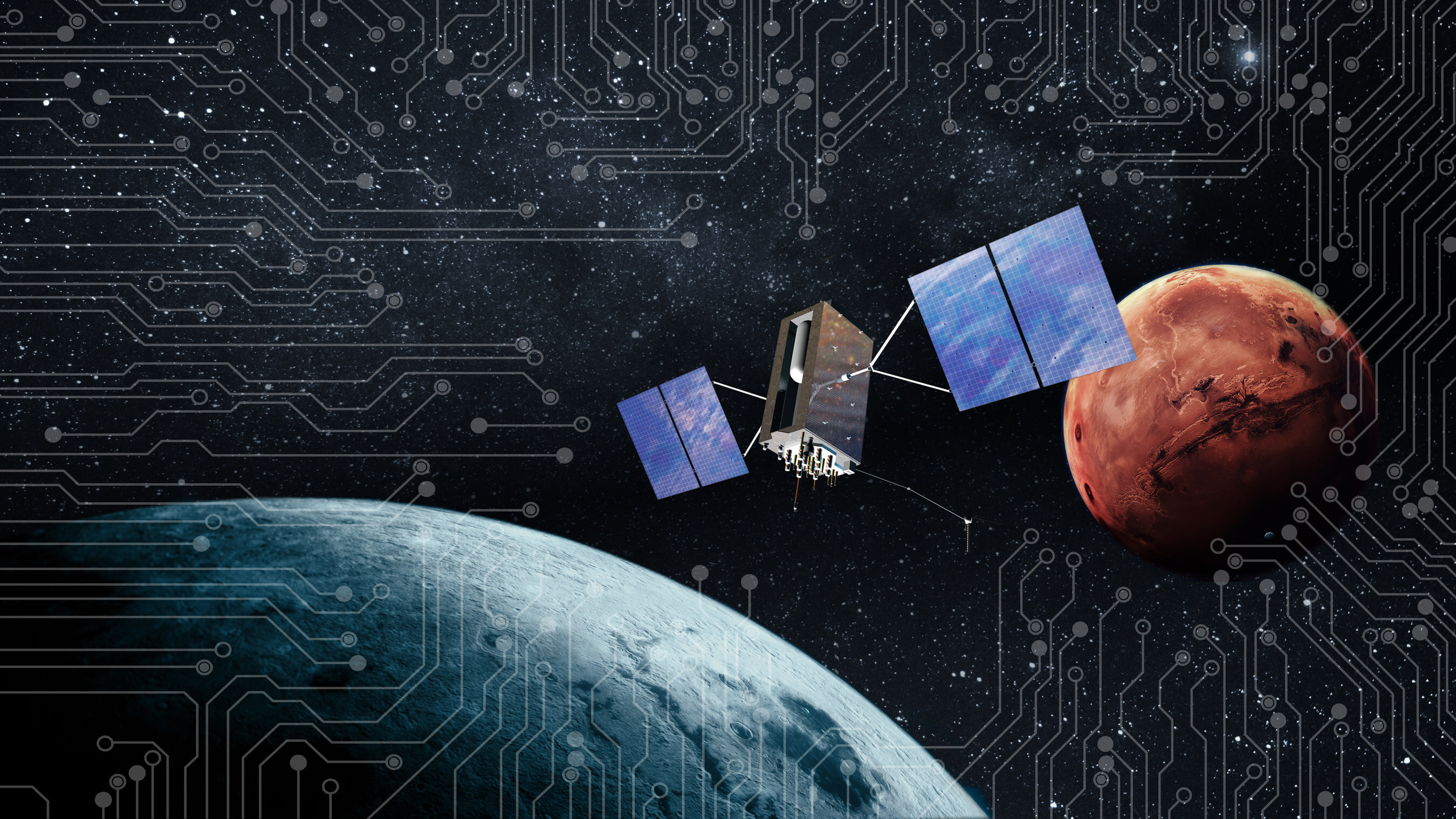
Above: BAE Systems’ RAD510 software development unit ready for order as space community prepares for next-gen single-board computer.
Courtesy of BAE Systems
Now made available for order to the space community, BAE Systems' RAD510 software development unit (SDU) enables initial software implementation and testing as customers prepare to convert from the RAD750 single-board computer (SBC) to the next-generation RAD510 SBC. Currently in qualification, the RAD510 SBC offers three times the performance capability of its predecessor, supporting critical space missions.

By offering the RAD510 SDU in parallel to SBC qualification, it enables users to develop, integrate, and test with their own applications. The approach mitigates risk and enables easier adoption of the new solution. To further prepare customers, the RAD510 SBC will launch in industry-standard 3U form factor and use software compatible with both BAE Systems' RAD750 and RAD5545® SBCs. This design commonality reduces user software development costs.
"Supporting our customers' space missions for decades, we equip satellites and other spacecraft with our single-board computers," said Joe Dziezynski, director of Space Systems at BAE Systems. "The RAD510 SBC builds on that legacy – providing a highly reliable radiation-hardened solution that scales performance while requiring less power. Our software development unit provides another readiness milestone to ensure our customers are prepared for the transition ahead of product completion."
The RAD510 SBC is designed to withstand the challenging environment of radiation and extreme temperatures of space. It is built on the demonstrated success of BAE Systems' RAD750 SBC that has enabled more than 100 satellites, carrying out a variety of missions. The next-generation SBC provides increased processing capability and interface connectivity while maintaining the similar size, weight, and power as the RAD750 SBC. It employs a system-on-chip to serve as the primary processing component and has the radiation advantages of rad-hard 45 nanometer silicon-on-isolator technology. The SBC is a complete, functioning computer in which the microprocessor, input/output functions, memory, and other features are all built on a single circuit board.
For more than 50 years, BAE Systems has developed and manufactured advanced, high-reliability radiation-hardened electronic components, cards, processors and units for civil, commercial and national security space missions. The family of space-based electronics can withstand radiation doses a million times stronger than a fatal human dose, durability which is valued on missions and on-orbit satellites.
Work on the RAD510 SDU is performed by BAE Systems' Space Systems group in Manassas, Virginia. This facility is a US Department of Defense Category 1A Microelectronics Trusted Source, covering design, aggregation, broker, packaging/assembly and test services. The RAD510 SBC is expected to complete qualification in 2026.