
Advancing UK Aerospace, Defence, Security & Space Solutions Worldwide
  • Home
  • /
  • Space
  • /
  • Biomass forest measuring satellite shipped to Kourou

Space

Biomass forest measuring satellite shipped to Kourou
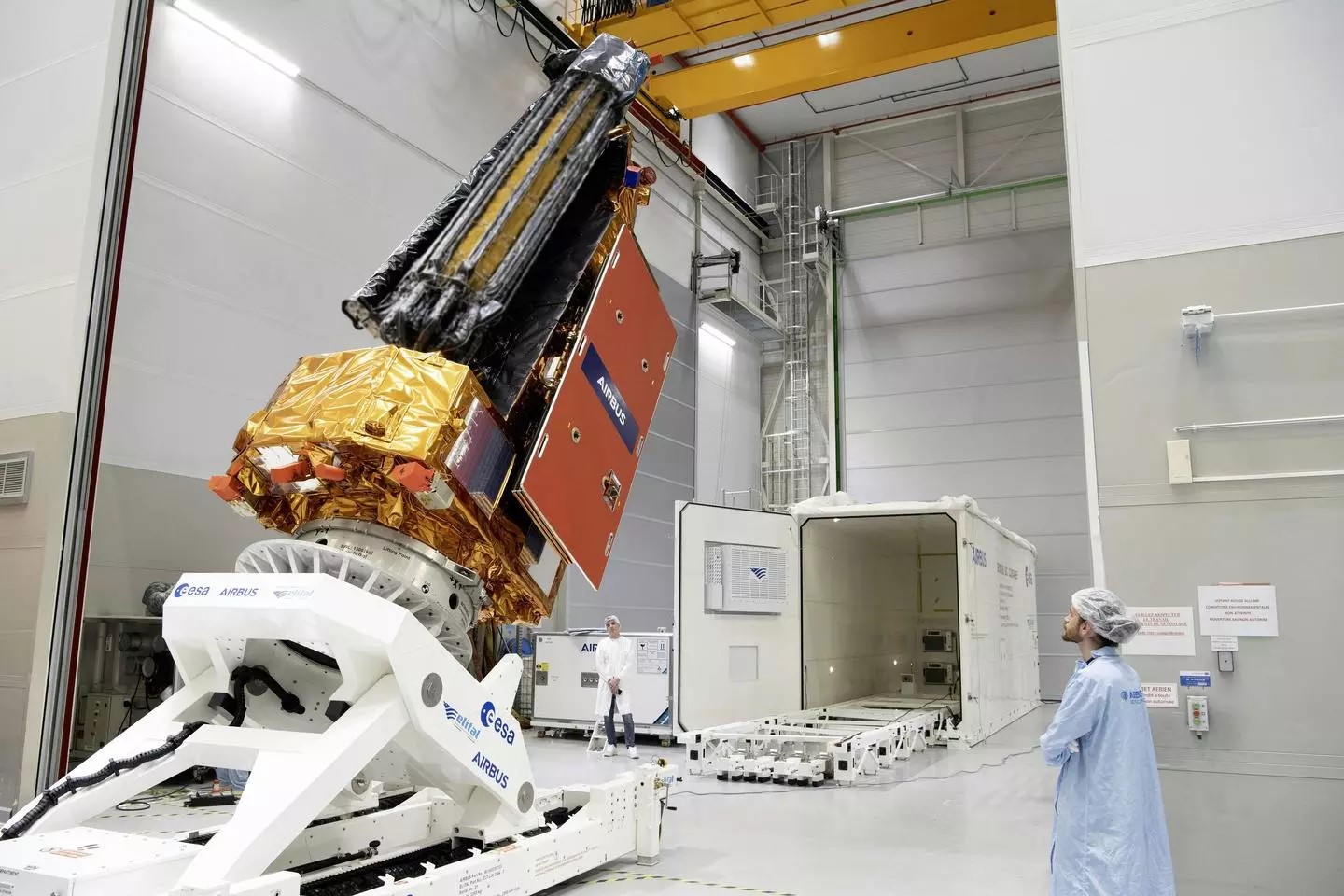
Biomass, the European Space Agency’s (ESA) Airbus-built satellite, has left Toulouse for its journey by ship to Kourou, French Guiana, ready for launch.

Image copyright Airbus

Biomass, an Earth Explorer satellite, is ESA's flagship mission to measure forest biomass to assess terrestrial carbon stocks and fluxes from an altitude of 666km above the Earth. The spacecraft will carry the first space-borne P-band synthetic aperture radar, delivering exceptionally accurate maps of tropical, temperate and boreal forest biomass.

Advertisement
ODU RT

Alain Fauré, Head of Space Systems at Airbus Defence and Space said: “Shipping this flagship mission is a major milestone after years of hard work and dedication from all our teams. The satellite’s groundbreaking technology will enable climatologists to accurately assess carbon stocks and fluxes from space and improve the understanding of the part that forests play in regulating climate.”

The spacecraft features a large 12x15 metre deployable antenna to capture the reflected SAR data that will be used to provide accurate global maps of tropical, temperate, and boreal forest biomass. Data on changes in biomass due to forest loss (for example from logging/burning) and regrowth is unattainable by ground measurement techniques.

Above: Biomass with its solar array deployed.
Copyright Airbus

Airbus engineers from Stevenage (UK), where the satellite was built, led the successful test campaign in Toulouse, supported by colleagues on site and from Airbus in Friedrichshafen (Germany), plus the wider industrial team.

Advertisement
ODU RT

Above: The unfurlable mesh reflector.
Copyright L3 Harris

The teams will now prepare for the in-orbit commissioning and operational phases, with a separate team managing the delivery of the ground calibration transponder, located in New Norcia, Australia. The Biomass satellite’s development and testing have involved more than 50 companies across 20 countries.

Biomass is scheduled to launch in April 2025 on a Vega-C rocket from Kourou and will operate in orbit for five years.

Advertisement
Gulfstream banner
Seraphim establishes Global Space Futures Advisory Council

Space

Seraphim establishes Global Space Futures Advisory Council

17 April 2026

London based space technology investment group, Seraphim Space, has announced the establishment of the Global Space Futures Advisory Council, created to address key strategic, commercial and geopolitical opportunities and challenges facing the space sector.

AccelerComm granted 56th patent as it advances 5G

Space

AccelerComm granted 56th patent as it advances 5G

16 April 2026

UK based provider of physical layer IP for 5G non-terrestrial networks (NTN), AccelerComm Ltd, today announced the grant of its 56th international patent, marking a significant milestone as the company completes its 10th year of operations.

DESI completes 3D map of the Universe

Space

DESI completes 3D map of the Universe

16 April 2026

The Dark Energy Spectroscopic Instrument (DESI) has completed the largest 3D map of the Universe.

BAE Systems introduces Ascent spacecraft

Defence Space

BAE Systems introduces Ascent spacecraft

15 April 2026

BAE Systems has introduced its Ascent spacecraft, a new addition to the company’s Elevation spacecraft line that supports superiority and exploration missions across the space domain.

Advertisement
ODU RT
Amazon to acquire Globalstar

Space

Amazon to acquire Globalstar

14 April 2026

Amazon.com, Inc. and Globalstar, Inc. have announced that they have entered into a definitive merger agreement under which Amazon will acquire Globalstar, enabling Amazon Leo to add direct-to-device (D2D) services to its low Earth orbit satellite network and extend cellular coverage to customers beyond the reach of terrestrial networks.

Northumbria University researchers awarded £4m to solve space radiation mystery

Space

Northumbria University researchers awarded £4m to solve space radiation mystery

14 April 2026

Researchers at Northumbria University have been awarded £4 million to unlock the secrets of Earth's radiation belts and why they behave so unpredictably – information which is crucial for protecting satellites and forecasting space weather.

Advertisement
ODU RT
Advertisement
Gulfstream banner