British Army's ETG test UAS on Salisbury Plain

Image British Army / MoD Crown Copyright
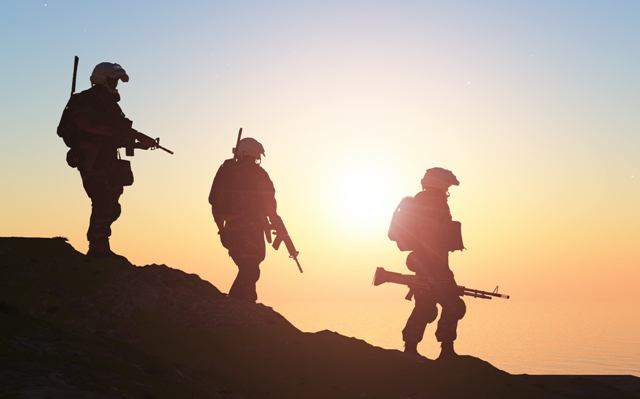
Soldiers from by 2nd Battalion The Royal Yorkshire Regiment have been experimenting with tactics currently being used in Ukraine where the lower infantry formations (platoons, companies and battle groups) have been subject to having to consider not just what is on the surface, but now what is in the air above them too.

The recce-strike complex considers the speed at which one can reconnoitre a target and then strike it. Historically, recce-strike has been the preserve of longer-range capabilities like artillery and aviation, whilst infantry formations have had a very limited ability to do this; however, UAS is drastically changing the shape of warfare.
Colonel Toby Till, The Experimentation and Trials Group (ETG), said: "We see this happening every day on the battlefields of Ukraine and other theatres. A soldier who previously used to focus on the ground, is now looking up as well, what we are calling near surface warfare, the ability to control the airspace above you and critically as part of that, the electronic space.
“We have a vital role to play in that, testing new ways of fighting and new technology, combining those together in what General Sir Roly Walker KCB DSO ADC Gen, Chief of the General Staff described as ‘tech craft,’ in his Royal United Services Institute (RUSI) speech enabling us to fight better in the future and be more lethal against any adversary we might face.
“To really work out the best ways to operate that equipment, work out the new tactics, techniques and procedures, making sure we ‘bleed’ that across to the whole Army to make it better.”
Supporting the acceleration of modernisation, some of the cutting-edge technology used in the experimentation has included: Spike Firefly, a loitering UAS munition that can remain undetected above the target for an extended period of time, First Person View (FPV) S1 Strike UAS and DefendTex D40 UAS which both provide ‘the eyes’ for a company size formation and a heavy lift Malloy T400 UAS designed to transport large loads like stores and assist with casualty extractions.
Colonel Till said: “It’s about getting that new technology into the hands of the Field Army soldiers.”
UAS are speeding up the decision-action cycle forcing commanders into more complex and dynamic decision making. The experimentation highlighted the importance of having a digitally connected network, and a requirement for more advanced and complex training at the lowest formation to enable this.
The 2nd Battalion The Royal Yorkshire Regiment is an infantry unit based in Chester and is currently the Army’s Experimentation Battalion. The recce-strike complex specifically focussed on the incorporation of UAS and complexity it involves in the modern-day battlefield, however there are also many other types of modern technology the Army is currently experimenting with.