

British Army test radiofrequency weapon on drones

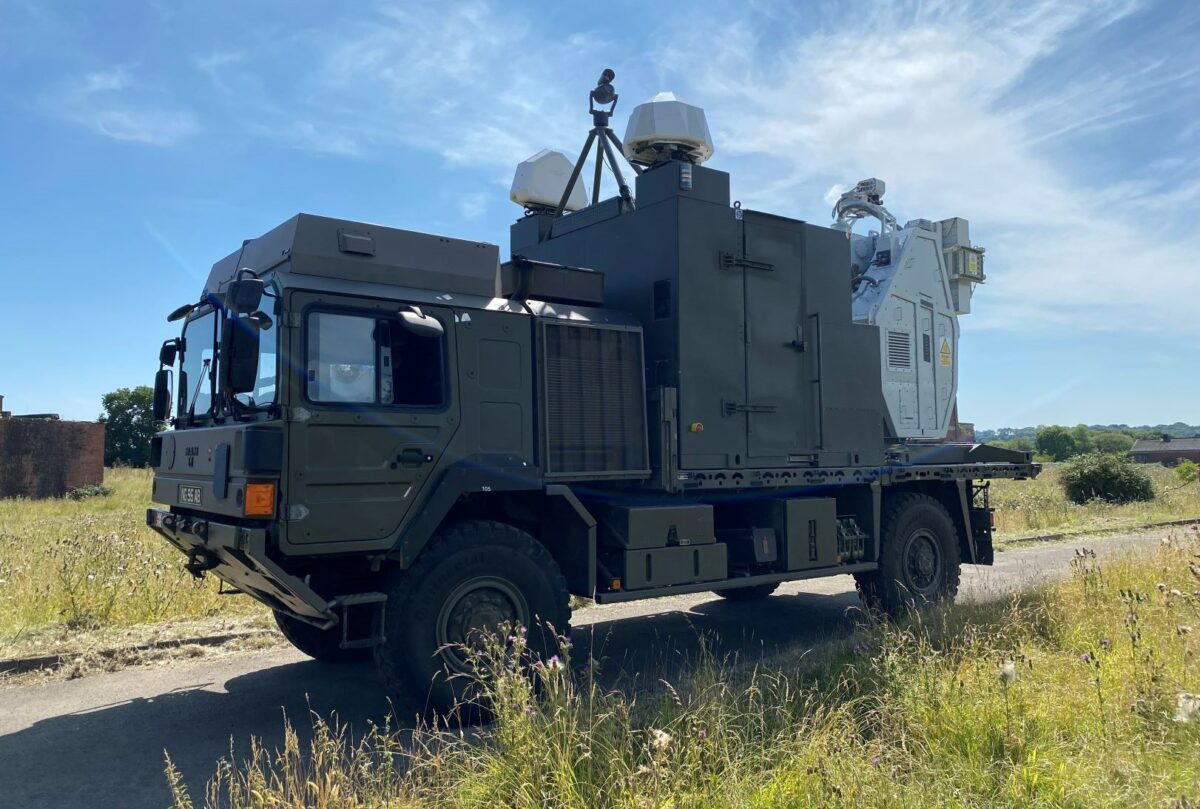
Image courtesy DE&S
The Radio Frequency Directed Energy Weapon (RFDEW) demonstrator developed through Project Ealing can detect, track and engage a range of threats across land, air and sea.
RFDEWs are capable of neutralising targets up to 1km away with near instant effect and at an estimated energy cost of less than 10p per shot fired, could provide a cost-effective complement to traditional missile-base air defence systems in future.
The system has been developed by a Thales UK-led consortium under a contract awarded by Team HERSA, the joint enterprise between DE&S and the Defence Science and Technology Laboratory (Dstl).
It uses high-frequency waves to disrupt or damage critical electronic components inside devices such as drones, causing them to be immobilised or fall out of the sky.
A live firing trial was completed by the Army’s Royal Artillery Trials and Development Unit and 7 Air Defence Group at Manorbier range in West Wales, where they successfully targeted and engaged drones.
A spokesman for DE&S’ RF DEW team said: “The DEW team are working closely with UK Armed Forces, Dstl and industry partners, using engineering, management and commercial expertise to deliver directed energy weapons into service and secure a crucial advantage against emerging threats.”

Above: The Radiofrequency demonstrator weapon tested by the British Army to engage flying drones.
Courtresy DE&S
While the demonstrator tested won’t go into service, the knowledge, experience and data gleaned from the experiments it has undergone this year will inform future directed energy requirements for the UK.
Its high level of automation means the system could be operated by a single person and could be mounted onto a military vehicle, such as a MAN SV, to provide mobility.
Minister for Defence Procurement and Industry, Maria Eagle MP, said: “The successful firing by the British soldiers of our Radio Frequency Directed Energy Weapon is another step forward for a potentially game-changing sovereign weapon for the UK.
“It’s great to see defence experts and industry working collaboratively to put cutting-edge equipment in the hands of our Armed Forces.”
The demonstrator has been produced by a consortium led by Thales UK, including sub-contractors QinetiQ, Teledyne e2v and Horiba Mira, and supports up to 135 jobs in the UK.
Nigel MacVean, MD of Thales Integrated Airspace-protection Systems, said: “I am thrilled with the successful RFDEW firing trials.
“Thales has been at the forefront of this pioneering technology for over 40 years and our continued research and development in this sector, along with our partners in Government, paves the way for a strong future in this field.”
Project Ealing will continue to enable further development and experimentation, while Team HERSA continues to work with operators to develop RFDEW requirements, doctrine and technology, shaping the next generation of mission-optimised RFDEWs.
Sign up for our newsletter and get our latest content in your inbox.
Similar Reads




Sign up for our newsletter. Select all sectors relevant to you.
Related