British Army trains robotic dogs
Developed by Ghost Robotics this go anywhere robotic canine, based on the bio-mechanics of the dog, is the equivalent of a Swiss army knife. You can swap its legs and add arms as the need or challenge dictates. The Ghost is the latest tool in the ever-expanding tool chest of 16 Air Assault Brigade Combat Team, the British Army’s global response force.

Colonel James Loudoun, 16 Air Assault Brigade Combat Team (BCT), said: "It is a fantastic opportunity for the team to be at the forefront of the Army experimentation with Robotics and Autonomous Systems."
The BCT is specially trained and equipped to deploy by parachute, helicopter and air-landing. Its core role is to maintain and command the Air Manoeuvre Task Force (AMTF) which is made up of infantry and aviation battlegroups held at very high readiness to move.
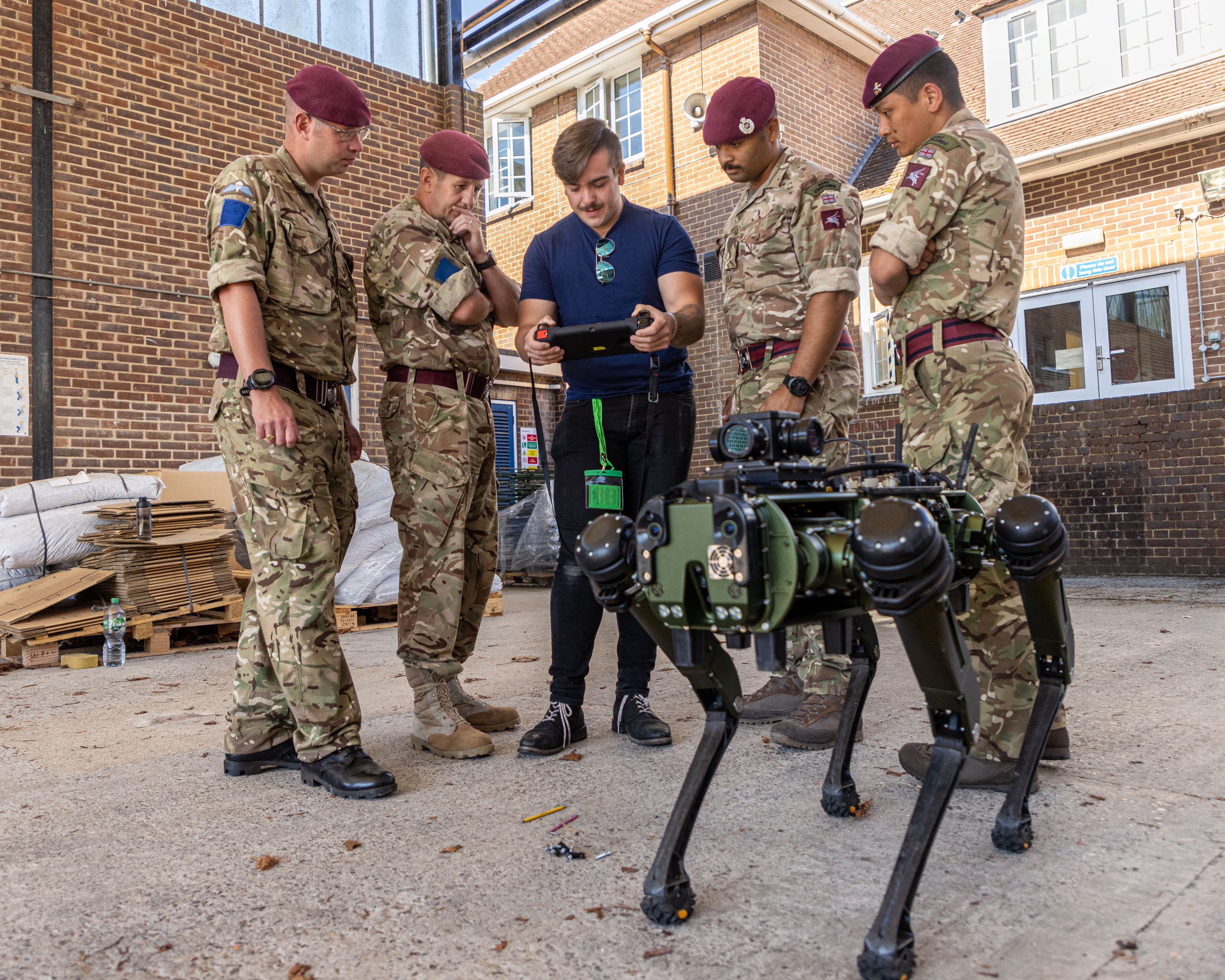
Above:
Soldiers are given a demonstration on how to use the Ghost V60 Robotic Dog remote control. .
Courtesy British Army / MoD / Crown Copyright
Described as a ‘mid-sized high endurance agile and durable all-weather ground drone’ the robot is not autonomous, it is at all times under the control of an operator using a control pad that most people would recognise as it looks and behaves not unlike a gaming controller.
Already in trials with the US Homeland Security to assist in patrolling the USA’s southern border and other defence forces, this new and exciting piece of kit will provide increased situational awareness which is vital in planning and developing effective stratagems.
No longer does the Army with the biggest or fastest piece of kit win the battle. In an age of ‘360-degree warfare’ software not hardware will give you the tactical advantage.
With tactical advantage comes greater understanding, increased accuracy in identifying and acquiring targets which ultimately leads to increased lethality.
Lance Corporal Heath, 16 Air Assault Brigade, said: "As airborne engineers we would definitely use this as our eyes and ears. If we were approaching a compound or an uncertain area we would be looking for a piece of kit to enable us to push forward, to scope out the area."
The 16 Air Assault Brigade Combat Team is relishing the opportunity to be the first Robotics and Autonomous Systems (RAS) enhanced brigade. Colonel James Loudoun, Deputy Commander of 16 Air Assault Brigade Combat Team, said: "It is a fantastic opportunity for the team to be at the forefront of the Army experimentation with Robotics and Autonomous Systems.
"Airborne forces were created as an innovation and we have maintained an innovative and open-minded approach to how we operate so that we can achieve the best with what we have.
"We are light forces and expect to operate at reach with limited resources and support, so we will embrace any way that we can use technology on the battlefield to support our soldiers and improve overall capability."
Lance Corporal Heath who trained on the Ghost V60 said: "As airborne engineers we would definitely use this as our eyes and ears. If we were approaching a compound or an uncertain area we would be looking for a piece of kit to enable us to push forward, to scope out the area.
"With things like thermal imaging, you are able to attach ‘LIDAR’ so you’d be able to map out a 3D image. So, commanders would be able to assess the dangers and mitigate those moving forward. The sole purpose of a piece of kit like this is to keep soldiers out of danger."