

British Army uses RF DEW to down drone swarms

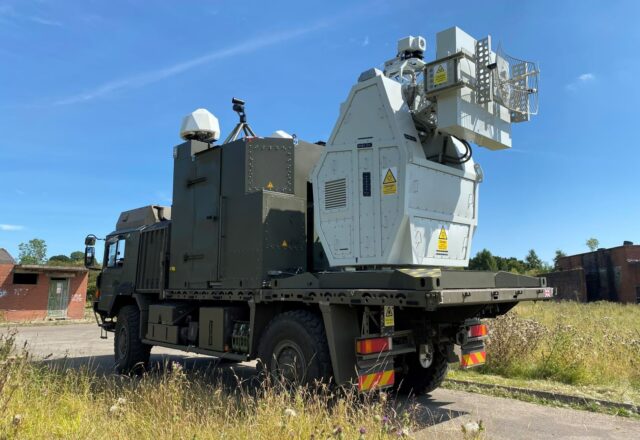
Image courtesy DE&S
Successful experiments included soldiers from 106 Regiment Royal Artillery taking down two swarms of drones in a single engagement, and more than 100 drones were immobilised using the weapon across all trials.
Sgt Mayers, a senior remotely piloted air systems operator, had the honour of being the first British soldier to bring down drones using radiofrequency technology. He said: “RF DEW is an exciting concept. We found the demonstrator quick to learn and easy to use. With improvements on range and power, which could come with further development, this would be a great asset to layered air defence.”

The project, known as Ealing, has been delivered by Team Hersa – a collaboration between Defence Equipment & Support and the Defence Science and Technology Laboratory (Dstl).
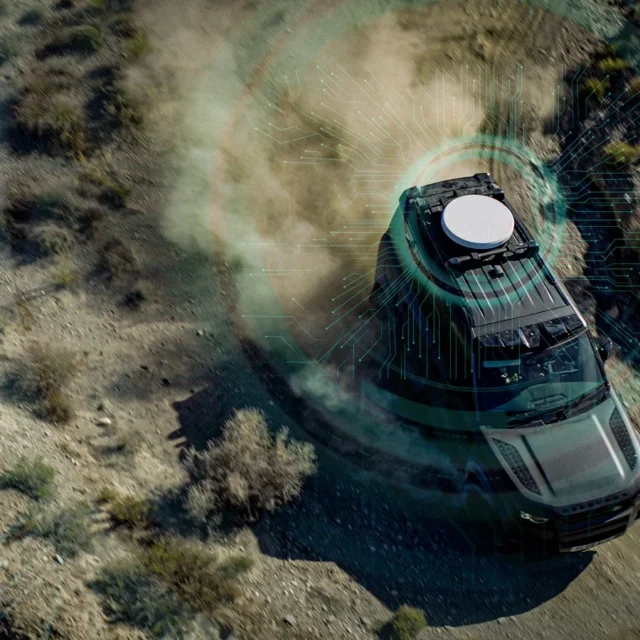
Developed by a Thales UK-led industry consortium, the demonstrator has been designed to explore the potential of radiofrequency weapons for UK Armed Forces.
The trial was completed at Air Defence Range Manorbier in West Wales and proved the demonstrator could neutralise multiple targets simultaneously, with near-instant effect.
It uses high frequency radio waves to disrupt or damage critical electronic components inside drones, causing them to crash or malfunction.
At an estimated cost of only pence per shot fired, if developed into operational service it could provide a cost-effective complement to traditional missile-based air defence systems.
RF DEW systems can defeat airborne targets at ranges of up to 1km and are effective against threats which cannot be jammed using electronic warfare.
Adam, from the DE&S Directed Energy Weapons team, was involved in the trials, said: “The purpose of this project is to develop an experimental directed energy weapon system that enables us to explore the system integration challenges and the operational challenges of fielding an RF DEW.
“It’s absolutely crucial that we not just maintain the ability to fight the threats we currently face, but also address the threats that are coming down the line and the development of radiofrequency weapons is really a big part of that.”

Above: A member of DE&S’ Directed Energy Weapons team holds a drone in front of an RF DEW demonstrator.
Courtesy DE&S
Thales employs around 100 highly skilled engineering and manufacturing staff in Northern Ireland on the project and there are a further 30-35 supply chain jobs in Chelmsford, Essex, that directly contribute to the development of the demonstrator.
Nigel MacVean, MD of Thales Integrated Airspace-protection Systems, said: “Thales continues to be at the forefront of this pioneering technology and we are proud to continue the research and development in this sector alongside our partners in government.”
Sign up for our newsletter and get our latest content in your inbox.
Similar Reads



Sign up for our newsletter. Select all sectors relevant to you.
Related