

Chess introduces AI-enabled Low SWaP CHARM50

As defence and security systems become increasingly distributed, there is growing demand for processing capability that can be deployed closer to the sensor. Applications including airborne surveillance, unmanned systems, compact gimbals and hand-held sensors are placing greater emphasis on technologies that can deliver advanced video processing capability whilst operating within strict size, weight and power constraints.
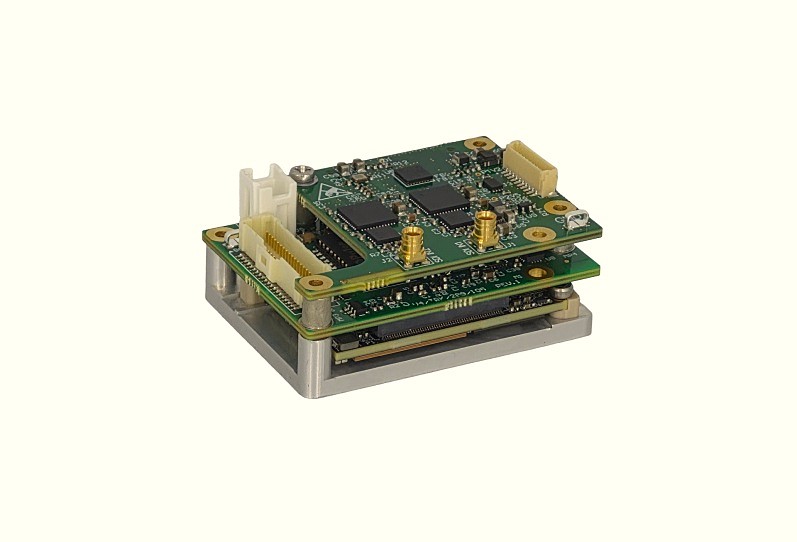
Designed specifically for these environments, CHARM50 combines AI-enabled detection, classification and tracking capability within a compact form factor measuring approximately 50 mm by 35 mm – a size reduction of approximately 50% compared to the CHARM100NX. The module supports edge video processing directly within sensor systems, enabling information to be processed locally rather than transmitting large volumes of raw video to a central processor.
Why processing video within sensor systems can enhance information sharing
The module supports HD-SDI video inputs and can process two HD-SDI streams simultaneously, making it well suited to systems combining daylight and thermal sensors. When configured with a single video input, CHARM50 can support higher bandwidth video feeds, including 3G-SDI. By processing video locally within the sensor system, CHARM50 can reduce bandwidth requirements, support lower-latency system response and enable processed information to be shared across wider architectures rather than raw video streams.
The CHARM50 also benefits from a modular design, with its interface enabling integration with a wide range of camera systems.
How advanced AI algorithms support smart sensors and distributed sensing architectures
The introduction of CHARM50 also supports broader industry trends towards smart sensors and distributed sensing architectures, which have been constrained by the lack of AI computing on small form factor modules and variable bandwidth challenges between operators and unmanned systems. The CHARM50 helps integrators navigate these barriers through its small form factor and advanced AI algorithms, enabling them to focus on their capability rather than image processing algorithms.
By combining processing capability directly with the sensor, systems can generate detections, classifications and tracking information closer to the point of capture, reducing reliance on centralised processing resources.
Owen Sogeler, Vision4ce Sales Manager at Chess Dynamics, said: “We’re seeing growing demand for processing capability that can be deployed closer to the sensor, particularly in applications where size, weight and power constraints are critical. At the same time, users increasingly want sensors that can do more than simply capture video and can, for example, support the latest AI innovations. CHARM50 has been developed to address this requirement, extending Vision4ce’s detection, classification and tracking capability into applications where larger processing modules may not be practical.”
CHARM50 joins the existing Vision4ce CHARM portfolio, which includes CHARM80, CHARM100NX and CHARM150AGX, providing a scalable range of edge processing solutions for different operational requirements and platform constraints.
Sign up for our newsletter and get our latest content in your inbox.
Similar Reads




Sign up for our newsletter. Select all sectors relevant to you.
Related