Comet chase to be led by UK scientists

Above:
Comet Interceptor concept.
Copyright ESA
Comet Interceptor would be the first mission to travel to a comet which has never previously encountered the inner Solar System.
To do this, it will need to launch and reach a holding position around 1.5 million miles away from Earth. There it will lie in wait until astronomers on the ground spot a suitable comet for it to intercept.

Scientists will then choose to target either a pristine comet travelling inward from the far reaches of our Solar System for the first time, or an interstellar object similar to Oumuamua – the cigar-shaped asteroid which passed through the Solar System last year – both untouched by the effects of the Sun.
This makes them scientifically important as ‘time capsules’ which offer an opportunity to study the conditions of the early Solar System and understand its formation.
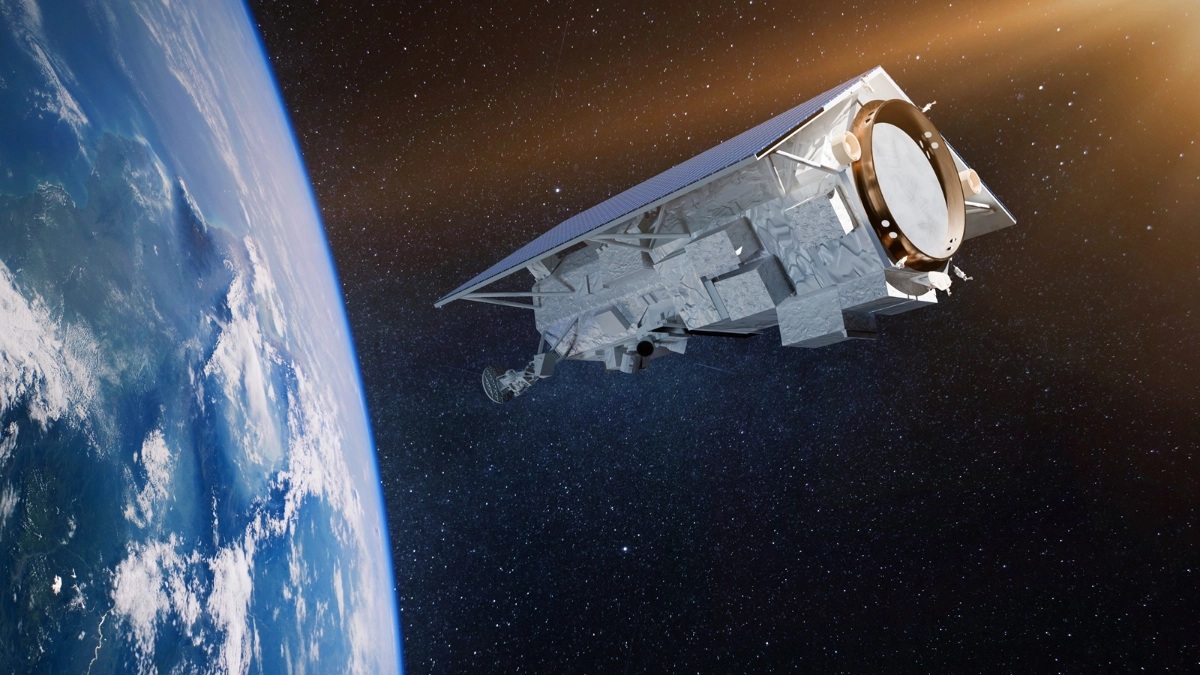
The Comet Interceptor mission will involve a main spacecraft – a ‘mothership’ – that will make observations of the comet from a distance. It will deploy two smaller ‘daughter’ spacecraft which then move in closer to measure features such as the comet’s structure and surface material, as well as the cocktail of gases it is releasing.
The European Space Agency Science Programme Committee has selected the project as the first in a new class of ‘Fast’ missions, which use existing, flight-proven technology to speed up the journey from mission concept to implementation.
Science Minister Chris Skidmore said: "Comet Interceptor sounds like something from a science fiction film but UK scientists are working to make it a reality in collaboration with our partners in the European Space Agency.
"This new type of fast mission is a great example of how advances in space technology can bring benefits back to the science community. Our modern Industrial Strategy is ensuring that the UK takes these opportunities to lead the new space age."
Comet Interceptor is a UK-led proposal with UCL and Edinburgh University leading the international payload consortium which includes the Japanese (JAXA) and American (NASA) space agencies, as well as other UK institutions.
Now that ESA has selected the proposal, the scientists and engineers will work together to develop the design and mission programme further.
The scheduled launch in 2028 would mean the mission sharing a ride on a rocket with another UK-led mission – the ARIEL (Atmospheric Remote-sensing Infrared Exoplanet Large-survey) space telescope, which aims to study the atmospheres of around 1,000 planets orbiting stars other than our own, known as exoplanets.
Chris Lee, Head of Science Programmes at UK Space Agency, said: "I’m delighted that our academic community impressed ESA with a vision of what a small, fast science mission can offer.
"In 1986 the UK-led mission to Halley’s Comet became the first to observe a cometary nucleus and, more recently, UK scientists took part in another iconic European comet mission, Rosetta. Now our scientists will build on that impressive legacy by attempting to visit a pristine comet for the very first time and learn more about the origins of our Solar System."