Cranfield Airport radar to enhance safety and support research
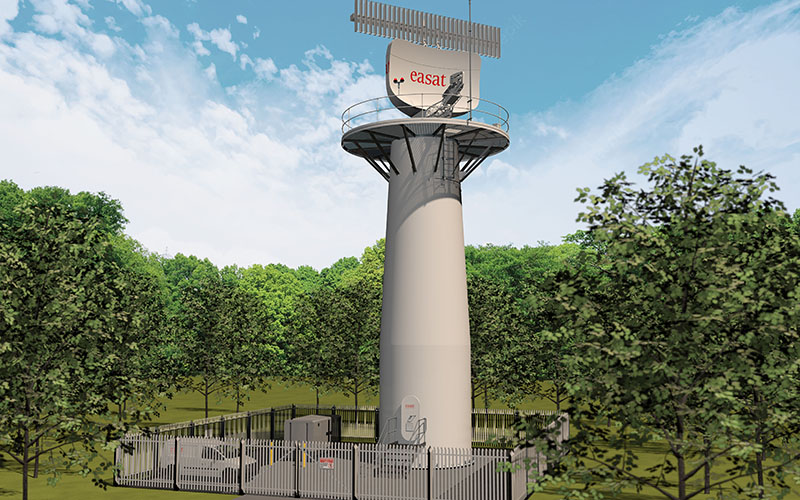
Image courtesy Cranfield University / Copyright Easat
The radar from Easat Radar Systems Limited is part of continual upgrades to the Airport’s technical capabilities, to maintain efficient operations and support the world-class aviation research that takes place at Cranfield University.
The 38 metre mono-tube radar tower will be sited at land north of Handley Page Close at Cranfield University, with construction starting in 2024. It is expected to become operational in 2026 and will improve the Airport’s capacity to map airspace, actively detecting aircraft rather than relying on them to transmit information.

The new capability will also support an increasing need from researchers for Air Traffic Controllers to understand activity around the Airport, including the integration of Unmanned Air Systems.
Funding for the radar was secured from UK Research and Innovation (UKRI).
Enhanced air safety and capabilities
The increase in capabilities adds to the digital control tower operation at Cranfield Airport, which was the UK’s first operational remote tower when it opened in 2018.
“This exciting news builds on the exceptional work of the Air Traffic Control personnel at Cranfield, who for many years have safely supported the operations at Cranfield in and around the Airport,” commented Rob Abbott, Cranfield Airport’s Director .
“Cranfield is one of the few remaining ‘procedural only’ controlling units and this addition will greatly increase understanding of the air traffic in the local area, further enhancing air safety. It will also be pivotal in developing the Air Navigation Service Provider’s ability to support research in critical areas, including unlocking the potential of Unmanned Aircraft Systems and Urban Air Vehicles.”
The cutting-edge Radar System from Easat features Co-Located Primary Surveillance (PSR) and Mono-Pulse Secondary Surveillance (MSSR) Radar functionalities. This state-of-the-art system is designed to provide advanced detection performance, with ranges exceeding 80NM for the PSR and exceeding 250NM for the MSSR, for small targets in harsh weather conditions.
“Easat is delighted to have the opportunity to supply our state-of-the-art Radar System to Cranfield Airport and to be a part of Cranfield’s exciting future. We are confident that our cutting-edge system will not only meet but exceed expectations, significantly enhancing operational efficiency, safety and future research at the airport.
“We eagerly anticipate witnessing the positive impact and benefits that our radar technology will bring to Cranfield Airport, further solidifying our commitment to delivering innovative solutions that push the boundaries of excellence in the radar industry,” commented Matt Jackson, Easat’s Director and General Manager
New radar to support global aviation research
The new radar is an element of Cranfield University’s Digital Aviation Research and Technology Centre , which supports research into sustainable aviation, aircraft of the future and the safe integration of drones.
Professor Graham Braithwaite, Director of Transport Systems at Cranfield University, said that the new radar will support ongoing and future research. “The radar will provide a more detailed understanding of our airspace and support effective monitoring of aircraft movement, which underpins the research we’re able to do.
“With improved quality of information, we expect this development will attract even more leading research projects and keep Cranfield at the forefront of global aviation research.”
Cranfield’s current Air Traffic Controllers will now commence a series of training courses to be qualified and ready for the radar becoming operational in 2026.
Radar services have not been offered by Cranfield Airport since 1993, before which it was provided by the now decommissioned Bedford Radar positioned at Bedford Aerodrome.