General Atomics

Cranfield University develops plant blast barrier

New research has revealed how everyday plants can help protect the public from blast impacts, whilst transforming cities into greener, healthier spaces.


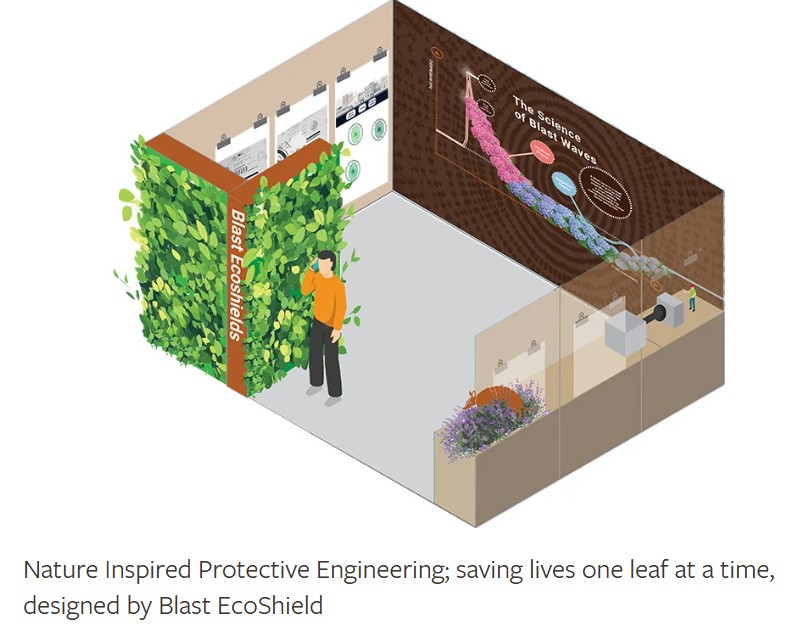
Above: The project, Blast Ecoshield, conceived and led by Cranfield’s Dr Rachael Hazael CEng, will be exhibited at the RHS Chelsea Flower Show 2026 for the first time.
Credit: Blast EcoShield / Cranfield University


The innovation is part of a four-year research project with experts that designed, experimentally validated and commercialised a potentially life saving product.

Blast Ecoshield, a modular plant barrier, will be exhibited at the RHS Chelsea Flower Show 2026 and has potential applications at arenas, large scale public events, high-profile venues such as conference centres and in protecting critical national infrastructure.

Conceived and developed by Dr Rachael Hazael, Reader in Applied Materials at Cranfield University, the groundbreaking work has explored how certain native plant species naturally behave like protective engineering materials.

A survivability specialist who has spent years researching protective materials, Dr Hazael has conducted over 50 extensive blast experiments to study how plants dissipate energy. The results showed that when arranged in specific ways, the living structures of plants can mitigate the impact of an explosive blast significantly.

Nature inspired engineering with real potential

“Plants have evolved over millions of years to survive extreme heat, pressure and movement,” explained Dr Hazael. “Some of those characteristics mirror the properties we design into protective clothing and blast-resistant materials. Once you join the dots and enhance these properties with engineering, the potential for using plants to help protect people becomes incredibly exciting. Nature offers brilliant engineering solutions; we just need to harness them.”

The project has identified plant types with just the right balance of flexibility and strength, focusing on native species that look good year-round, which support biosecurity and can even be colour matched for major events like state visits or sporting fixtures.

Bringing together explosive engineering, materials behaviour and horticultural design, the modular vegetated physical barriers give protection whilst remaining sustainable. The concept is now being developed into a university spin out, Blast EcoShield, with plans to bring the innovation to market.

A green way to keep people safe
The project aligns with a number of national and international policies including Environmental, Social and Governance (ESG) policy and outputs of the UN Climate Summit COP 27.

It also supports the Terrorism (Protection of Premises) Act 2025 (also known as Martyn’s Law), which focuses on improving public safety in crowded places.

Currently, large venues, city centres and event spaces rely on heavy barriers and security fencing to reduce vulnerability. Yet these can create a negative atmosphere for visitors. In contrast, green living walls offer a subtle, discreet, sustainable and effective protection for people and infrastructure.

The concept developed will improve wellbeing whilst meeting safety requirements.

As cities face growing pressures from climate change and public safety, this project could help shape a new generation of sustainable and safe urban design.

“Cities are already embracing greener design to tackle pollution, heat and mental health challenges,” said Dr Hazael. “If we can enhance that greenery so it also provides passive protection, it really is a win-win.”

A showcase at RHS Chelsea
Blast Ecoshield will be exhibited at RHS Chelsea’s GreenSTEM area in the Great Pavilion. The display will include a selection of the plant species tested in the research, blast experiment footage, demonstrations to show how plants interact with a simulated blast wave and an eco-friendly stand constructed from reclaimed materials including wood from aerodynamic wind tunnels. The stand is fully accessible with ramps and QR codes for audio commentary.

After the show, the entire garden will be relocated to the Defence College for Military Capability Integration at the UK Defence Academy, where Cranfield is academic provider to the UK Ministry of Defence. The garden will give students the opportunity to see how protecting people from explosive blasts can be done more sustainably.

Related

UK Finance Minister signals support for London Heathrow Airport’s £33 billion runway expansion
London Heathrow
UK Finance Minister signals support for London Heathrow Airport’s £33 billion runway expansion
In contrast to the cautious response of the UK Prime Minister, Chancellor John Healey has backed Heathrow's expansion plans.
Aerospace

17 Oct 2026

Marshall Aerospace outlines its next chapter following AURELIUS acquisition
Marshall Aerospace
Marshall Aerospace outlines its next chapter following AURELIUS acquisition
Speaking exclusively to Advance, Marshall Aerospace discusses its military aircraft contracts, manufacturing priorities and search for a new home following the takeover.
Aerospace Insights

17 Oct 2026

17,000 aircraft on order: How does the industry actually clear the backlog?
Boeing 737 factory in Renton
17,000 aircraft on order: How does the industry actually clear the backlog?
Aircraft manufacturers are under pressure to deliver faster, but supply-chain constraints continue to hold production back. What will it take to turn growing orderbooks into aircraft ready to fly?
Aerospace

17 Oct 2026

UK defence is moving faster. Can its legal frameworks keep pace?
As UK defence procurement accelerates, legal experts at Crowell & Moring explore how businesses can seize opportunities while managing legal risk.
Defence Insights

17 Oct 2026

From trials to frontline capability: Accelerating AI adoption in UK defence
Jack Maxton headshot
From trials to frontline capability: Accelerating AI adoption in UK defence
Jack Maxton, CEO of DIGI2AL, argues that faster experimentation, closer industry collaboration and a shift in mindset can help the MOD turn AI ambitions into operational advantage.
BAE Systems to design satellite comms terminals for US Space Force
Satellite
BAE Systems to design satellite comms terminals for US Space Force
Building on its space-hardened family of software-defined radios, BAE Systems will develop resilient ultra-compact radio-frequency (RF) terminals for the US Space Force.
Defence Member News

16 Oct 2026

Viasat orders ALL.​SPACE Hydra MAX Terminals for Ka-band networks
ALL.SPACE Hydra
Viasat orders ALL.​SPACE Hydra MAX Terminals for Ka-band networks
Viasat has placed an order for multiple ALL.​SPACE Hydra MAX terminals approved to operate on Viasat's global NextGen Ka-band network, providing resilient SATCOM connectivity for defence and government users.
Defence Member News Space

15 Oct 2026

Cornwall Space Cluster launches £15k legal support programme for space SMEs
Goonhilly satellite near Cornwall Space Cluster
Cornwall Space Cluster launches £15k legal support programme for space SMEs
Cornwall Space Cluster has partnered with Stephens Scown to offer specialist legal advice to space businesses, helping them protect intellectual property, prepare for investment and support future growth.
Space

15 Oct 2026

ClearSpace selected to deliver UK’s first active debris removal mission
ClearSpace removing space debris
ClearSpace selected to deliver UK’s first active debris removal mission
The UK-led programme will remove two defunct satellites while creating specialist jobs, supporting supply chains and building capability in the growing in-orbit services sector.
Space

15 Oct 2026

Police officers risk accidental AI misconduct, watchdog warns
National Police Chiefs Council photo of police on duty
Police officers risk accidental AI misconduct, watchdog warns
The Independent Office for Police Conduct has warned that officers and staff risk misconduct investigations for inappropriate AI use.
Security

16 Oct 2026

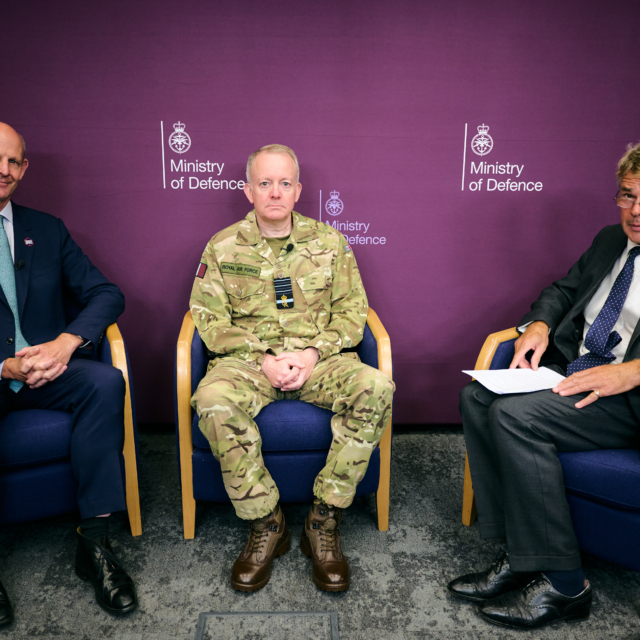
NAD and CDS want accelerated capability as DSEI UK 27 launched
NAD and CDS launch DSEI UK 27
NAD and CDS want accelerated capability as DSEI UK 27 launched
As the National Armaments Director (NAD) and the Chief of the Defence Staff (CDS) launched DSEI UK 2027 yesterday, they said faster capability delivery, greater innovation and improved readiness are required to ensure the UK and its allies are suitably prepared for any future conflict.
Warwickshire Police turns to AI to review the quality of investigations
Chat with AI or Artificial Intelligence technology. Man touching chatting virtual with an intelligent artificial intelligence asks for the answers he wants. Smart assistant futuristic, Chatbot,
Warwickshire Police turns to AI to review the quality of investigations
An eight-agent system checks investigation records against policing standards, with officers retaining responsibility for decisions.
Security

14 Oct 2026