General Atomics

Dstl assesses robotic systems in hazardous incident recovery trial

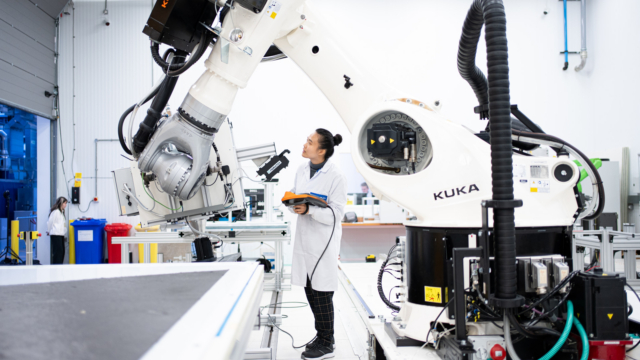
In a ‘real life’ scenario played out in an empty shopping unit, the Defence Science and Technology Laboratory (Dstl) has tested the ability of robotic and autonomous systems to navigate through a building and detect, sample and remediate (clean) a contaminated environment.

Courtesy Dstl

Robots, not people, could respond to future high-risk incidents following a recent trial by Dstl. 

Chemical, biological and radiological (CBR) substances can pose a significant risk to public health, especially in confined spaces which concentrate vapours and spills. Robots, however, allow the human operators to manage any contamination but remain at a safe distance away from any harmful substances.

This trial built on experience from a previous trial by deploying the machines in an operational setting and improving their technical capability.


Urban interior spaces pose numerous challenges, such as:

  • low lighting
  • obstacles
  • high or difficult to reach surfaces

Drones can also struggle with interior airflow and navigation between walls and structures of the same colour.

Ian, Dstl’s technical lead, said: "This trial has allowed us to bridge the gap between research and the operational environment. Dstl has expertise in operational analysis, uncrewed vehicles and autonomy. We bring all these together to deliver cutting-edge science to improve UK resilience."

Specialist Equip
ment
Dstl worked with a range of innovative academic and industrial partners deploying specialist equipment in the Department for Environment, Food and Rural Affairs (Defra) funded trial. This included the following:

Multidirectional drone
Autonomous devices have created a multi-directional drone with a swabbing system to test for contamination and apply decontamination spray.

Robot control software
Createc have developed advanced robot control software to enable their fleet of robots to gather information and samples to deal with an incident including a drone, a robot dog and four-wheeled vehicles.

These vehicles are autonomous but can be switched over to remote control if required and they can:

  • climb stairs
  • open car doors
  • use tools

Uncrewed ground vehicle
The University of Bristol is pioneering an uncrewed ground vehicle with a robotic arm that would work with a tethered drone to carry out decontamination with a spray system at a range of heights.

Ewen, Defra recovery science lead, said: "These sorts of trials are critical for us to deliver the best value for taxpayers’ money. Not only do they allow us to test our newly developed techniques and technologies in representative environments, but they often throw up exciting new possibilities and opportunities for development which would be far less apparent in a lab context.


Dstl and Defra partnership

This trial is the latest in a series for the Defra, the UK’s lead government department for recovery, who are responsible for the environmental remediation following a homeland CBR contamination event.

Defra has partnered with Dstl to establish a National Technical Advisory Group for CBR Recovery (NTAG-R). It will provide authoritative technical advice on the requirements and capabilities needed to conduct CBR recovery operations.

Related

Riyadh Air suspends flagship London and Manchester flights following airport attacks
Riyadh Air Boeing 787 at London Heathrow Airport in the sun
Riyadh Air suspends flagship London and Manchester flights following airport attacks
The closure of Riyadh’s main airport has disrupted the Saudi carrier’s UK connections, just weeks after it added Manchester to its growing network.
Aerospace

12 Oct 2026

Quieter drones could still face noise backlash as UK prepares for BVLOS expansion
A drone flies with a package on delivery past residential houses.
Quieter drones could still face noise backlash as UK prepares for BVLOS expansion
The CAA wants early action on flight patterns, community engagement and noise assessment to help emerging aviation services grow without creating avoidable disturbance.
Aerospace

12 Oct 2026

NCC to lead business support for Greater South West robotics hub
GSWRAH
NCC to lead business support for Greater South West robotics hub
The UK's National Composites Centre (NCC) is to going to help businesses across the Greater South West navigate the challenges and opportunities of robotics and automation through a new £9.8 million regional programme.
Aerospace Defence

12 Oct 2026

ITURRI unveils GRITSTONE for British Army Light Mobility Vehicle programme
ITURRI GRITSTONE for the british army LMV programme
ITURRI unveils GRITSTONE for British Army Light Mobility Vehicle programme
The proposal has been developed specifically to meet the future mobility requirements of the British Armed Forces for an LMV to replace its existing Land Rovers.
Defence

12 Oct 2026

BAE Systems to produce new ACV variant for US Marine Corps
ACV
BAE Systems to produce new ACV variant for US Marine Corps
Under a $230 million contract, BAE Systems will adapt its modular Amphibious Combat Vehicle (ACV) design to produce a new variant that will complement the US Marine Corps’ advanced amphibious capabilities.
Defence Member News

12 Oct 2026

Voyant demonstrates GNSS-denied navigation in MoD maritime trial
Kraken K3 Scout
Voyant demonstrates GNSS-denied navigation in MoD maritime trial
Could autonomous vessels operate without GPS? A UK Ministry of Defence trial saw a Kraken K3 Scout navigate the Solent using Voyant's PNT software.
Defence Member News

12 Oct 2026

UK and Germany back SaxaVord in new European space launch deal
SaxaVord Spaceport, Shetland
UK and Germany back SaxaVord in new European space launch deal
The UK and Germany have agreed to deepen space launch cooperation, with Scotland's SaxaVord Spaceport securing European access to orbit.
Aerospace Defence Space

9 Oct 2026

Excelerate Technology to build UK CNI robotic security solution
Satellite in Earth orbit
Excelerate Technology to build UK CNI robotic security solution
In a project co-funded by the European Space Agency Business Applications and Space Solutions (ESA BASS) and supported by the UK Space Agency, Excelerate Technology will build and demonstrate how space-enabled assets can provide innovative safety and security solutions, including protection of Critical National Infrastructure (CNI) at a site in the UK.
World Space Week: How British technology will help ESA return to the Moon
ESA Argonaut
World Space Week: How British technology will help ESA return to the Moon
As Europe prepares to return to the Moon, British-developed LEIA LiDAR technology will help ESA's Argonaut lander autonomously identify safe touchdown zones on the lunar surface.
Space

5 Oct 2026

UK steps up AI cyber defences as minister warns dependence is a national security risk
Engineering team implements digital guardrails on autonomous AI agent to limit risk, Teamworking tech startup colleagues apply artificial intelligence safety constraints, brainstorming, camera A.
UK steps up AI cyber defences as minister warns dependence is a national security risk
The UK plans to expand AI-powered cyber protection and prepare for incidents involving autonomous systems, while calling for stronger UK technology capabilities.
Security

12 Oct 2026

UK opens weapons test ranges to SMEs as hypersonic testing investment advances
Project Safari hypersonics testing opens at QinetiQ MOD Hebridies for UK defence SMEs
UK opens weapons test ranges to SMEs as hypersonic testing investment advances
The MoD is easing SME access to UK weapons test ranges through Project Safari while advancing hypersonic missile testing plans at MOD Hebrides.
Defence Security

12 Oct 2026

Avon Protection secures US military order for MITR System
Avon Protection’s MITR System
Avon Protection secures US military order for MITR System
The United States Department of War (DoW) has placed an order for Avon Protection’s MITR System for its Special Operations Forces, becoming the second Five Eyes (FVEY) nation to adopt the system.