General Atomics

Dstl hones its AIM

The Defence Science and Technology Laboratory (Dstl) has developed AIM – Assured Intent Messaging – a new system designed to help commanders better coordinate surveillance, targeting and weapons across a wide range of platforms, from uncrewed systems to missiles.


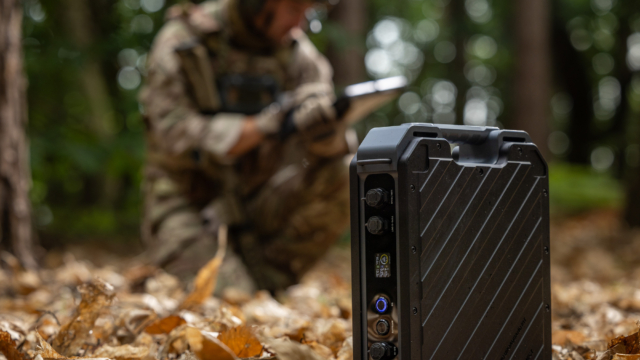
Above: The AIM user interface being used during Dstl trials in March 2026.
Image courtesy INVERGEX


The technology was put through its paces in a major live trial in Texas in March 2026. During the exercise, a single operator successfully controlled multiple in-service and experimental systems at once, including sensors, uncrewed platforms, target-designation tools and ground-launched missiles. The connected devices were able to ‘talk’ to each other using AIM’s standardised digital messages.

This was the first real-world test of the AIM common messaging language built specifically for networked ‘find and strike’ operations – the military process of spotting a target, confirming it and engaging it as quickly as possible, in turn increasing lethality.

Ten industry supplier teams took part in the trial, which proved AIM works as a minimum viable product. The standard will be officially published in mid‑May and made available to industry.

Why Assured Intent Messaging (AIM) matters
Modern military operations rely on many different technologies operating at the same time, often from different manufacturers. Until now, getting these systems to work together smoothly has been complex, slow and prone to errors.

AIM addresses that problem by giving all systems a shared, government-owned messaging standard that is designed to support the exchange of clear, reliable instructions.

A member of Dstl’s technical team explained: "Commanders have multiple technologies in the battlespace, and it’s vital they work together quickly and efficiently. This universal messaging system helps harmonise communication between different systems, so decisions can be turned into action much faster."

Built for tough environments
Unlike older systems, AIM is designed to work even when communications are limited or disrupted – a common challenge in modern conflict.

The messages are deliberately small, meaning they can be transmitted over low‑bandwidth networks more reliably. AIM also uses a ‘publish and subscribe’ approach, similar to Internet of Things (IoT) technology, so messages are only sent to systems that actually need them. That reduces network congestion and improves resilience.

AIM avoids common problems caused by converting between different data formats, which can introduce errors at critical moments.

Open, secure and industry-friendly
Importantly, AIM is government-owned and open to industry, rather than controlled by a single supplier. This allows any company to build compatible systems, increasing competition and reducing reliance on proprietary solutions.

AIM complements Dstl’s Sensing for Asset Protection with Integrated Electronic Networked Technology (SAPIENT) standard for networked sensor systems. Together they offer UK and allies armed forces another step towards a future where military systems are more connected, more adaptable and easier to control – even in the most challenging conditions.
 

Related

Windracers proves ULTRA in Ukraine, but Britain poses a different drone challenge
Windracers ULTRA drone flying in Wales
Windracers proves ULTRA in Ukraine, but Britain poses a different drone challenge
Three years of operations in Ukraine have helped Windracers adapt its autonomous aircraft at speed. Bringing those lessons home requires a balance between rapid development and peacetime safety.
Aerospace Defence Insights

29 Aug 2026

BAE Systems wins £5 million contract to keep BBMF Lancaster flying
The Battle of Britain Memorial Flight Avro Lancaster in flight
BAE Systems wins £5 million contract to keep BBMF Lancaster flying
The aerospace group will provide specialist design and airworthiness support as PA474 undergoes an extensive overhaul at Duxford.
Aerospace Member News

28 Aug 2026

Discover Airlines sets sights on UK expansion
Discover Airlines A320-200
Discover Airlines sets sights on UK expansion
Lufthansa Group's leisure carrier, Discover Airlines, has its sights set on UK expansion, as it adds Bristol, Glasgow and Inverness to its network from summer 2027.
Aerospace

28 Aug 2026

Windracers proves ULTRA in Ukraine, but Britain poses a different drone challenge
Windracers ULTRA drone flying in Wales
Windracers proves ULTRA in Ukraine, but Britain poses a different drone challenge
Three years of operations in Ukraine have helped Windracers adapt its autonomous aircraft at speed. Bringing those lessons home requires a balance between rapid development and peacetime safety.
Aerospace Defence Insights

29 Aug 2026

Retired Air Vice-Marshal for the Royal Air Force Tom Burke joins GA-ASI
RAF Protector
Retired Air Vice-Marshal for the Royal Air Force Tom Burke joins GA-ASI
Retired RAF Air Vice-Marshal Tom Burke has joined General Atomics Aeronautical Systems, Inc. (GA-ASI), drawing on his military experience to support its current defence operations in the UK and lead on strategic market development.
Defence Member News

28 Aug 2026

ZeroUSV unveils first of its new Oceanus17 USV
Oceanus17 class of USV
ZeroUSV unveils first of its new Oceanus17 USV
ZeroUSV’s brand new Oceanus17 class of unmanned surface vessel (USV) has been unveiled, officially named The Lady of the Lake, marking a key advance in the development of British autonomous maritime capabilities.
Defence Security

28 Aug 2026

Scottish space tech to power self-consuming rocket engine
Alpha Impulsion
Scottish space tech to power self-consuming rocket engine
Aurora Avionics is to supply crucial electronic systems that will deliver key electrical power functions for a pioneering new rocket engine, that aims to cut propulsion costs and support next-generation spacecraft.
Space

27 Aug 2026

STFC reveals latest Ernest Rutherford Fellows
space nebula
STFC reveals latest Ernest Rutherford Fellows
Backed by an investment of £6 million, seven early-career physicists have been awarded Ernest Rutherford Fellowship’s by the Science and Technology Facilities Council (STFC), supporting research, from the search for dark matter to the physics of black holes.
Space

25 Aug 2026

Austrian ENPULSION moves to acquire UK space propulsion specialist Lift Me Off
Enpulsion space propulsion manufacturer buys UK company lift me off
Austrian ENPULSION moves to acquire UK space propulsion specialist Lift Me Off
Austrian spacecraft propulsion manufacturer ENPULSION has agreed to acquire British specialist Lift Me Off, bringing together electric and chemical propulsion capabilities in a deal that will require UK Government approval.
Member News Space

21 Aug 2026

ZeroUSV unveils first of its new Oceanus17 USV
Oceanus17 class of USV
ZeroUSV unveils first of its new Oceanus17 USV
ZeroUSV’s brand new Oceanus17 class of unmanned surface vessel (USV) has been unveiled, officially named The Lady of the Lake, marking a key advance in the development of British autonomous maritime capabilities.
Defence Security

28 Aug 2026

Antare launches AI physical security platform
Security staff
Antare launches AI physical security platform
Using AI to automatically review footage from body-worn and fixed cameras, Antare's new security platform provides organisations with a complete picture across every shift and site, transforming unwatched camera footage into intelligence.
Security

28 Aug 2026

Manchester Airports Group reports cyber security incident
Manchester Airport
Manchester Airports Group reports cyber security incident
Manchester Airports Group has reported a cyber security incident involving customer data, amid growing concern over cyber attacks in the UK.
Aerospace Security

27 Aug 2026