Advancing UK Aerospace, Defence, Security & Space Solutions Worldwide

Defence Security

Dstl trials AMAPS

Working with the Royal Navy, industry partners and the US Naval Undersea Warfare Centre, the Defence Science and Technology Laboratory (Dstl) has conducted research to improve detection, tracking, classification and defeat capabilities against surface and subsurface threats to high value assets and critical infrastructure, using autonomous maritime asset protection system (AMAPS) alongside traditional systems.


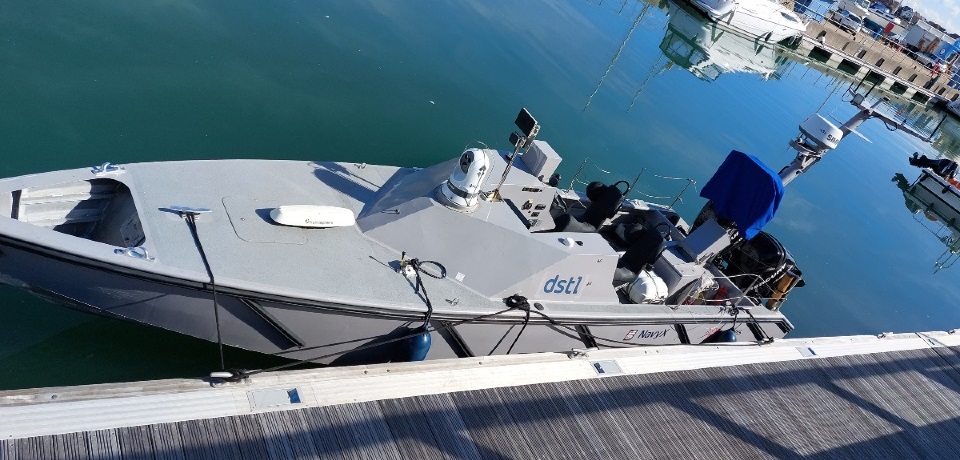
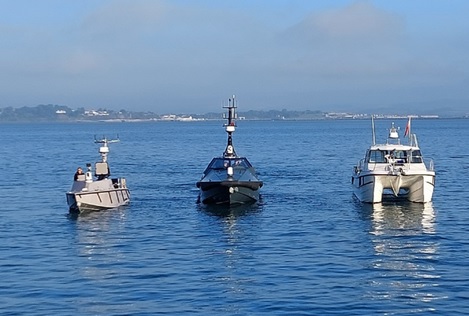
Above:
Autonomous maritime asset protection system moored up in harbour.
Courtesy Dstl

Dstl worked collaboratively with an industry consortium comprising QinetiQ, SeeByte, L3 Harris ASV and Thales, to develop a concept demonstrator based on open architectures and autonomous systems. This demonstrator was tested in a synthetic environment to ensure the viability of the concept before experimentation during a two week trial in Portland Harbour in October 2021 using Dstl’s containerised system and the Maritime Autonomy Surface Testbed vessel MAST-13.

Advertisement
ODU RT

Different levels of autonomy were evaluated, enabling a better assessment of the role that maritime autonomous systems can play in protecting vulnerable assets while also furthering understanding of the current maturity of the technology.
The trial successfully demonstrated end-to-end autonomy with the remote operation of a long range acoustic device and firing of a vessel arrestor system with the aim to stop a suspect craft.

Future trials will look to stress the system with the aim to assess robustness while completing interoperability tests with the US that were impacted by COVID-19.

Advertisement
Tritax 300x250

Dstl Programme Manager, Alasdair Gilchrist MBE, commented: "The research showed the benefit of integrating multiple sensors, fixed and on uncrewed vessels (UXVs), into a common tactical picture to aid command decisions.

"We have progressed maritime Artificial Intelligence/machine learning by developing apps that enable multiple UXVs to be command and controlled from a single operator to protect assets.

"We have also developed algorithms to autonomously control and launch non-lethal effectors from uncrewed surface vessels (USVs) to deter aggressors and protect our valuable maritime assets."


 

Advertisement
Babcock LB
Aldershot and Farnborough to host 2026 National Armed Forces Day

Defence Events

Aldershot and Farnborough to host 2026 National Armed Forces Day

5 December 2025

Rushmoor borough has today been awarded the prestigious honour of hosting the 2026 National Armed Forces Day celebrations.

Blighter adds radar target tracker to BlighterNexus system

Defence Security

Blighter adds radar target tracker to BlighterNexus system

5 December 2025

Cambridge based Blighter has added a proprietary dynamic radar target tracker module to its integrator-friendly BlighterNexus AI-assisted multisensor connectivity & processing system.

Serco to support RCAF FAcT

Defence

Serco to support RCAF FAcT

5 December 2025

Serco has been awarded a 25-year contract by SkyAlyne to support its Future Aircrew Training (FAcT) programme for the Royal Canadian Air Force (RCAF).

Babcock strengthens French defence training with L-39

Defence

Babcock strengthens French defence training with L-39

4 December 2025

Babcock France has been awarded a contract to support the French Test Pilot school (EPNER) with an L-39 aircraft – the first for its fleet.

Advertisement
Leonardo animated rectangle
Navantia UK hosts official FSS steel cutting ceremony in Appledore

Defence

Navantia UK hosts official FSS steel cutting ceremony in Appledore

4 December 2025

The traditional steel cutting ceremony was held at Navantia UK’s Appledore shipyard in North Devon yesterday, marking a significant achievement for the FSS programme that is driving a £100 million investment across Belfast and Appledore.

British designed satellites successfully launched

Defence Security Space

British designed satellites successfully launched

3 December 2025

A cluster of British designed and built satellites has been successfully launched into low Earth orbit, providing defence, security and civil sectors with UK space-based intelligence, surveillance and reconnaissance to enhance the nation’s ability to protect against modern threats.

Advertisement
ODU RT