General Atomics

The need for speed: Why the English Electric Lightning was designed the way it was

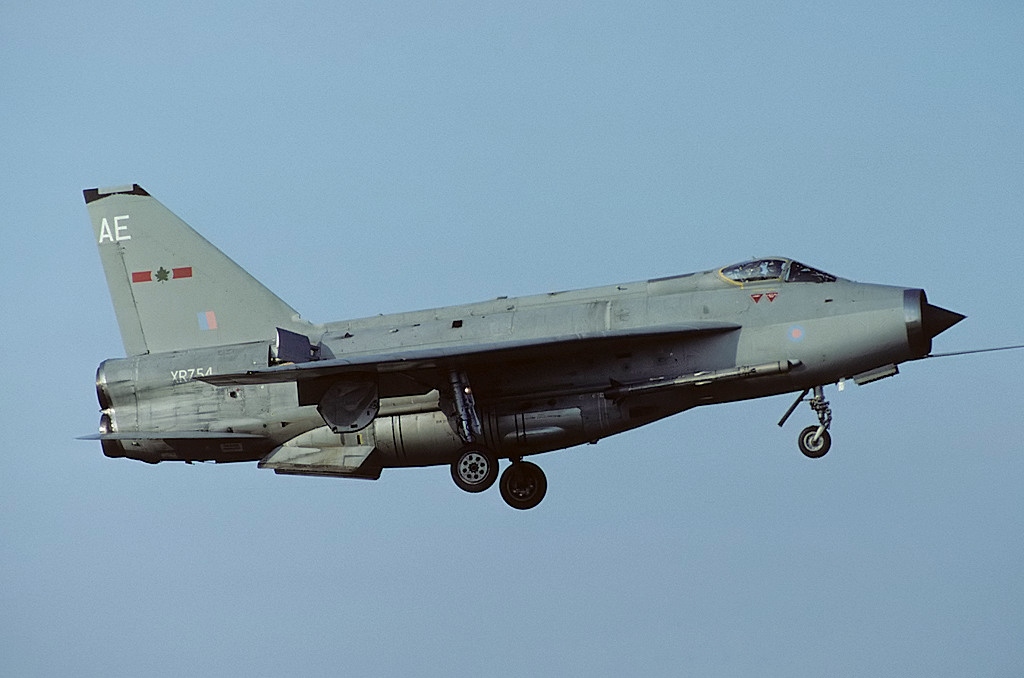
With its unconventional design, the Lightning was designed to climb rapidly, reach great heights and intercept an enemy aircraft before it could approach its target.

English Electric Lightning
Photo: Mike Freer / Wikimedia Commons

The English Electric Lightning was developed during the early years of the Cold War, when Britain urgently needed a high-performance interceptor capable of defending the country against fast, high-altitude Soviet bombers.

Designed by English Electric under the leadership of W. E. W. Petter, the Lightning first flew in 1954 and entered Royal Air Force service in 1960.

Its design was driven by one overriding requirement – to climb rapidly, reach great heights, and intercept an enemy aircraft before it could approach its target. Rather than prioritising long-range endurance or manoeuvrability, the Lightning was engineered for exceptional speed and rate of climb.

The unusual, stacked engines

Perhaps the Lightning’s most distinctive feature was its two Rolls-Royce Avon turbojet engines mounted one above the other in the fuselage. This unusual arrangement was chosen to provide substantial thrust while keeping the aircraft’s frontal area relatively small.
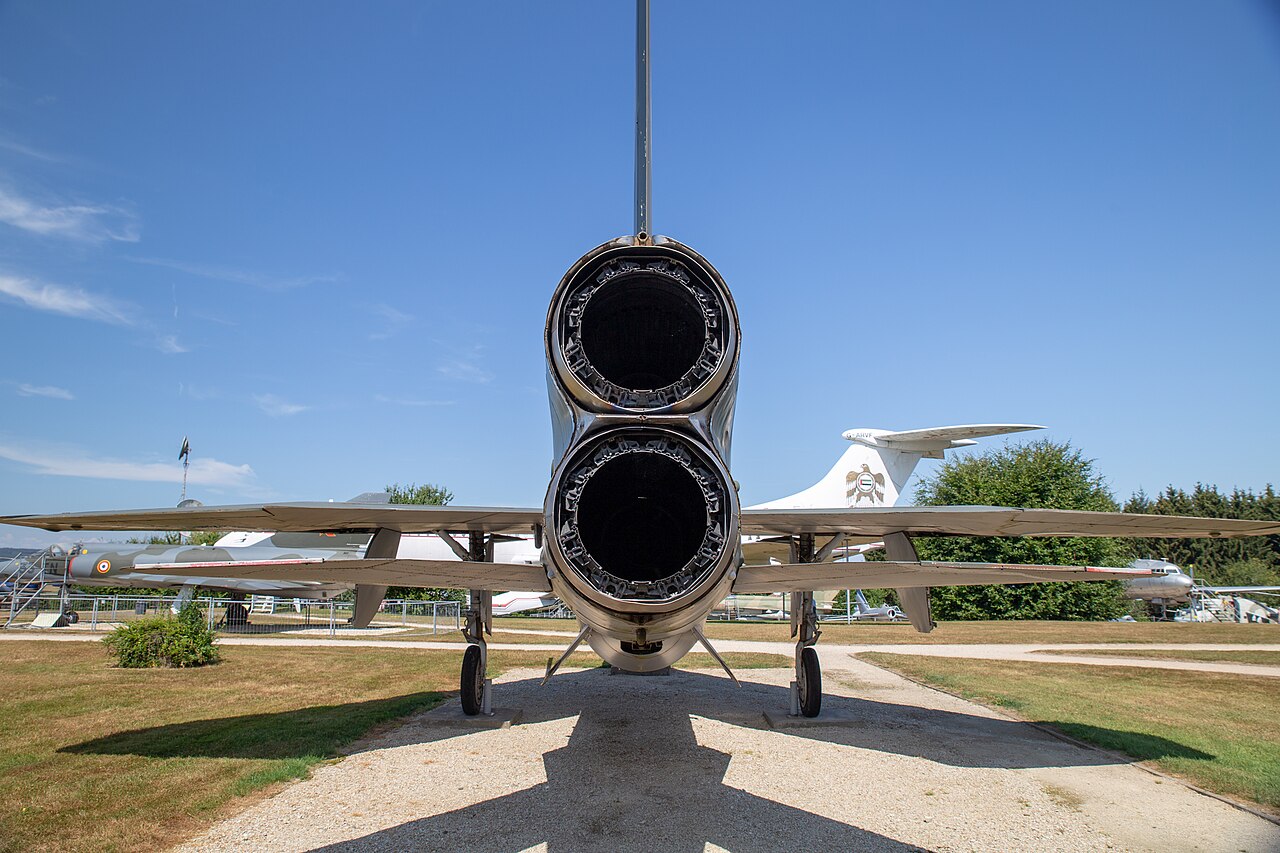
English Electric Lightning
Photo: Clemens Vasters / Wikimedia Commons

Mounting the engines vertically also allowed the designers to accommodate two powerful engines within a narrow fuselage, reducing drag compared with a wider, side-by-side arrangement. The configuration did, however, create engineering challenges, particularly in maintaining adequate airflow and managing the aircraft’s centre of gravity.

The engines were fed by a single nose intake, giving the Lightning its unmistakable appearance. This arrangement helped preserve a clean aerodynamic profile at the high speeds for which the aircraft was designed.

Swept wings and aerodynamic efficiency

The Lightning’s sharply swept wings were another essential feature. At transonic and supersonic speeds, conventional straight wings generate substantial drag as airflow becomes locally supersonic. Sweeping the wings backwards delays these effects, allowing the aircraft to fly faster and more efficiently.

The relatively small wing area also reduced drag, but it came at a price. The Lightning had a high wing loading, meaning it could be demanding to handle at low speeds and required relatively high approach and landing speeds.
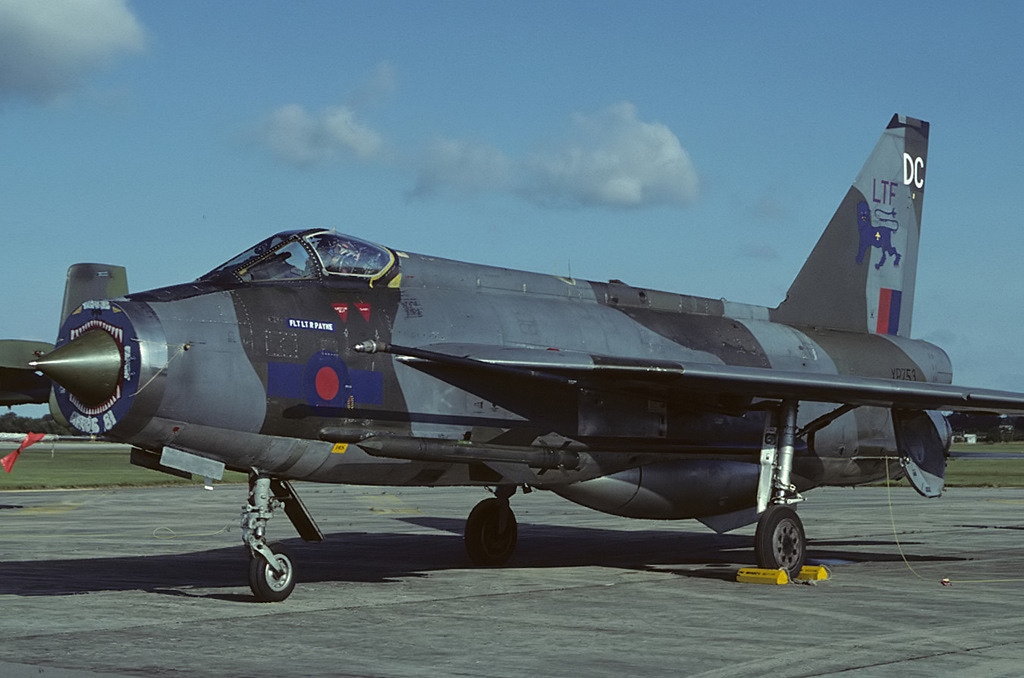
English Electric Lightning
Photo: Mike Freer / Wikimedia Commons

These compromises reflected the aircraft’s intended role: it was designed primarily to intercept hostile aircraft at altitude, rather than to excel in slow-speed combat or provide sustained long-range patrols.

Climbing power and high-altitude performance

The Lightning’s powerful engines and lightweight airframe gave it an extraordinary rate of climb. It could accelerate rapidly through the atmosphere and reach altitudes that challenged many contemporary aircraft.
English Electric Lightning
Photo: Mike Freer / Wikimedia Commons

This performance was especially important because the threat of nuclear-armed bombers made early interception essential. The Lightning needed to reach an approaching target quickly, engage it with missiles or guns, and return to base.

Its limitations included relatively short range and high fuel consumption, particularly when using afterburner. These drawbacks were accepted because rapid interception, rather than endurance, was the priority.

A purpose-built Cold War interceptor

The English Electric Lightning was not designed to be a universal fighter. Almost every major feature reflected the demands of its intended mission: the stacked engines for compact power, swept wings for supersonic flight, and a streamlined fuselage for speed.

The result was one of Britain’s most distinctive combat aircraft. Although later developments in radar, missiles and aircraft design eventually made newer interceptors more practical, the Lightning remained a remarkable example of engineering shaped by a specific military need – getting airborne, getting high and getting to the enemy as quickly as possible.

Related

UK Finance Minister signals support for London Heathrow Airport’s £33 billion runway expansion
London Heathrow
UK Finance Minister signals support for London Heathrow Airport’s £33 billion runway expansion
In contrast to the cautious response of the UK Prime Minister, Chancellor John Healey has backed Heathrow's expansion plans.
Aerospace

17 Oct 2026

Marshall Aerospace outlines its next chapter following AURELIUS acquisition
Marshall Aerospace
Marshall Aerospace outlines its next chapter following AURELIUS acquisition
Speaking exclusively to Advance, Marshall Aerospace discusses its military aircraft contracts, manufacturing priorities and search for a new home following the takeover.
Aerospace Insights

17 Oct 2026

17,000 aircraft on order: How does the industry actually clear the backlog?
Boeing 737 factory in Renton
17,000 aircraft on order: How does the industry actually clear the backlog?
Aircraft manufacturers are under pressure to deliver faster, but supply-chain constraints continue to hold production back. What will it take to turn growing orderbooks into aircraft ready to fly?
Aerospace

17 Oct 2026

UK defence is moving faster. Can its legal frameworks keep pace?
As UK defence procurement accelerates, legal experts at Crowell & Moring explore how businesses can seize opportunities while managing legal risk.
Defence Insights

17 Oct 2026

From trials to frontline capability: Accelerating AI adoption in UK defence
Jack Maxton headshot
From trials to frontline capability: Accelerating AI adoption in UK defence
Jack Maxton, CEO of DIGI2AL, argues that faster experimentation, closer industry collaboration and a shift in mindset can help the MOD turn AI ambitions into operational advantage.
BAE Systems to design satellite comms terminals for US Space Force
Satellite
BAE Systems to design satellite comms terminals for US Space Force
Building on its space-hardened family of software-defined radios, BAE Systems will develop resilient ultra-compact radio-frequency (RF) terminals for the US Space Force.
Defence Member News

16 Oct 2026

Viasat orders ALL.​SPACE Hydra MAX Terminals for Ka-band networks
ALL.SPACE Hydra
Viasat orders ALL.​SPACE Hydra MAX Terminals for Ka-band networks
Viasat has placed an order for multiple ALL.​SPACE Hydra MAX terminals approved to operate on Viasat's global NextGen Ka-band network, providing resilient SATCOM connectivity for defence and government users.
Defence Member News Space

15 Oct 2026

Cornwall Space Cluster launches £15k legal support programme for space SMEs
Goonhilly satellite near Cornwall Space Cluster
Cornwall Space Cluster launches £15k legal support programme for space SMEs
Cornwall Space Cluster has partnered with Stephens Scown to offer specialist legal advice to space businesses, helping them protect intellectual property, prepare for investment and support future growth.
Space

15 Oct 2026

ClearSpace selected to deliver UK’s first active debris removal mission
ClearSpace removing space debris
ClearSpace selected to deliver UK’s first active debris removal mission
The UK-led programme will remove two defunct satellites while creating specialist jobs, supporting supply chains and building capability in the growing in-orbit services sector.
Space

15 Oct 2026

Police officers risk accidental AI misconduct, watchdog warns
National Police Chiefs Council photo of police on duty
Police officers risk accidental AI misconduct, watchdog warns
The Independent Office for Police Conduct has warned that officers and staff risk misconduct investigations for inappropriate AI use.
Security

16 Oct 2026

NAD and CDS want accelerated capability as DSEI UK 27 launched
NAD and CDS launch DSEI UK 27
NAD and CDS want accelerated capability as DSEI UK 27 launched
As the National Armaments Director (NAD) and the Chief of the Defence Staff (CDS) launched DSEI UK 2027 yesterday, they said faster capability delivery, greater innovation and improved readiness are required to ensure the UK and its allies are suitably prepared for any future conflict.
Warwickshire Police turns to AI to review the quality of investigations
Chat with AI or Artificial Intelligence technology. Man touching chatting virtual with an intelligent artificial intelligence asks for the answers he wants. Smart assistant futuristic, Chatbot,
Warwickshire Police turns to AI to review the quality of investigations
An eight-agent system checks investigation records against policing standards, with officers retaining responsibility for decisions.
Security

14 Oct 2026