Advancing UK Aerospace, Defence, Security & Space Solutions Worldwide
  • Home
  • /
  • Space
  • /
  • ESA-JAXA EarthCARE satellite launched

Space

ESA-JAXA EarthCARE satellite launched
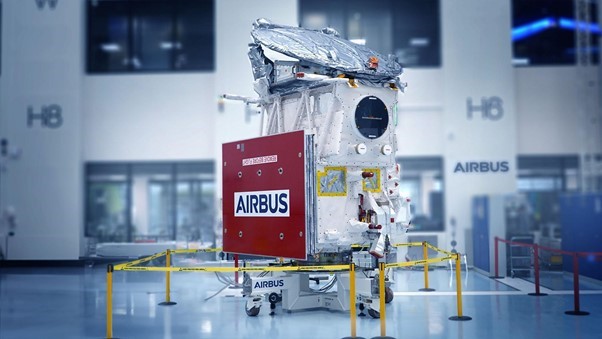
The Airbus-built EarthCARE climate monitoring satellite has been successfully launched from Vandenberg military base, California.


Above: EarthCARE ready in Airbus cleanroom in Friedrichshafen, Germany
Copyright Airbus

EarthCARE (Earth Cloud Aerosol and Radiation Explorer) is a joint undertaking between the European and Japanese Space Agencies (ESA and JAXA). The satellite will examine the role clouds and aerosols (tiny atmospheric particles) play in reflecting solar radiation back into space (i.e. cooling down the atmosphere) as well as in trapping infrared radiation emitted from the Earth’s surface (i.e. heating up the atmosphere).

Advertisement
PTC rectangle

“EarthCARE is ESA’s largest and most complex Earth Explorer spacecraft – a flagship mission whose data will help improve the accuracy and reliability of climate and numerical weather prediction models,” said Alain Fauré, Head of Space Systems at Airbus. “International cooperation was key with more than 200 research institutes and 45 companies across Europe working hand in hand to deliver this spacecraft.”

EarthCARE will draw up vertical profiles of natural and human-made aerosols, register the distribution of water droplets and ice crystals and how they are transported in clouds, and provide essential input to improve the modelling of the warming climate and weather forecasting. Aerosols influence the life cycle of clouds, and so contribute indirectly to how they give off radiation – measuring them will give a better understanding of Earth’s energy budget.

Instrumental cooperation: one mission, two agencies, four instruments
The spacecraft was developed, built and tested with the involvement of experts from 15 European countries as well as Japan and Canada, under the leadership of Airbus, in Friedrichshafen, Germany.

The Airbus-built atmospheric lidar ATLID is one of the four instruments on the EarthCARE satellite, providing vertical profiles of aerosols and thin clouds. ATLID is the second spaceborne ultraviolet lidar from Europe following Aeolus’, making Airbus a worldwide specialist in spaceborne lidars.

Advertisement
ODU RT

The satellite also includes a Broad-Band Radiometer developed by ESA through European industry, a Multi-Spectral Imager developed by Airbus’ subsidiary Surrey Satellite Technology Limited and a Cloud Profiling Radar developed by JAXA.

This unique combination of instruments will allow scientists for the first time to directly assess the role of clouds and aerosols on Earth’s radiation budget with one integrated satellite system thereby reducing current uncertainties.

EarthCARE will circle Earth in a Sun-synchronous 400 km polar orbit crossing the equator in the early afternoon to optimise daylight conditions. Weighing 2.3 tonnes, and measuring 18 metres long, once its solar panel and CPR instrument are deployed EarthCARE will be on duty for at least three years.


Advertisement
Gulfstream banner
SSTL joins Eric and Wendy Schmidt Observatory System’s Lazuli

Space

SSTL joins Eric and Wendy Schmidt Observatory System’s Lazuli

9 March 2026

Surrey Satellite Technology Ltd (SSTL) today announced its role as a key industrial collaborator in the Eric and Wendy Schmidt Observatory System’s Lazuli, a pioneering initiative that will deliver one of the most ambitious privately funded space telescopes ever conceived.

UK space tech startups target debris, wildfires and climate risk

Security Space

UK space tech startups target debris, wildfires and climate risk

9 March 2026

Six UK space tech startups have joined the European Space Agency Business Incubation Centre UK (ESA BIC UK) to develop technologies that deliver practical benefits in space and on Earth, applying space technology to some of today’s most urgent challenges, from clearing space junk to detecting wildfires in seconds.

UK National Microgravity Research Centre opens in Swansea

Space

UK National Microgravity Research Centre opens in Swansea

9 March 2026

The UK’s first National Microgravity Research Centre has been completed at Swansea University, marking the successful delivery of a £13 million project part-funded by the UK Space Agency.

Collaboration to support in-orbit pharmaceuticals manufacturing

Space

Collaboration to support in-orbit pharmaceuticals manufacturing

5 March 2026

The UK Space Agency, the Medicines and Healthcare products Regulatory Agency (MHRA), the Regulatory Innovation Office (RIO) within the Department for Science, Innovation and Technology (DSIT) and the Civil Aviation Authority (CAA) are working collaboratively to provide a supportive regulatory environment to space, biopharma and pharmaceutical ...

Advertisement
Security & Policing Rectangle
UK funding aimed at £40bn satellite communications market

Space

UK funding aimed at £40bn satellite communications market

5 March 2026

British companies developing satellite communications technology are to receive £30 million in government funding, Space Minister Liz Lloyd announced yesterday, as the UK looks to secure a larger share of a global market worth £40 billion.

Mutable Tactics secures Seraphim Space led funding

Defence Space

Mutable Tactics secures Seraphim Space led funding

4 March 2026

British robotics autonomy company, Mutable Tactics, has closed a pre seed funding round of $2.1 million led by Seraphim Space, with support from the UK’s National Security Strategic Investment Fund, Koro, Entrepreneurs First and Transpose.

Advertisement
Security & Policing Rectangle
Advertisement
ECS leaderboard banner