Europe's Ariane 6 launched
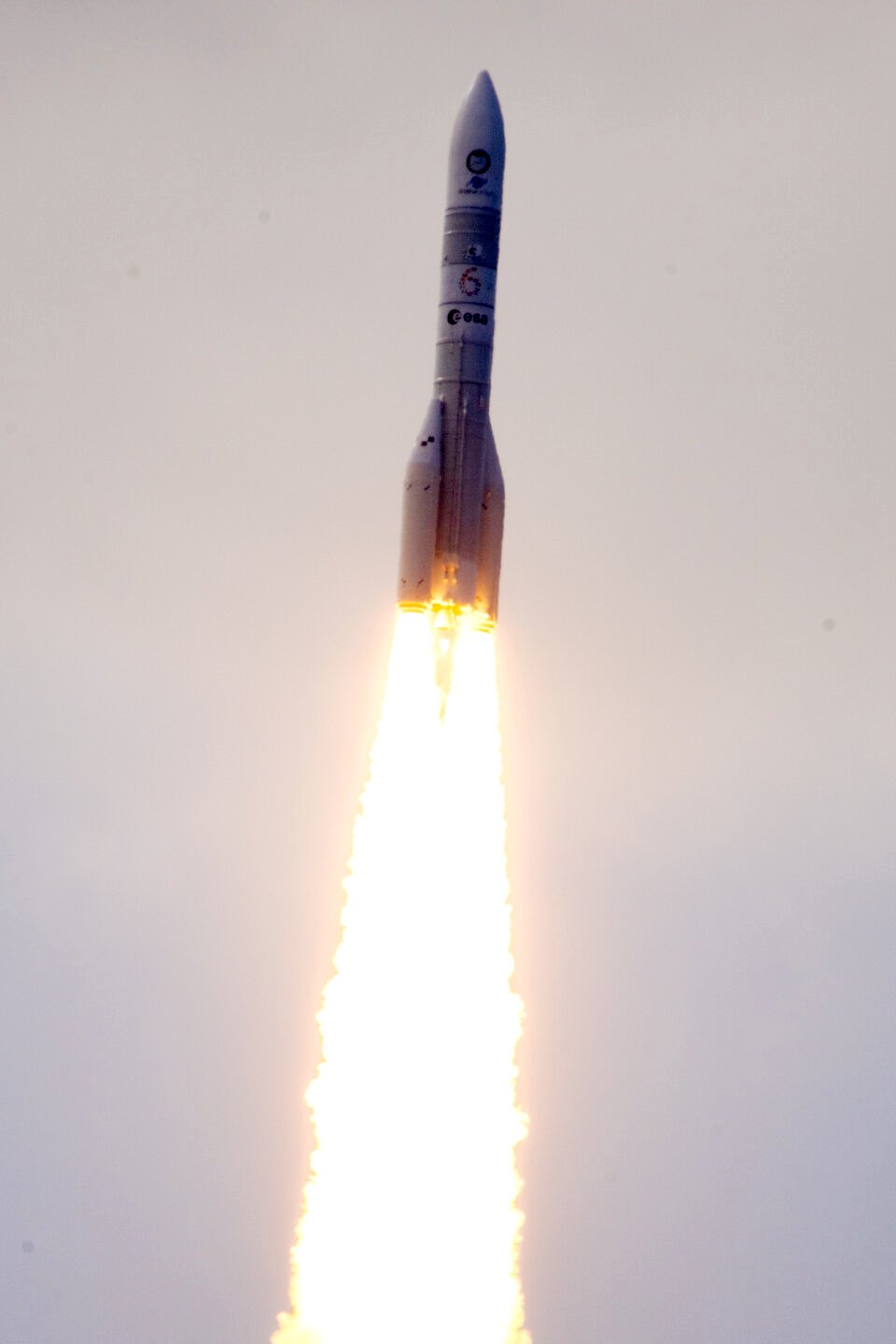
Above: Ariane 6 takes flight.
Courtesy ESA
Ariane 6 is the latest in Europe's Ariane rocket series, taking over from Ariane 5 and featuring a modular and versatile design that can launch missions from low-Earth orbit and farther out into deep space.
ESA's Director General Josef Aschbacher said: "A completely new rocket is not launched often and success is far from guaranteed. I am privileged to have witnessed this historic moment when Europe's new generation of the Ariane family lifted off – successfully – effectively reinstating European access to space.

"An inaugural launch is a huge undertaking from thousands of people who have worked relentlessly for years. To see it perform wonderfully at the first attempt is testament to their dedication and a demonstration of European excellence in engineering and technology. Heartfelt thanks go to the teams at ESA, CNES, ArianeGroup and Arianespace for their hard work to get to this point. I also want to sincerely thank our Member States for having enabled and supported the Ariane 6 programme along the way. Not always easy but the endurance shown has paid off handsomely today."
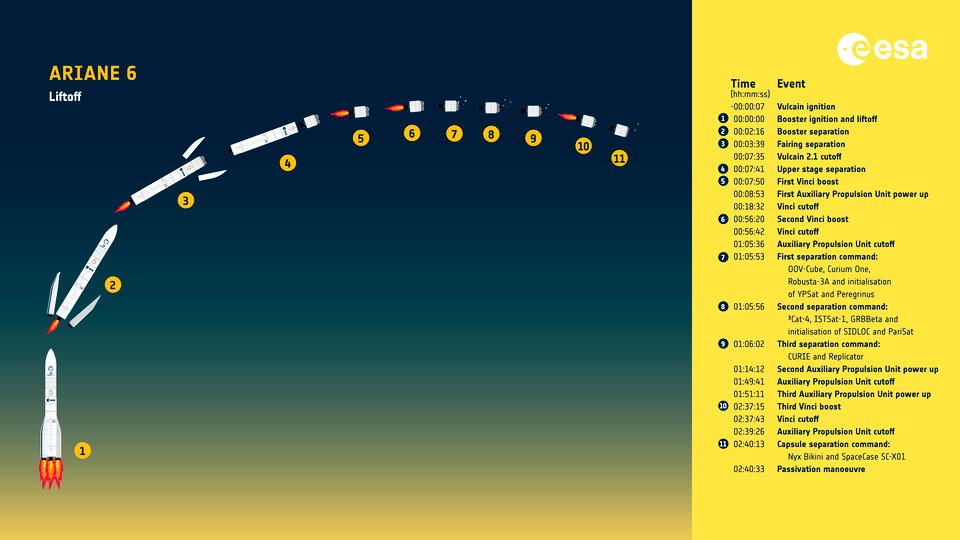
This inaugural flight, designated VA262, is a demonstration flight that aims to show the capabilities and prowess of Ariane 6 in escaping Earth's gravity and operating in space. Nevertheless, it had several passengers on board.
At 21:06 BST, 22:06 CEST, one hour after liftoff, the first set of satellites on board Ariane 6 were released from the upper stage and placed into an orbit 600 km above Earth. Satellites and experiments from various space agencies, companies, research institutes, universities and young professionals were included on this inaugural flight.
In addition to the rocket, the liftoff demonstrated the functioning of the launch pad and operations on the ground at Europe's Spaceport. The new custom-built dedicated launch zone was built by France's space agency CNES and allows for a faster turnover of Ariane launches.
On the occasion of the launch, Philippe Baptiste, CEO of CNES, said: “With this first successful launch by Ariane 6, Europe has finally recovered its capacity to access space. Beyond the great emotion I am feeling right now, my first thoughts are for all the teams in Kourou, Paris, Vernon, Les Mureaux, Toulouse, Bremen, Lampoldshausen, Liège, Barcelona, Colleferro, Zürich and everywhere else in Europe who made this success possible. I would like to acknowledge the commitment of the employees of CNES, ESA, ArianeGroup, Arianespace and our subcontractors. The last few months have been intense and I would like to thank them all. Europe can be proud of its space programme, Europe can be proud of its knowledge and expertise. Together, let's prepare the future of launchers and space.”
Ariane 6 was built by prime contractor and design authority ArianeGroup. “With the successful first flight of Ariane 6, the European space industry has moved into a new era,” said Martin Sion, CEO of ArianeGroup. “This historic launch demonstrates the unfailing commitment of our teams and partners, whom I would like to thank warmly for this success, which reflects on the entire European industry. Seeing Europe’s new launcher lift off into space marks the culmination of an outstanding technical and technological adventure and the beginning of a long history of Ariane 6 operations. The next flight models are already in production and the stages of the second model will be shipped to the Guiana Space Centre this autumn for the first commercial flight of Ariane 6.”
With the placement of satellites into orbit, Ariane 6 has demonstrated that it can successfully launch its payloads into space, but ground control has more in store for its inaugural flight. Over the next hour, Ariane 6's upper stage will show again that it can restart its Vinci engine using the novel auxiliary propulsion unit. This restart capability will allow Ariane 6 to drop off multiple passengers into different orbits on future flights and deorbit itself through Earth’s atmosphere at the end of its mission, to ensure it does not become space debris.
On this flight the Ariane 6 upper stage is set to release two reentry capsules as it enters Earth's atmosphere for a clean disposal to burn up harmlessly, leaving no space debris in orbit.
The next Ariane 6 is planned for launch this year on its first commercial flight under Arianespace as operator and launch service provider. “The success of this first flight marks the start of Ariane 6’s operational career, giving Europe an autonomous access to space,” added Stéphane Israël, CEO of Arianespace. “The new launcher’s order book is proof of the versatility of Ariane 6 and of its capacity to accomplish a wide range of missions into multiple orbits. It reflects the confidence that customers have in Ariane 6 for both their institutional and commercial missions. We are eager to begin operating our new launcher.”