Exeter Airport hosts UK’s first hydrogen-powered live aircraft turnaround

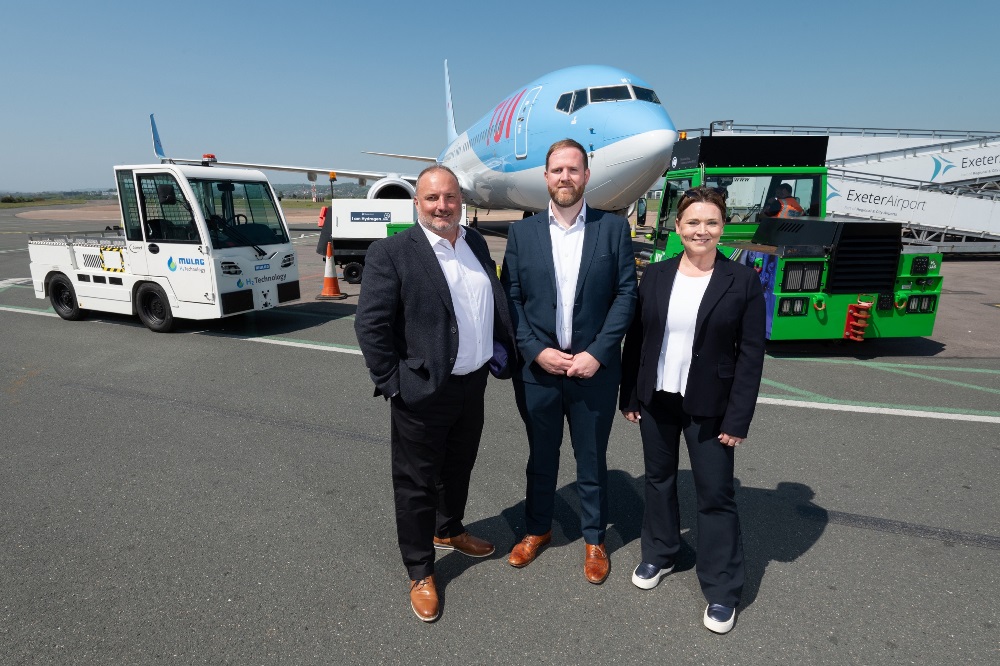
Above: (left to right): Stephen Wiltshire from Exeter Airport, TUI’s Brendan Kelly and Cranfield University’s Professor Anna Smallwood pictured with the hydrogen-powered equipment during the live aircraft turnaround trial at Exeter Airport on Tuesday 29th April 2025.
Courtesy Exeter Airport / RCA / Rigby Group
In a first of its kind for the UK, the trial, delivered by a partnership of Exeter Airport, TUI, Cranfield University, ULEMCo, MULAG and Boeing and supported by the UK Civil Aviation Authority’s Hydrogen Challenge programme, saw a TUI Boeing 737 passenger aircraft undergo a turnaround using ground support equipment powered by green hydrogen.
The live demonstration involved a hydrogen-powered baggage tug, pushback tug and ground power unit. It is the first time in the UK – and possibly the world – that multiple pieces of hydrogen-powered equipment have been used simultaneously for a commercial air transport operational aircraft and using ‘green’ hydrogen from renewable energy sources.
Refuelling of the equipment was conducted using a HyQube 350 refueller, supplied by Fuel Cell Systems Ltd, using green hydrogen, produced and supplied by Protium.
Contributing to an academic study led by Cranfield University, the learnings from the trial are expected to help shape the future safety and regulatory framework for the airside handling of hydrogen, paving the way for hydrogen-fuelled aircraft in the years to come.
The trial forms part of the CAA’s wider Hydrogen Challenge, funded through the Regulators’ Pioneer Fund, which is overseen by the Department for Science, Innovation and Technology. The fund has most recently supported a diverse range of projects aimed at enabling UK regulators and local authorities to help create a UK regulatory environment that encourages business innovation and investment.
The Hydrogen Challenge initiative supports the Government’s Jet Zero ambitions by enabling safe, early adoption of low- and zero-emission aviation technology and infrastructure. The programme brings together regulators, academia and industry to address the regulatory, safety and operational challenges of introducing hydrogen into aviation.
Science Minister Lord Vallance said: “Fresh thinking and new regulatory approaches will give confidence to investors, researchers and consumers alike. We want to encourage businesses to choose the UK as the best destination to develop their new ideas and bring great technologies to market.
“Our funding for these 15 pioneering projects will give UK regulators and local authorities the support they need to accelerate innovation and turn it into success in every corner of the country."
Stephen Wiltshire, Managing Director of Exeter Airport which is owned and operated by Regional and City Airports, said: “We’re proud to have hosted this important trial, which reflects our commitment to sustainability and innovation. The demonstration shows how hydrogen can be integrated into day-to-day airport operations, with lessons we can share across our airport group and the wider sector. Regional airports are most likely to be those handling the first generation of smaller hydrogen aircraft, so it makes sense that they should be the focus of any test-bed activities.”
Giancarlo Buono, Group Director of Safety & Airspace Regulation Group at the UK Civil Aviation Authority, said: “This demonstration brings the UK a step closer to realising hydrogen as a safe and viable energy source for aviation. It showcases the potential of decarbonising ground operations today, while helping shape the regulatory frameworks needed for tomorrow. Our Hydrogen Challenge is about enabling innovation, and we’re proud to have supported this unique collaboration.”
Brendan Kelly, TUI Director of Airline Operations, said: “At TUI, we’re committed to reducing emissions across all areas of our operations. Participating in this trial has been an exciting opportunity to explore how sustainable technologies, like hydrogen-powered ground support equipment, can contribute to that goal. It’s a promising step toward real-world solutions that can be implemented across the aviation industry.”
Professor Anna Smallwood, Head of Centre for Air Transport Management at Cranfield University, said: “This project is an important milestone in understanding how hydrogen can be safely and effectively deployed at airports. Cranfield is proud to play a key role within this collaboration – providing expertise in emissions analysis, systems integration, refuelling technologies, risk management and operational analysis. The insights gained here will directly inform future standards, procedures and innovation as we work toward net-zero aviation.”
Amanda Lyne, Managing Director of ULEMCo, said: “The number of hydrogen technologies on show here demonstrates the versatility of this clean fuel in a range of applications. In addition to providing the academic data requested by government, this project shows practical, cost-effective solutions to decarbonisation. As real-world examples of hydrogen fuel usage increase, the case for investment in UK wide refuelling infrastructure grows ever stronger.”
Steven Gillard, Regional Sustainability Director of UK, Europe, the Middle East, Türkiye, Africa and Central Asia at Boeing, said: “Boeing is committed to enabling the safe, responsible, and resilient growth of aviation through cross-industry collaboration. Projects like this are critical to laying the foundations for safe and scalable sustainable operations at airports. We are proud a TUI owned Boeing 737-800 is involved in this initiative and to be supporting the operational and regulatory work needed to enable more sustainable ground operations.”
In preparation for the trial, a comprehensive study of Exeter Airport’s ground handling operations during aircraft turnarounds was conducted by Cranfield University in partnership with Exeter Airport and TUI.
The study showed that over 78,000 litres of diesel fuel were consumed in a 12-month period, resulting in nearly 200 tonnes of CO2e emissions. Ground Power Units (GPUs), which provide electrical power to aircraft when they are parked on stand, emerged as the single largest source of emissions, accounting for nearly 39% of the total.
The trial at Exeter Airport used vehicles retrofitted with different hydrogen technologies: hydrogen fuel cell (baggage tractor), hydrogen internal combustion (aircraft tug) and a hybrid dual-fuel (hydrogen-diesel) GPU.
Sign up for our newsletter and get our latest content in your inbox.
Similar Reads




Sign up for our newsletter. Select all sectors relevant to you.
Related