

Counter-drone defence in a box: Inside Leonardo’s Containerised Falcon Shield

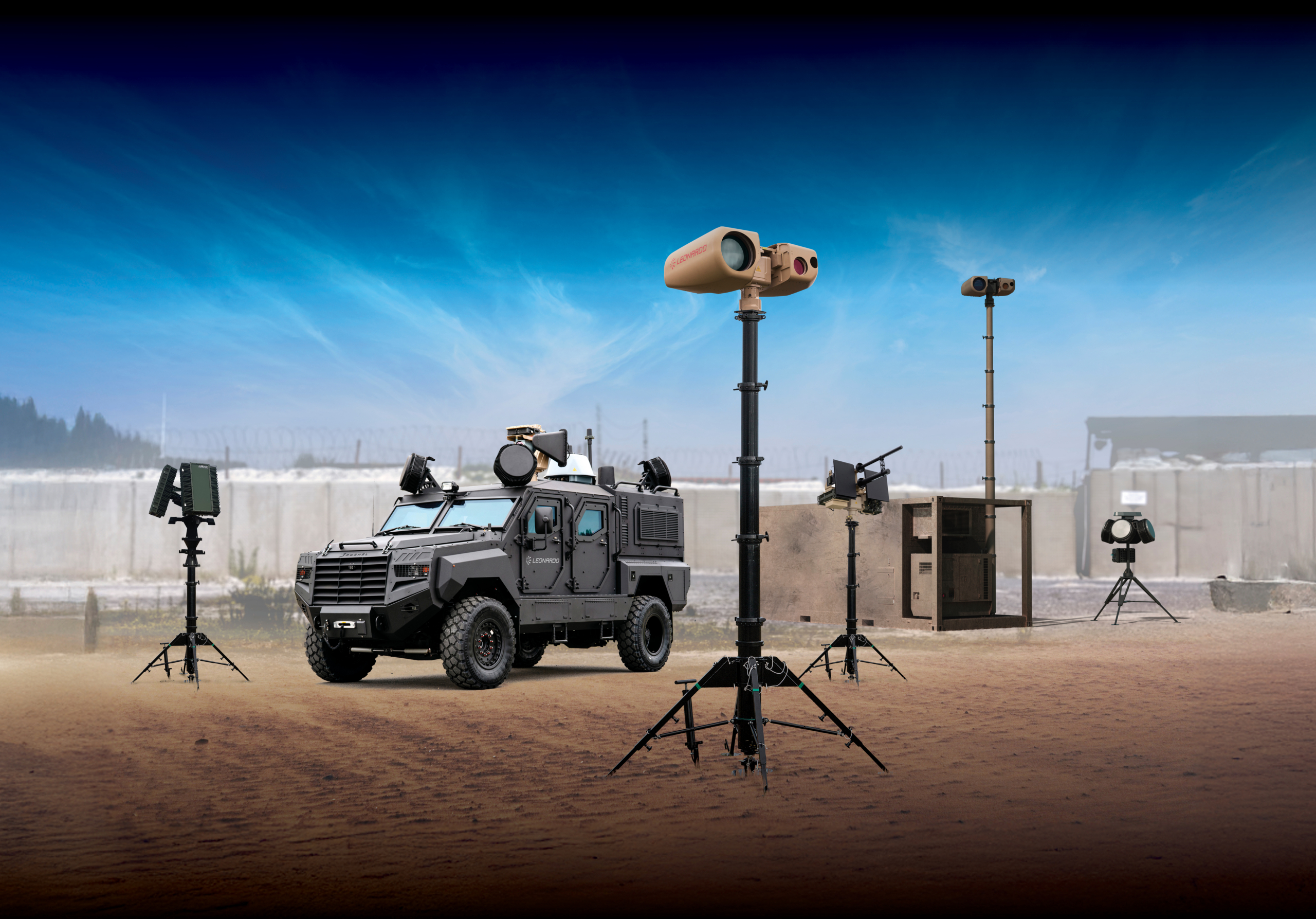
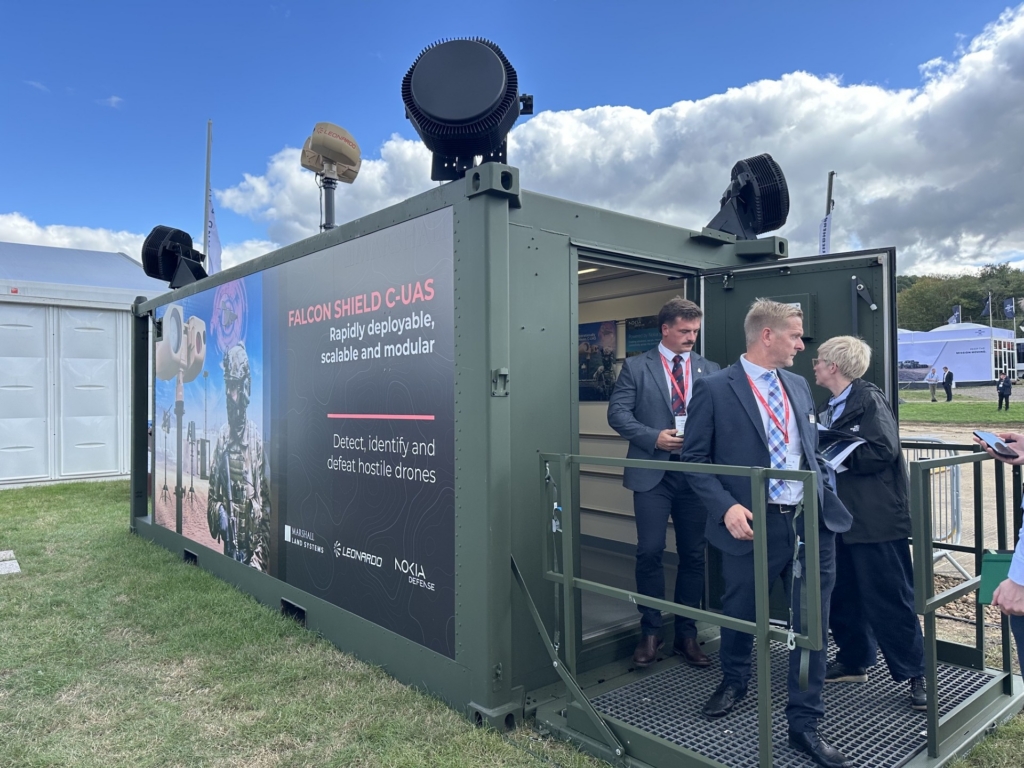
From the outside, it resembles a military-green 20ft shipping container. Inside, Leonardo and Marshall Land Systems have combined long-range surveillance, command-and-control software and AI-assisted threat identification to create a counter-drone system that can be moved wherever protection is needed.
Unveiled at DVD 2026, Containerised Falcon Shield is designed to bridge the gap between permanent base defence and smaller systems mounted on military vehicles.
The ISO-format container can travel by road, rail, sea or military aircraft, allowing it to protect an airbase, border, critical infrastructure site or deployed force without the support burden of a dedicated vehicle fleet.
“Any vehicle that can take a 20ft ISO container can take this,” Mike Sharpe, senior engineering manager at Marshall Land Systems, told ADS Advance. “You can move those assets around very quickly.”
Bridging the counter-drone gap
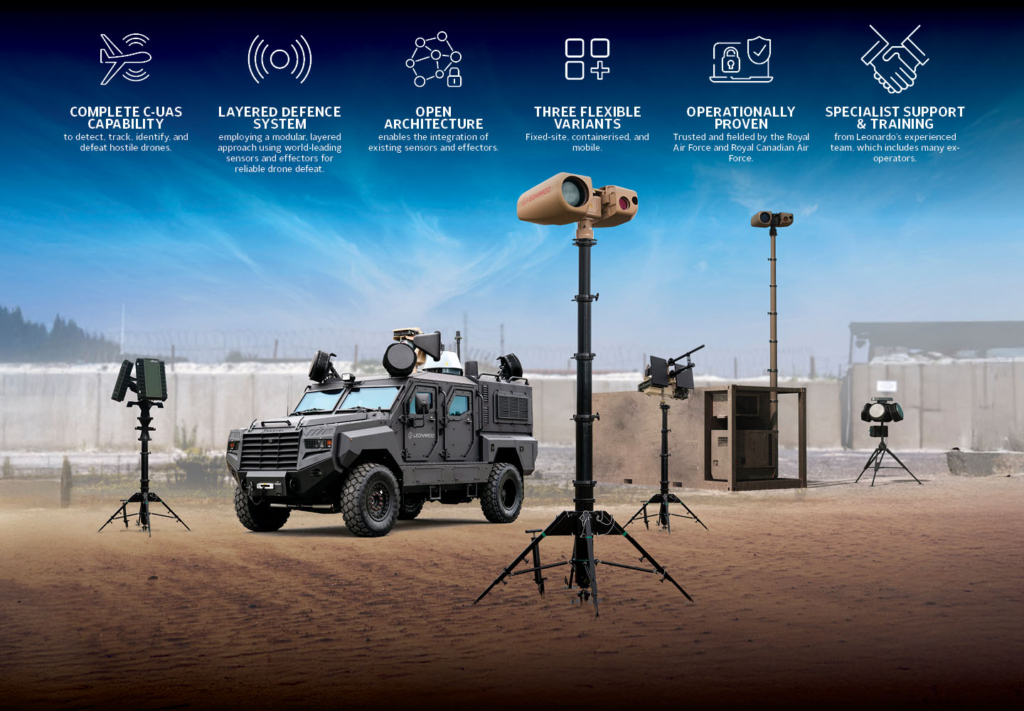
Falcon Shield is not one fixed collection of hardware, but an open counter-uncrewed air system into which different sensors and effectors can be integrated. Leonardo says the wider ecosystem is designed to detect and defeat Class 1, 2 and 3 uncrewed aircraft weighing up to approximately 600kg.
The RAF configuration, known as ORCUS, was first deployed at Gatwick Airport during the drone disruption of December 2018 and reached initial operating capability in 2020. It has since supported operations overseas, civilian authorities in the UK and security at major international events.
Leonardo has also developed a vehicle-mounted Falcon Shield capable of detecting and defeating drones on the move. Andrew Brooker, senior technical specialist for Falcon Shield, described the containerised version as the “sweet spot” between the two.
The demonstrator combines Leonardo’s HYAS command-and-control system, a hemispherical S-band radar and the UK-built Nerio ultra-long-range surveillance and target-acquisition sensor.
Customers can add other radars, cameras and electronic surveillance equipment, alongside responses ranging from drone takeover and electronic warfare to interceptor drones, guns, missiles and directed-energy weapons. Existing equipment can also be integrated rather than replaced.
Multiple containers, vehicles and fixed installations can be networked, allowing every node to contribute to the same air picture.
The system supports SAPIENT, the open architecture developed by the Defence Science and Technology Laboratory and adopted by the Ministry of Defence as its counter-UAS standard. It allows sensors and command systems from different suppliers to exchange information without extensive redevelopment, reducing both integration time and the danger of becoming locked into one manufacturer’s hardware.
AI cuts the operator’s workload
The latest Falcon Shield development also introduces greater automation to prevent operators becoming overwhelmed by crowded airspace.
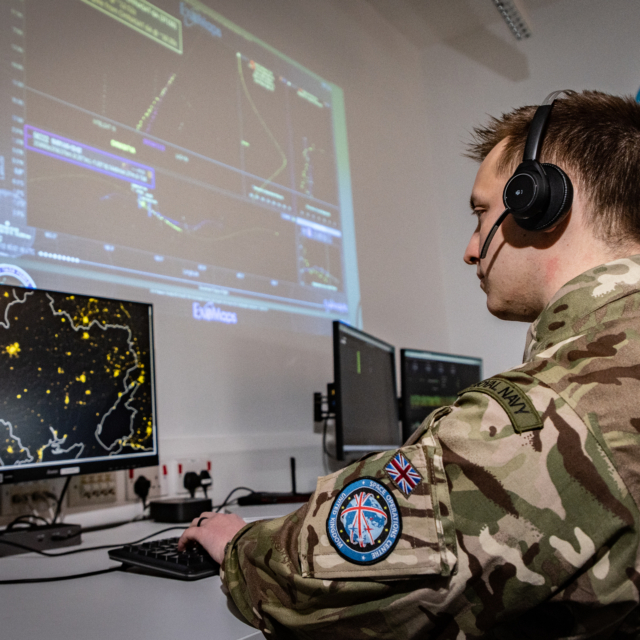
HYAS assesses the tracks reported by its sensors and presents a prioritised list of possible threats. In sentry mode, it can automatically direct cameras towards suspicious objects and use Leonardo’s in-house AI to distinguish drones from aircraft and birds.
“The key is to generate as much capacity as possible, remove the mundane work and show operators only the information they need, as far in advance as possible,” said Paul Norry, Leonardo’s C-UAS campaign manager for Falcon Shield.
Birds are among the most difficult objects to separate from small drones. Leonardo regularly operates a Nerio sensor from the roof of its Basildon facility, gathering imagery that can be used to improve the model.
It does not need to be trained against every make of quadcopter. Once it has learnt their common visual characteristics, Brooker said, the system can identify unfamiliar models with the same underlying form.
The team has also had to teach it greater nuance. A vertical take-off and landing drone was initially classified as a multirotor because its rotors were visible, despite flying like a fixed-wing aircraft. Leonardo subsequently introduced a separate VTOL category.
If forces encounter an entirely new drone, video can be returned to Leonardo, used to update the model and then distributed to operational systems.
AI is also employed within the radar to maintain track continuity. A conventional radar may assign a new identity to a drone that stops, hovers and begins moving again. Falcon Shield uses micro-Doppler data alongside track prediction and smoothing to help operators follow it as one continuous threat.
Humans retain control of weapons
Classification does not give the AI authority to use a weapon.
Once Falcon Shield identifies a hostile track, a safety-assured, rules-based engine recommends responses according to the type of drone, its speed, range and trajectory, and the effectors available.
A commercial quadcopter might be taken over electronically and directed to a safe holding point or landing area. Against a one-way attack drone such as the Shahed-136, the system would avoid presenting electronic options it judged ineffective and instead offer suitable kinetic responses.
The operator retains the decision to engage.
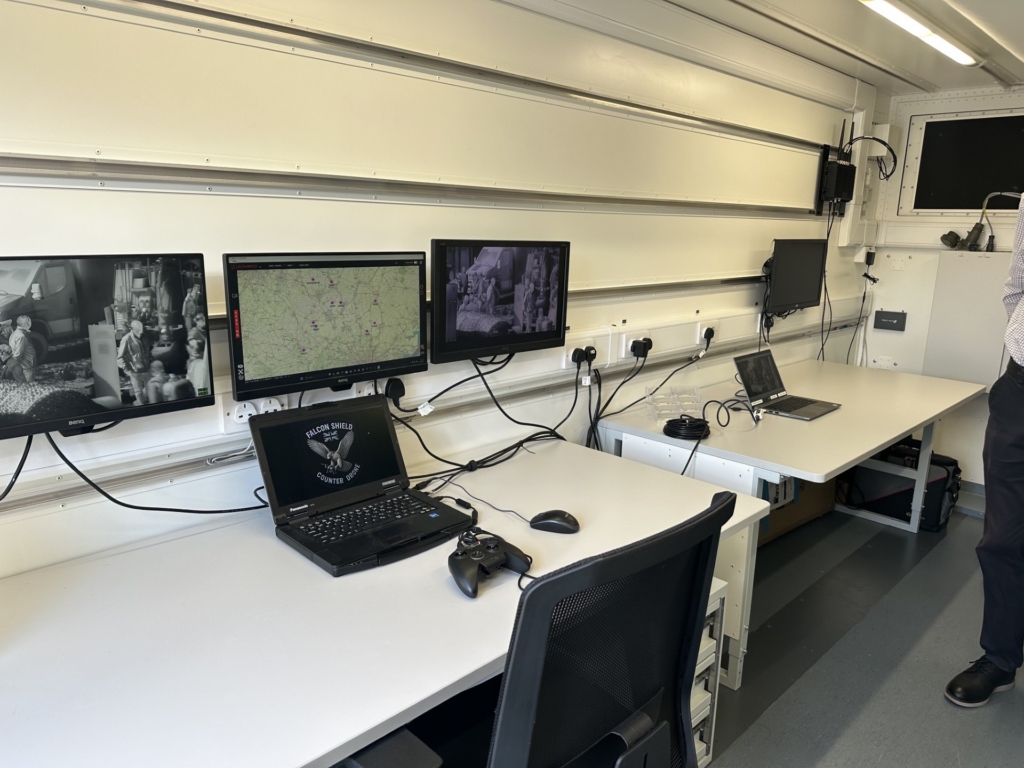
Automation could nevertheless allow a single person to monitor a system that previously required several operators.
“If you put it into sentry mode, that’s it,” Brooker explained. “It will give you visual and audio alerts to draw the operator’s attention back to what is going on.”
Built and supported in the UK
Marshall can tailor the container to each deployment, adding independent power, environmental control, CBRN filtration, electromagnetic protection and ballistic armour.
Achieving that protection is more complicated than the box suggests. Doors, ventilation and cable entry points can all allow electromagnetic emissions to escape or interference to enter.
“You think it is a steel box and it is nice and easy,” Sharpe said. “But doors are a real problem for EMC emissions. Sealing them for immunity is a specialist art.”
The containers are currently manufactured in Cambridge. Marshall has since confirmed that production is moving to a new assembly plant at Pentrebach in Merthyr Tydfil, which will initially employ 160 people and is expected to grow to 250 within five years.
Leonardo’s HYAS system and Nerio sensor are also developed in the UK. At Basildon, engineers maintain a like-for-like Falcon Shield system through which they can reproduce faults, generate synthetic threat scenarios and support deployed operators remotely.
The container does not make the drone threat any less complicated. Its value lies in giving armed forces a common framework that can move quickly, connect with other systems and absorb new sensors, software and weapons as the threat changes.
Sign up for our newsletter and get our latest content in your inbox.
Similar Reads