Hawk airframe to fly for decades to come
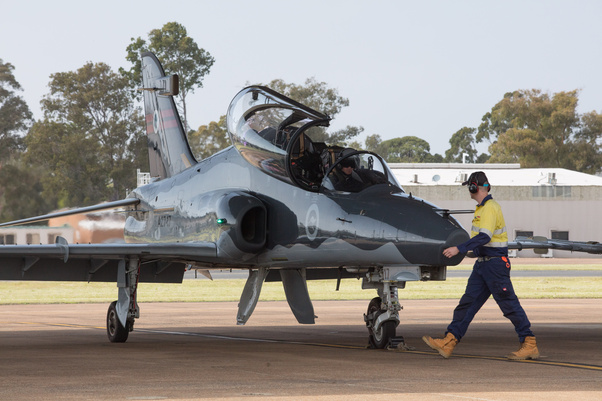
Above:
Hawk on runway in Australia.
Courtesy BAE Systems
Hawk aircraft are used to prepare pilots from 13 countries across the world for life in a fast jet cockpit.
The Mark 127 Hawk operated by the Royal Australian Air Force has a safety clearance to fly 10,000 hours and is the most advanced standard of the aircraft.
Air forces in the United Kingdom, the Kingdom of Saudi Arabia and Oman operate similar standards of aircraft in their Hawk fleets with the Qatar Emiri Air Force due to become the latest to operate this most advanced standard of aircraft.
A team from BAE Systems and the Australia Defence Department have recently completed a major structural testing programme on a specially adapted Hawk Mark 127 to put it through five-times this clearance.
The airframe has been subjected to and tested on the range of loads it would experience in actual flight, with durability tests carried out at the Defence Science and Technology Organisation in Melbourne to simulate real life fleet usage based on projected operational requirements.
Mike Swales, Head of International Markets, BAE Systems, said: "This a major milestone for the Hawk programme which proves there is many years more life left in the 650 aircraft we have training pilots across the globe every day.
"To achieve 50,000 flying hours in structural testing is five times the current clearance of the most modern Hawk in air forces across the world and more than ten times the current flying hours on most of the Australian fleet.
"Hawk has been the world's flying classroom, preparing more than 20,000 pilots for life in a frontline fast jet, for decades and this is proof that it has many years more safe, effective flying ahead of it with customers set to operate the aircraft well into the 2040's."
The testing programme began in February 2006 with the intention of demonstrating the structural integrity of a Mark 127 airframe to five times its intended life. The testing was completed on June 5 2020.
It involved a team of BAE Systems engineers in Brough, United Kingdom working alongside the DSTO team in Melbourne, Australia, to ensure the successful completion of the programme.

The airframe will now be dismantled with components undergoing a further two-year period of detailed inspections.
The first Hawk aircraft entered service with the Royal Air Force in 1976 and is currently in service with air forces from Canada and the United States to India and Australia.
There is production work underway on nine further Hawk aircraft for the Qatar Emiri Air Force which are scheduled to enter service in 2021, preparing its pilots for fast jet aircraft including Typhoon.