

Hexagon refines handheld 3D scanners to reduce MRO fit-and-rework risk

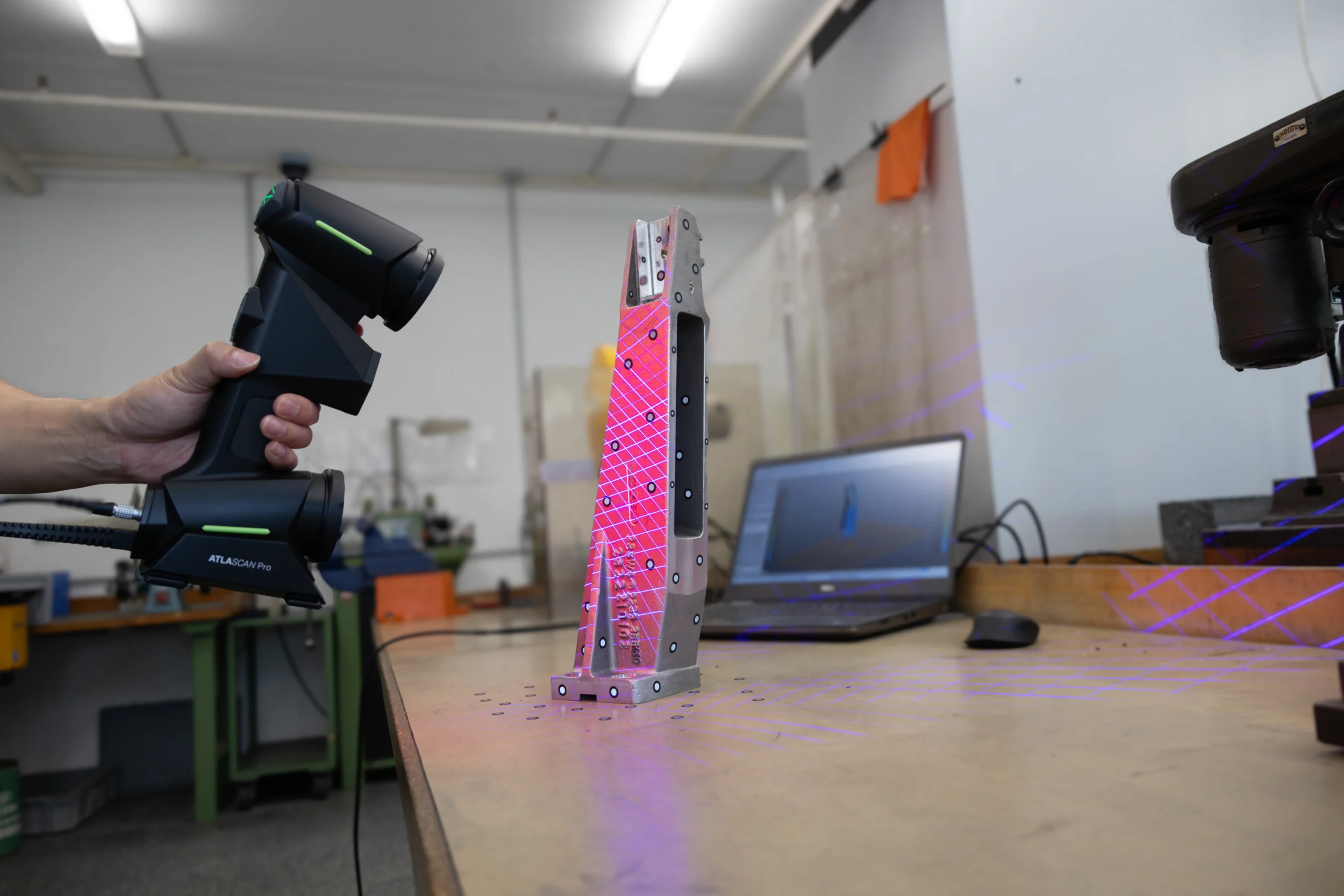
Hexagon’s Portable Metrology Division has brought a rapid-delivery reverse engineering workflow to maintenance, repair and overhaul (MRO) teams, pairing its handheld 3D scanners with Geomagic Design X software to remove the fit-and-rework risk that comes with replacing a part that has no available CAD data.
Better input data means faster reverse engineering and a higher-quality output part, whether it is machined or 3D printed, with less trial-and-error or manual rework before a replacement part is of sufficient quality and fit. The handheld scanner needs no specialist training and holds its accuracy in unstable hangar, shopfloor and field conditions.
Civil aviation and defence MRO teams face the same bottleneck: no CAD, no quick fix. On-demand manufacturing is gaining traction for reproducing ageing interiors with cracked, delaminated, or obsolete parts such as seat shrouds, armrests and tray tables, galley doors, latches and hinges.
The US Air Force has reverse-engineered and 3D-printed F-35 canopy frames for testing and the RAF fitted its first in-house 3D-printed part to a Typhoon aircraft in 2025 and is contributing to European Defence Agency efforts to scale such and ‘on-demand’ approach further.
Successful scan-based reverse engineering makes it easier to replicate a part, avoiding the costly errors that come with manual feature measurement and outdated drawings but in practice it is often too slow, needing specialist CAD and scanning skills to redraw a usable 3D model from an incomplete scan. Non-specialist CAD software compounds that problem: it can take three to eight times longer to rebuild an accurate model this way.
Reversing back to CAD
By combining direct scanner control with automated tools such as Region Segmentation, Modelling Wizards and Auto Sketch, plus NURBS (non-uniform rational B-spline) surfacing, Geomagic Design X can turn even complex, freeform shapes into fully editable, parametric CAD models with complete history intact.
The reverse engineering software’s Accuracy Analyzer checks constructed surfaces against the scan data at every stage, cutting the risk of rework, tooling iterations and fit issues. It then sends the finished model by LiveTransfer directly into the CAD software the customer uses, whether that is SOLIDWORKS, Siemens NX, Autodesk Inventor, or PTC Creo.
Aziz Tahiri, Global Director, Aerospace and Defence, Hexagon commented: “Reverse engineering is becoming indispensable for interior refurbishment and we are seeing rising interest from defence customers in mobile units that combine a scanning arm, reverse engineering software and a 3D printer in one container, so a damaged part can be scanned, rebuilt and repaired on site.
“But in practice, reverse engineering even a single mechanical component is often a laborious process that might involve several people, unreliable results and manual repair. With Geomagic Design X and high-quality accessible 3D scanning equipment like Hexagon’s new handheld scanners, we are making it feasible to reverse engineer directly back into CAD in a matter of hours – it’s a highly productive workflow that engineers and manufacturing teams can easily adopt.”
Sign up for our newsletter and get our latest content in your inbox.
Similar Reads




Sign up for our newsletter. Select all sectors relevant to you.
Related