General Atomics

Hidden galaxies may hold answers about Universe

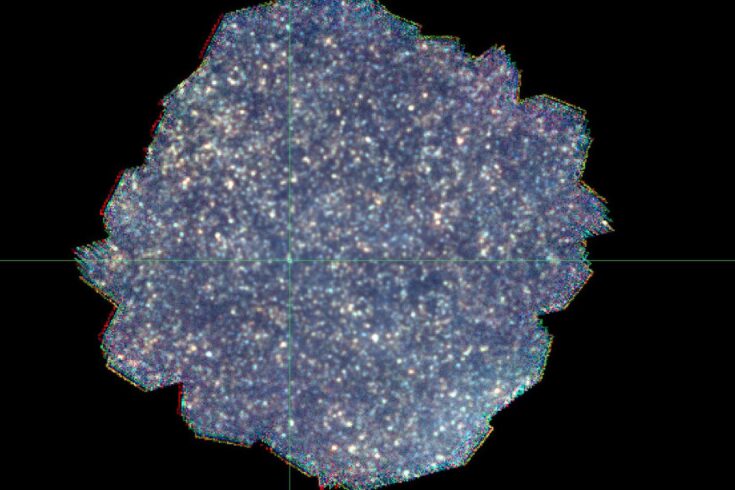
A team of scientists led by RAL Space, operated by the Science and Technology Facilities Council (STFC) and Imperial College London, has created the deepest ever image of the Universe in long far-infrared wavelengths, using newly processed data from the Herschel Space Observatory to reveal almost 2,000 distant galaxies, that could help answer key questions about our Universe.

Above: Image of countless stars against a blue background.
Courtesy STFC RAL Space    

The resulting image is called the Herschel-SPIRE Dark Field.

The research suggests the existence of a population of ‘hidden’ galaxies that could account for the missing energy in the Universe’s infrared light budget.

Dr Chris Pearson from STFC RAL Space, lead author of one of two papers published today in Monthly Notices of the Royal Astronomical Society, said: "This work has pushed the science with Herschel to its absolute limit, probing far below what we can normally discernibly see and potentially revealing a completely new population of galaxies that are contributing to the very faintest light we can observe in the universe."

Creating the deep image
Approximately half of our Universe remains hidden from direct observation, obscured by intervening cosmic dust.

To build a complete picture of the Universe and its evolution, astronomers must observe across multiple wavelengths of light, like long far-infrared wavelengths observed by Herschel’s SPIRE (Spectral and Photometric Imaging REceiver) instrument.


Above: SPIRE in a RAL Space cleanroom.
Courtesy STFC RAL Space


Dr Pearson explained: "The SPIRE instrument routinely stared at a single patch of ‘dark sky’ every month or so for the duration of its mission in space in order to monitor and measure its performance

"Our paper published today has taken each of these single observations – 141 images in total – stacking them on top of each other to create a final image known as the ‘Herschel-SPIRE Dark Field’.

"This new image will provide insight into the faintest galaxies in the cosmos that contribute to the infrared background light emitted by the universe, allowing scientists to drill down to the individual sources responsible for all the infrared light we see from space."

Importance of infrared observations
Dr Pearson highlighted the importance of observing the Universe in infrared light: "When we look at starlight through normal telescope, we are only able to read half of the story of our Universe, the other half is hidden, obscured by intervening dust.

"In fact, roughly half of the energy output of the Universe is from starlight that has been absorbed by dust and re-emitted as cooler infrared radiation. To fully understand the evolution of our Universe we need to observe the sky in both optical and longer wavelength infrared light."

Unexpected increase in galaxies
The analysis revealed possible evidence of a previously undiscovered population of faint galaxies hidden in the image blur, too faint to be detected by conventional methods. This unexpected increase in the number of galaxies is not predicted by current models.

If proven to exist, this new population may provide the missing piece to account for all remaining infrared energy observed in the Universe.

Dr David Clements, astrophysicist at Imperial College, said: "These results show just how valuable the Herschel archive is. We’re still getting great new results more than 10 years after the satellite stopped operating.

"What we can’t get, though, is more data at these wavelengths to follow up these fascinating new results. For that we need the next generation far-IR mission, PRIMA, currently being proposed to NASA."

The next-generation far-IR mission
Dr Clements continues: "What we can’t get, though, is more data at these wavelengths to follow up these fascinating new results. For that we need the next generation far-IR mission, PRIMA, currently being proposed to NASA."

The Probe far-Infrared Mission for Astrophysics (PRIMA) is being supported by a UK consortium including:

  • RAL Space
  • the University of Sussex
  • Imperial College London
  • Cardiff University

It would involve the use of a 1.8m telescope optimised for far-infrared imaging and spectroscopy, bridging the gap between existing observatories such as the James Webb Space Telescope and radio telescopes.

PRIMA is one of two proposals shortlisted for NASA’s next $1 billion (£772 million) probe mission. NASA will confirm its final mission selection in 2026.

Related

B&H Worldwide appoints Matt Silverberg as CEO
Matt Silverberg
B&H Worldwide appoints Matt Silverberg as CEO
With the appointment of Matt Silverberg as its new Chief Executive Officer, B&H Worldwide aims to accelerate the growth of its specialist logistics solutions for the global aerospace industry.
Aerospace Member News

24 Aug 2026

The price of transformation: The biggest losers in the UK’s Defence Investment Plan
AAC Wildcat AH1 during Ex Khanjar Oman 2021 [MOD CC - SAC Charlotte Hopkins] (CROP)
The price of transformation: The biggest losers in the UK’s Defence Investment Plan
Britain’s 2026 Defence Investment Plan promises more money, more autonomous systems and greater military mass. But the transformation comes at a price, with established capabilities disappearing before all of their successors are ready.
Aerospace Defence Insights

24 Aug 2026

easyJet pulls out of Leeds Bradford as Ryanair and Jet2 step up
easyJet 100th neo
easyJet pulls out of Leeds Bradford as Ryanair and Jet2 step up
easyJet is pulling out of Leeds Bradford Airport after 16 years, while Ryanair and Jet2 move quickly to target passengers affected by the withdrawal.
Aerospace

24 Aug 2026

The price of transformation: The biggest losers in the UK’s Defence Investment Plan
AAC Wildcat AH1 during Ex Khanjar Oman 2021 [MOD CC - SAC Charlotte Hopkins] (CROP)
The price of transformation: The biggest losers in the UK’s Defence Investment Plan
Britain’s 2026 Defence Investment Plan promises more money, more autonomous systems and greater military mass. But the transformation comes at a price, with established capabilities disappearing before all of their successors are ready.
Aerospace Defence Insights

24 Aug 2026

The UK clears Storm Shadow technology release to enable missile assembly in Ukraine
RAF aircraft with Storm Shadow / SCALP missile
The UK clears Storm Shadow technology release to enable missile assembly in Ukraine
Britain has authorised MBDA to release classified technology covering UK components of Storm Shadow/SCALP, clearing the way for assembly in Ukraine.
Defence

24 Aug 2026

Navantia UK’s £26.7m Methil investment builds sovereign shipbuilding capacity
Rear Admiral Matthew Stratton tours Methil
Navantia UK’s £26.7m Methil investment builds sovereign shipbuilding capacity
Navantia UK is modernising its Methil yard for future defence work as investment, new equipment and recruitment rebuild shipbuilding capacity in Fife.
Defence

24 Aug 2026

Austrian ENPULSION moves to acquire UK space propulsion specialist Lift Me Off
Enpulsion space propulsion manufacturer buys UK company lift me off
Austrian ENPULSION moves to acquire UK space propulsion specialist Lift Me Off
Austrian spacecraft propulsion manufacturer ENPULSION has agreed to acquire British specialist Lift Me Off, bringing together electric and chemical propulsion capabilities in a deal that will require UK Government approval.
Member News Space

21 Aug 2026

Lanarkshire AI Growth Zone gains £300m investment as Dell establishes Scottish base
Lanarkshire’s AI Innovation Park
Lanarkshire AI Growth Zone gains £300m investment as Dell establishes Scottish base
A £202 million guarantee from the UK National Wealth Fund has attracted an investment of £300 million in Lanarkshire's AI Growth Zone, which with Dell Technologies establishing a base there too, is set to support over 3,400 skilled jobs.
UK satellite funding targets connectivity ‘not-spots’ for farmers and remote railways
Young farmer works with a digital tablet in a wheat field, smart farm and quality control
UK satellite funding targets connectivity ‘not-spots’ for farmers and remote railways
British farmers and passengers travelling through remote parts of Scotland could gain better connectivity through a new £13 million package backing 16 UK satellite communications projects.
Space

18 Aug 2026

UK defence jobs jump by 26,000 as MoD spending supports 274,000 workers
Ministry of Defence spending with UK industry now supports one in every 100 jobs, according to new figures.
Defence Security

21 Aug 2026

Darktrace among first cybersecurity firms selected to integrate risk signals into Microsoft Agent 365
Using laptop and mobile phone
Darktrace among first cybersecurity firms selected to integrate risk signals into Microsoft Agent 365
The integration will bring Darktrace's behavioural risk signals into Microsoft Agent 365, enabling customers to view organisation-specific insights alongside Microsoft signals in a single interface.
Security

20 Aug 2026

Lanarkshire AI Growth Zone gains £300m investment as Dell establishes Scottish base
Lanarkshire’s AI Innovation Park
Lanarkshire AI Growth Zone gains £300m investment as Dell establishes Scottish base
A £202 million guarantee from the UK National Wealth Fund has attracted an investment of £300 million in Lanarkshire's AI Growth Zone, which with Dell Technologies establishing a base there too, is set to support over 3,400 skilled jobs.