HMS Queen Elizabeth completes 70-day test
A final package of training in the autumn – working alongside NATO and US allies – will confirm her ability to act as a task group flagship, so that she can lead a potent carrier strike force on frontline operations anywhere in the world.
Minister for the Armed Forces James Heappey said: “HMS Queen Elizabeth is an extraordinary ship crewed by extraordinary people from both the Royal Navy and the Royal Air Force.

“They deployed at the height of the COVID-19 outbreak and have remained at sea for over 10 weeks so that they could complete their operational training with the minimal risk of infection.
“They’ve put their duty to our country ahead of spending time with their families during the pandemic and in the process, they’ve taken us a step closer to, once again, having a carrier strike capability with the capacity to project British influence across the globe.”
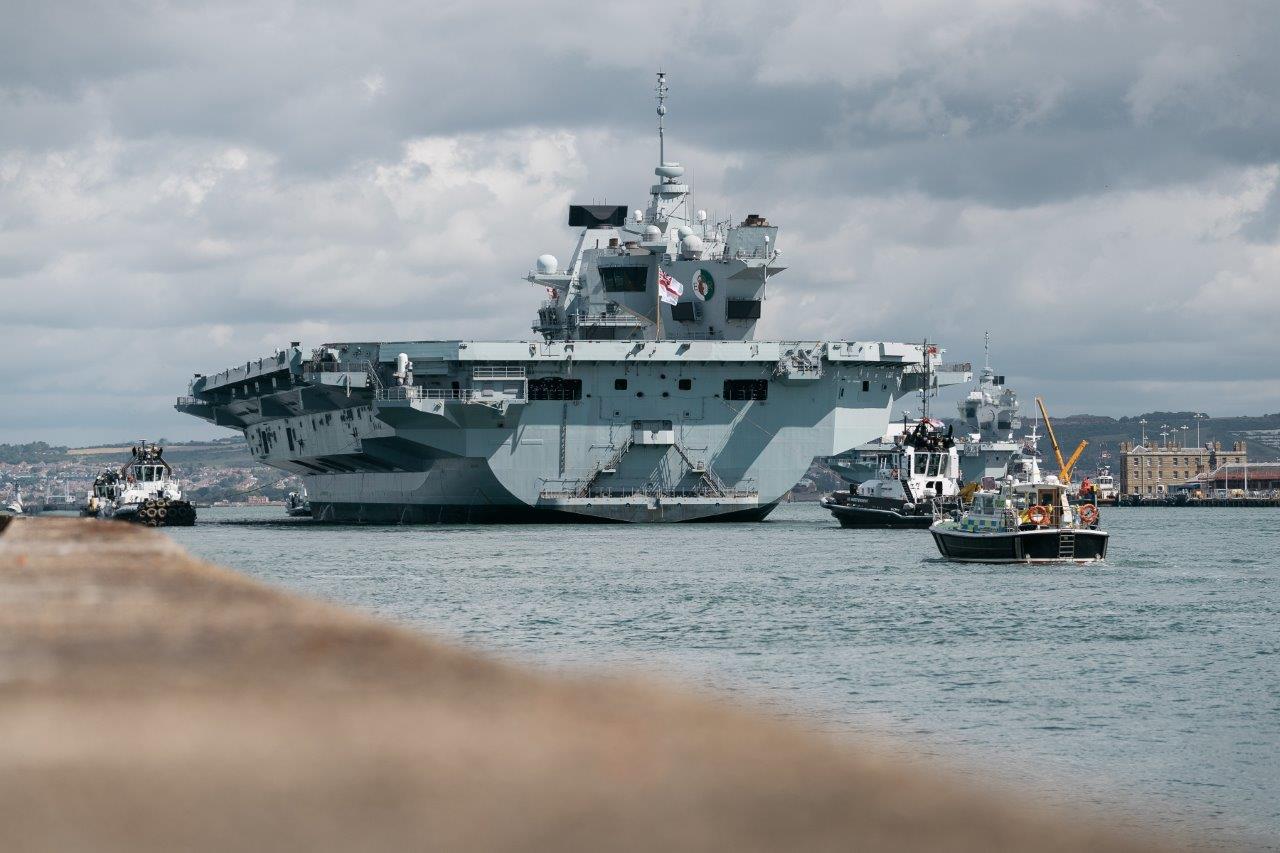
Above:
HMS Queen Elizabeth, Portsmouth.
Courtesy Royal Navy
In view of the size and complexity of the carrier, she received a dedicated training package, initially off the south coast, to test the ability of all 1,100 men and women on board to deal with everything they might expect to face in peace and war.
The training package reached its climax with 18 fictional fire and flood incidents raging simultaneously – with the ship expected to continue flying operations while damage control teams toiled in the carrier’s depths.
“Given the sheer size of the ship, Operational Sea Training has been a learning curve for all involved,” said Lieutenant Commander Si Bailey, one of the 46-strong team of assessors on board.
“It’s been a challenging time for HMS Queen Elizabeth, but the ship’s company and embarked personnel have been receptive to the training and advice – and have done so with a smile.”
Having passed that assessment, the carrier shifted to the North Sea to welcome F-35 Lightnings from 617 Squadron, better known as The Dambusters.
It is the first time operational UK F-35s have worked with Queen Elizabeth and they faced a punishing schedule once aboard, completing a record number of landings on the flight deck.
The future of Carrier Strike is a truly joint effort and the Royal Navy has worked closely with the RAF throughout the development of the carrier.
617 squadron – based at RAF Marham and comprising both Royal Air Force and Royal Navy personnel – progressed from qualifying pilots in the art of landing on and taking off from a moving warship by day and night all the way up to the first ‘four-ship package’: launching four F-35s on a combat sortie in rapid succession.
The fighters shared the flight deck with submarine hunting Merlin helicopters of 820 Naval Air Squadron from RNAS Culdrose. In all the fast jets and helicopters touch down on Queen Elizabeth 830 times in all weathers, at all times of day.
The collective training ended with a five-day test of the ship to defend against threats in the air, on the sea and beneath the waves, herself using F-35s, Merlins and frigate HMS Kent.
In the 70 days since leaving Portsmouth at the end of April, the carrier has been almost exclusively at sea and clocked up 11,500 miles – the equivalent of the distance from her home base to Auckland, New Zealand.
“The ship’s company have worked incredibly hard over the past 70 days, making every effort to surpass the high standards set by our assessors,” said Captain Angus Essenhigh, HMS Queen Elizabeth’s Commanding Officer.
“They have come through with flying colours which means Her Majesty’s Ship Queen Elizabeth has taken a huge step towards sailing on her maiden deployment, flying the flag for the United Kingdom and demonstrating that we are a global naval power with global ambitions.”
HMS Queen Elizabeth will now enjoy planned maintenance in Portsmouth before task group training later in the year, which will also see the ship work with two F-35 squadrons for the first time.