HyImpulse receives first flight license from CAA
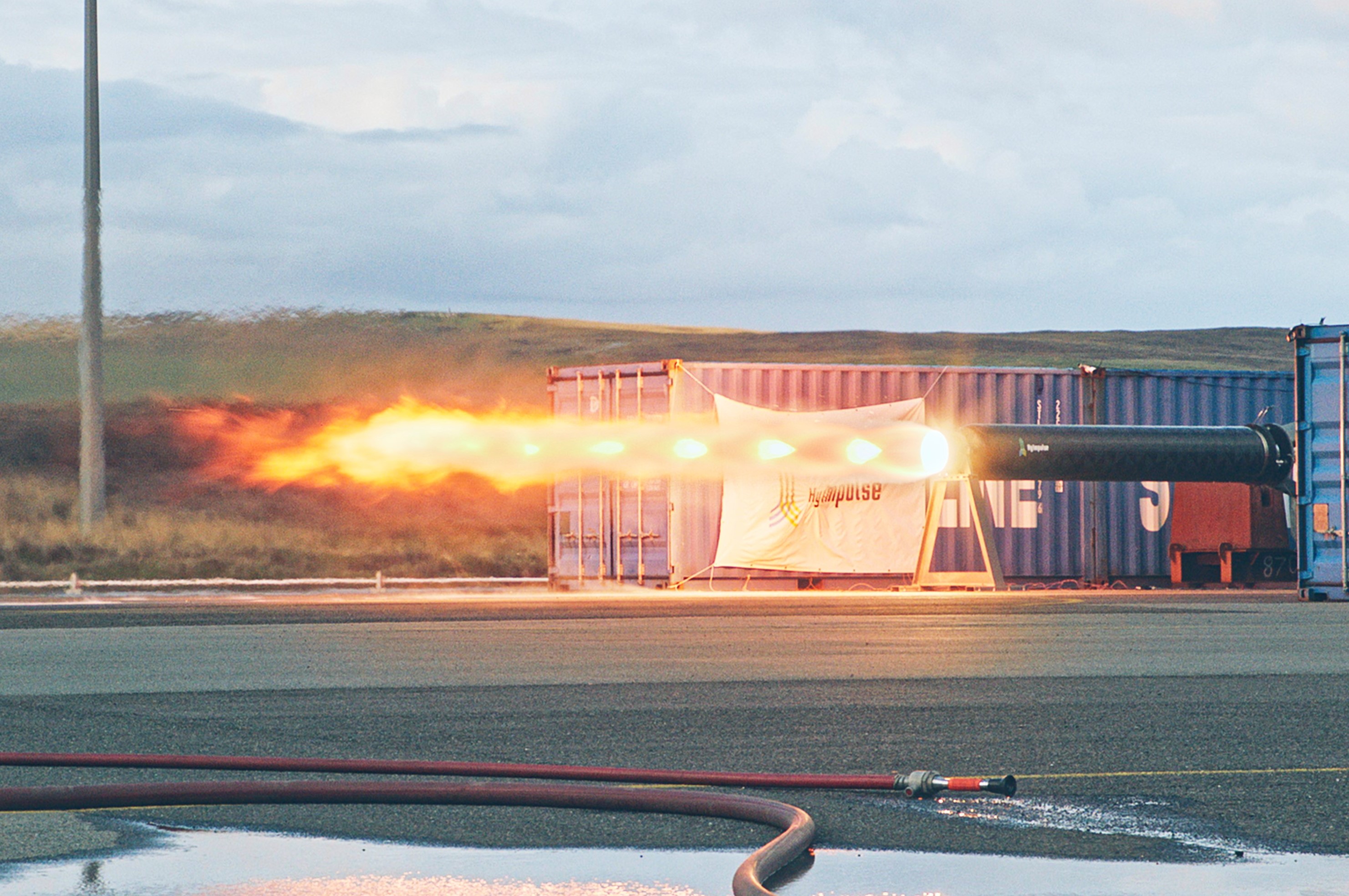
Image courtesy HyImpulse
Consecutive launches of the sounding rocket are planned later this year from the SaxaVord spaceport in Shetland, which will be the largest hybrid rocket ever launched vertically from the UK. The rocket’s maiden launch is planned to commence from Australia this April.
Licensing from the CAA was key to this stage of the company’s space programme and comes after a rigorous testing campaign supported by metrology experts at the National Manufacturing Institute Scotland (NMIS) with funding from Innovate UK. NMIS is operated by the University of Strathclyde and is part of the High Value Manufacturing Catapult (HVMC).

During the testing phase, HyImpulse worked with NMIS to develop a methodology to capture detailed dimensional measurement data to check the engine’s safety and performance before and after a series of trial horizontal tests on land at Scatsta Airport. The data collected was verified against existing virtual simulations.
Konstantin Tomilin, chief operating officer, HyImpulse said: “With the latest round of testing, we are another step closer to launching the rocket and the support from NMIS has been instrumental in getting us to this point.
“The hybrid system provides a more cost-effective and efficient way to launch payloads into space and will be a game changer in getting small satellites into orbit. Our propulsion system is poised to push the boundaries of hybrid rocket technology and we look forward to seeing the impact this new technology will have on the industry as a whole.”
As well as the challenges of testing in a remote island location, the size of HyImpluse’s five-metre engine made it impossible for conventional metrology scanners to be used for these critical tests. Instead, NMIS’s experts developed a methodology using handheld, high-accuracy 3D scanners and combined this with advanced analysis tools to complete the checks.
Over two weeks, 20 sets of internal and external measurements from several sections of the hybrid engine were taken, as well as one scan of the whole rocket. NMIS also provided training and software to support HyImpulse with interpreting complex data and analysing the scan results.
Hybrid rocket engines use a combination of both liquid and solid propellants. Therefore, they offer the simplicity and safety of solid rockets combined with the controllability of liquid rockets. This makes them easier to handle and store, and they have fewer parts than traditional engines. Hybrid rockets also use non-toxic fuels with lower emissions, making them more sustainable.
Joshua Walker, R&D engineer at NMIS, said: “The emerging space sector presents a big opportunity for manufacturing in Scotland, where space companies and startups can maximise the skills and experience, we already have, and manufacturers can branch out into a new market. In this case, it was the specialised equipment and expertise that NMIS was able to offer HyImpulse that has enabled them to take another step closer to getting into space.
“It’s been fantastic to work with HyImpulse and we look forward to seeing the rocket launched into space as SaxaVord nears completion.”