IATA reports 2020 as worst year ever for air travel demand

.jpg)
Above:
IATA’s Director General and CEO Alexandre de Juniac.
Courtesy IATA
International passenger demand in 2020 was 75.6% below 2019 levels. Capacity, (measured in available seat kilometers or ASKs) declined 68.1% and load factor fell 19.2 percentage points to 62.8%.
Domestic demand in 2020 was down 48.8% compared to 2019. Capacity contracted by 35.7% and load factor dropped 17 percentage points to 66.6%.
December 2020 total traffic was 69.7% below the same month in 2019, little improved from the 70.4% contraction in November. Capacity was down 56.7% and load factor fell 24.6 percentage points to 57.5%.
Bookings for future travel made in January 2021 were down 70% compared to a year-ago, putting further pressure on airline cash positions and potentially impacting the timing of the expected recovery.
IATA’s baseline forecast for 2021 is for a 50.4% improvement on 2020 demand that would bring the industry to 50.6% of 2019 levels. While this view remains unchanged, there is a severe downside risk if more severe travel restrictions in response to new variants persist. Should such a scenario materialise, demand improvement could be limited to just 13% over 2020 levels, leaving the industry at 38% of 2019 levels.

“Last year was a catastrophe. There is no other way to describe it. What recovery there was over the Northern hemisphere summer season stalled in autumn and the situation turned dramatically worse over the year-end holiday season, as more severe travel restrictions were imposed in the face of new outbreaks and new strains of COVID-19.” said Alexandre de Juniac, IATA’s Director General and CEO.
International Passenger Markets
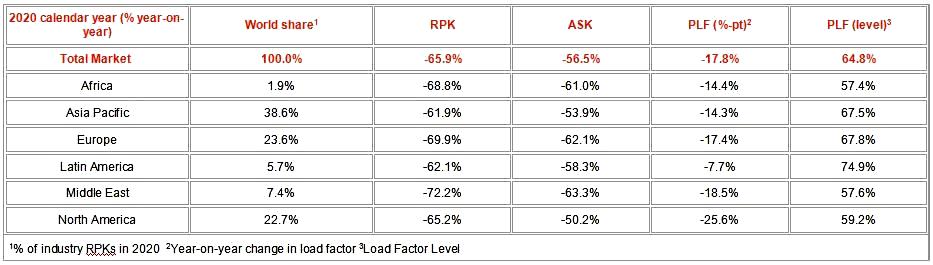
- Asia-Pacific airlines’ full-year traffic plunged 80.3% in 2020 compared to 2019, which was the deepest decline for any region. It fell 94.7% in the month of December amid stricter lockdowns, little changed from a 95% decline in November. Full year capacity was down 74.1% compared to 2019. Load factor fell 19.5 percentage points to 61.4%.
- European carriers saw a 73.7% traffic decline in 2020 versus 2019. Capacity fell 66.3% and load factor decreased 18.8 percentage points to 66.8%. For the month of December, traffic slid 82.3% compared to December 2019, an upturn over the 87% year-to-year decline in November reflecting pre-holiday momentum that was reversed toward the end of the month.
- Middle Eastern airlines’ annual passenger demand in 2020 was 72.9% below 2019. Annual capacity fell 63.9% and load factor plummeted 18.9 percentage points to 57.3%. December’s traffic was down 82.6% compared to December 2019, improved from an 86.1% drop in November.
- North American airlines’ full year traffic fell 75.4% compared to 2019. Capacity dropped 65.5%, and load factor sank 23.9 percentage points to 60.1%. December demand was down 79.6% compared to the same month a year-ago, a pick-up over an 82.8% drop in November reflecting a holiday surge.
- Latin American airlines had a 71.8% full year traffic decline compared to 2019, making it the best performing region after Africa. Capacity fell 67.7% and load factor dropped 10.4 percentage points to 72.4%, by far the highest among regions. Traffic fell 76.2% for the month of December compared to December 2019, somewhat improved from a 78.7% decline in November.
- African airlines’ traffic fell 69.8% last year compared to 2019, which was the best performance among regions. Capacity dropped 61.5%, and load factor sank 15.4 percentage points to 55.9%, lowest among regions. Demand for the month of December was 68.8% below the year-ago period, well ahead of a 75.8% decline in November. Carriers in the region have benefitted from somewhat less severe international travel restrictions compared to the rest of the world.
Domestic Passenger Markets
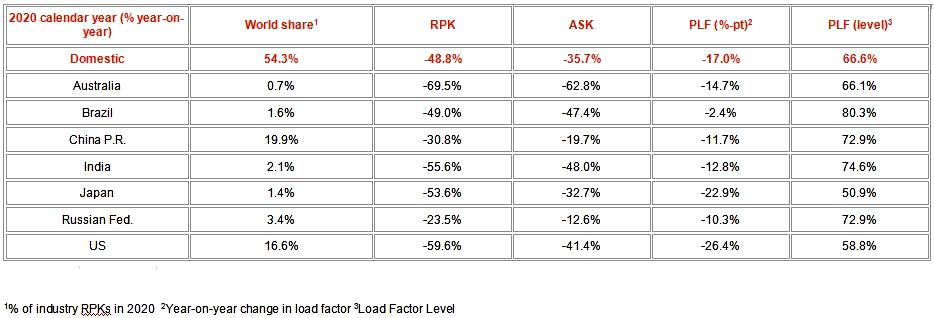
- China’s China’s domestic passenger traffic fell 30.8% in 2020 compared to 2019. It was down 7.6% for the month of December versus December a year-ago period, which was a deterioration compared to a 6.3% decline in November amid new outbreaks and resulting restrictions.
- Russia’s domestic traffic fell 23.5% for the full year, but 12% for the month of December, much improved over a 23% decline in November. Full year results were supported by booming domestic tourism over the summer and falling fares.
“Optimism that the arrival and initial distribution of vaccines would lead to a prompt and orderly restoration in global air travel have been dashed in the face of new outbreaks and new mutations of the disease. The world is more locked down today than at virtually any point in the past 12 months and passengers face a bewildering array of rapidly changing and globally uncoordinated travel restrictions. We urge governments to work with industry to develop the standards for vaccination, testing, and validation that will enable governments to have confidence that borders can reopen and international air travel can resume once the virus threat has been neutralized. The IATA Travel Pass will help this process, by providing passengers with an App to easily and securely manage their travel in line with any government requirements for COVID-19 testing or vaccine information. In the meantime, the airline industry will require continued financial support from governments in order to remain viable,” said de Juniac.