IATA sees air passenger and air cargo demand up in January

Image courtesy IATA
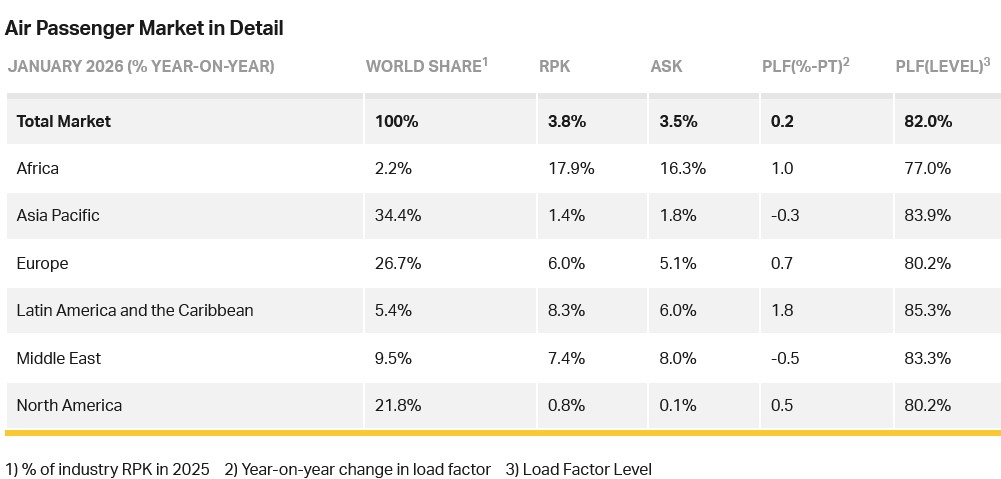
Total demand, measured in revenue passenger kilometres (RPK), was up 3.8% compared to January 2025. Total capacity, measured in available seat kilometres (ASK), increased 3.5% year-on-year. The load factor was 82.0% (+0.2 ppt compared to January 2025), a record high for January.
International demand rose 5.9% compared to January 2025. Capacity was up 5.8% year-on-year, and the load factor was 82.5% (+0.1 ppt compared to January 2025). Domestic demand increased 0.1% compared to January 2025. Capacity was down -0.4% year-on-year. The load factor was 81.2% (+0.4 ppt compared to January 2025).

January demand was skewed by a shift in the Lunar New Year from January in 2025 to February in 2026. Lunar New Year typically drives a spike in demand, as families reconnect to celebrate the holiday. The year-on-year comparison has the effect of making January 2026 demand appear slightly weaker.
Willie Walsh, IATA’s Director General., said: “The timing of the Lunar New Year partly explains the slightly slower 3.8% expansion in January, but the fundamentals are in place for demand to continue strong growth in 2026. Schedule data, for example, indicate a 5.2% increase in global seat capacity by March, which would be the fastest expansion since April 2024.
"Events over the weekend have, however, introduced some uncertainty into the evolution of traffic and fuel costs. We all hope for an early peaceful resolution to the current hostilities. In the meantime, it is critical that states respect their obligation to keep civilians, and civil aviation free from harm.”
“Average fares are expected to fall in real terms over the course of 2026, continuing a long-established trend of ever more affordable air travel. This is despite persistent cost pressures from rising infrastructure charges, onerous regulatory burdens and the mounting cost of the energy transition. In the face of these cost and regulatory pressures, it is notable that 2025 saw the slowest rate of new airline start-ups since 1999. Governments who value competition should consider this a canary in the coal mine. To protect and enhance the consumer benefits of connectivity, these cost and regulatory issues must be addressed.”
Regional Breakdown - International Passenger Markets
International RPK growth reached 5.9% in January year-on-year. All regions expanded but year-on-year growth decelerated, particularly in Asia Pacific, reflecting the timing of Lunar New Year falling in February. The international load factor, at 82.5%, was a record high for the month.
Asia-Pacific airlines achieved a 4.4% year-on-year increase in demand. Capacity increased 5.2% year-on-year and the load factor was 85.9% (-0.7 ppt compared to January 2025).
European carriers had a 6.3% year-on-year increase in demand. Capacity increased 5.7% year-on-year, and the load factor was 79.4% (+0.5 ppt compared to January 2025).
North American carriers saw a 3.4% year-on-year increase in demand. Capacity increased 2.6% year-on-year, and the load factor was 82.3% (+0.6 ppt compared to January 2025).
Middle Eastern carriers saw a 7.2% year-on-year increase in demand. Capacity increased 7.8% year-on-year, and the load factor was 83.2% (-0.4 ppt compared to January 2025).
Latin American airlines saw a 11.4% year-on-year increase in demand. Capacity climbed 8.9% year-on-year. The load factor was 86.5% (+2.0 ppt compared to January 2025).
African airlines saw an 11.7% year-on-year increase in demand. Capacity was up 10.1% year-on-year. The load factor was 77.4% (+1.1 ppt compared to January 2025).
Domestic Passenger Markets
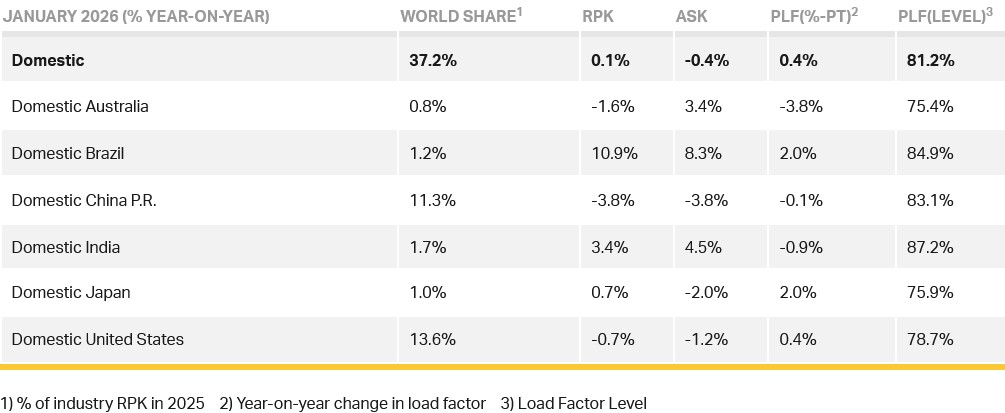
Domestic RPK rose just 0.1% over January 2025, mostly affected by the shift of Lunar New Year. The load factor rose slightly by 0.4 ppt to a record January high of 81.2%, as capacity fell -0.4%. China, Australia, and the United States all posted traffic declines, but Brazil was once again a strong performer, rising 10.9% year-on-year.
Air Cargo
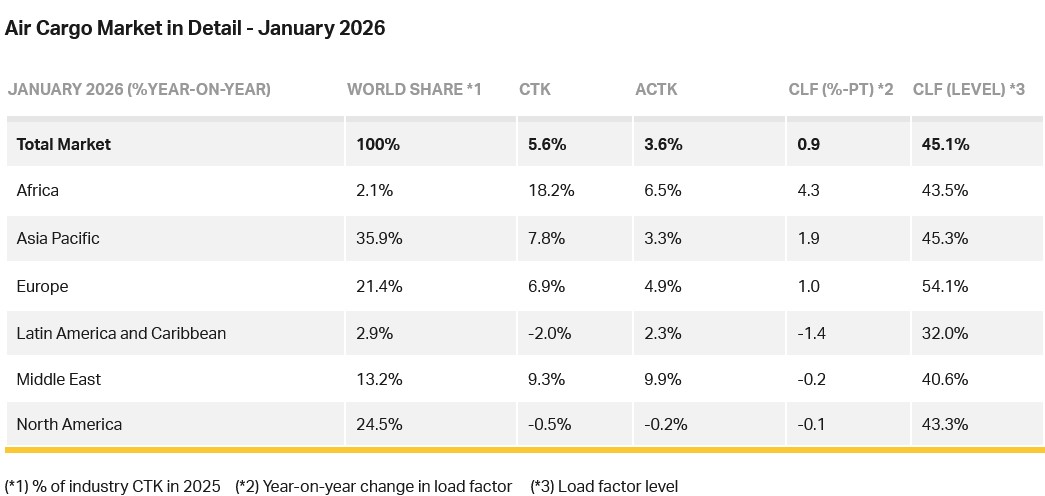
Total air cargo demand, measured in cargo tonne-kilometres (CTK), was up by 5.6% in January 2026 compared to January 2025 levels (+7.2% for international operations). Capacity, measured in available cargo tonne-kilometres (ACTK), increased by 3.6% compared to January 2025 (+5.7% for international operations).
Willie said: “The demand for air cargo had a robust start to 2026, recording 5.6% year-on-year growth in January. At the regional level, the story is more polarised. Carriers in Africa, Middle East, Asia-Pacific, and Europe all reported faster growth than the global average. In contrast, carriers in the Americas reported aggregate contractions.
"The resilience of air cargo will continue to be tested in the coming months. In addition to the long-running uncertainties of evolving US trade policies, the outbreak of hostilities in the Middle East will both weigh heavy on global supply chains. Addressing these topics will add extra importance to discussions at the upcoming World Cargo Symposium in Lima, Peru (10t-12th March 2026) where strengthening air cargo’s adaptability and efficiency through digitalization and other measures will be a key focus.”
Several factors in the operating environment should be noted:
- The global goods trade grew by 4.9% year-on-year in December 2025.
- Jet fuel prices decreased by 6.5% year-on-year in January.
- Global manufacturing sentiment strengthened in January, with the global Purchasing Managers’ Index (PMI) rising above the 50-point expansion threshold to 51.8, its highest level in over a year and a half. The PMI for new export orders climbed to 49.9, slightly below the growth threshold but the highest in 10 months, reflecting mixed but cautiously optimistic industrial growth.
January Regional Performance
Asia-Pacific airlines saw a 7.8% year-on-year growth in air cargo demand in January, maintaining the region’s role as the primary engine of the industry expansion. Capacity increased by 3.3% year-on-year.
North American carriers saw a 0.5% year-on-year decline for air cargo demand in January. North America was the only region showing a capacity decrease, slightly declining by 0.2% year-on-year.
European airlines saw a 6.9% year-on-year increase in demand for air cargo in January. Capacity increased 4.9% year-on-year.
Middle Eastern carriers saw a 9.3% year-on-year increase in demand for air cargo in January. Capacity increased by 9.9% year-on-year, the strongest rise of all regions.
Latin American and Caribbean carriers saw a 2.0% year-on-year decrease in demand for air cargo in January, the weakest performance of all regions. Meanwhile, capacity increased by 2.3% year-on-year.
African airlines saw a 18.2% year-on-year increase in demand for air cargo in January, the strongest growth of all regions. Capacity increased by 6.5% year-on-year.
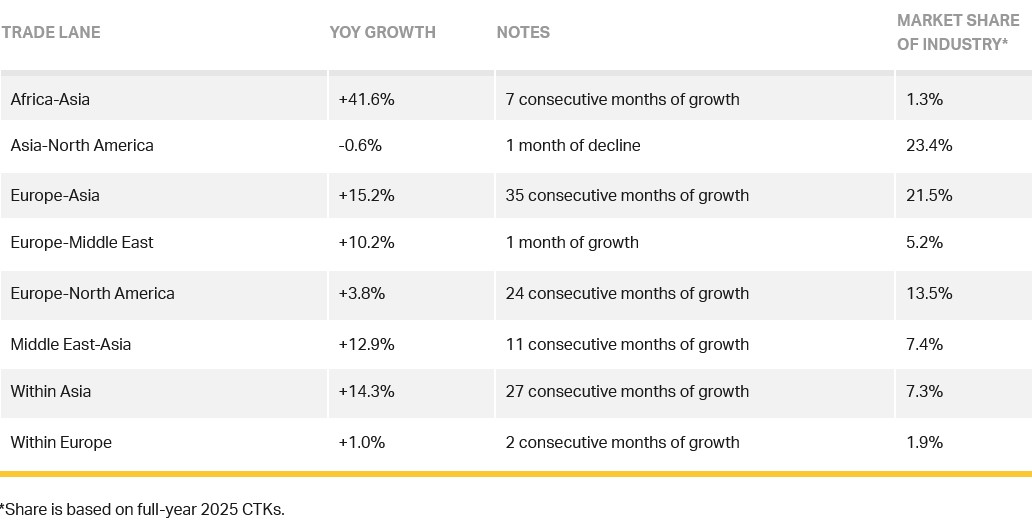
Trade Lane Growth
Air freight volumes in January 2026 increased across most major trade corridors, with the notable exception of the Asia–North America route area.