IBA data shows overall aviation CO2 emissions fell by -2.1% in 2021
IBA today released its latest monthly Aviation Carbon Emissions Index in association with KPMG, showing that Overall CO2 emissions reduced by -2.1% from 2020 to 2021.
CO2 emissions in the commercial aviation industry averaged 143.7 grams of CO2 per-seat-per mile in December 2021. Overall carbon intensity per-seat reduced by -0.4% month on month from November to December 2021, and -2.1% year on year from 2020 to 2021.
Last year proved to be a challenging one for a sector reeling from the pandemic but the industry is following a positive trend, with improving overall efficiency.

Whilst deliveries of new generation aircraft continue, the pandemic has hampered the pace at which they can enter service in airline fleets. As the recovery begins to ramp up through 2022 and beyond, IBA expects operators will continue to reactivate their dormant fleets as the requirement for capacity increases. This is likely to result in the global emissions figure creeping up slightly, before plateauing in the next two to three years as demand returns and stabilises.
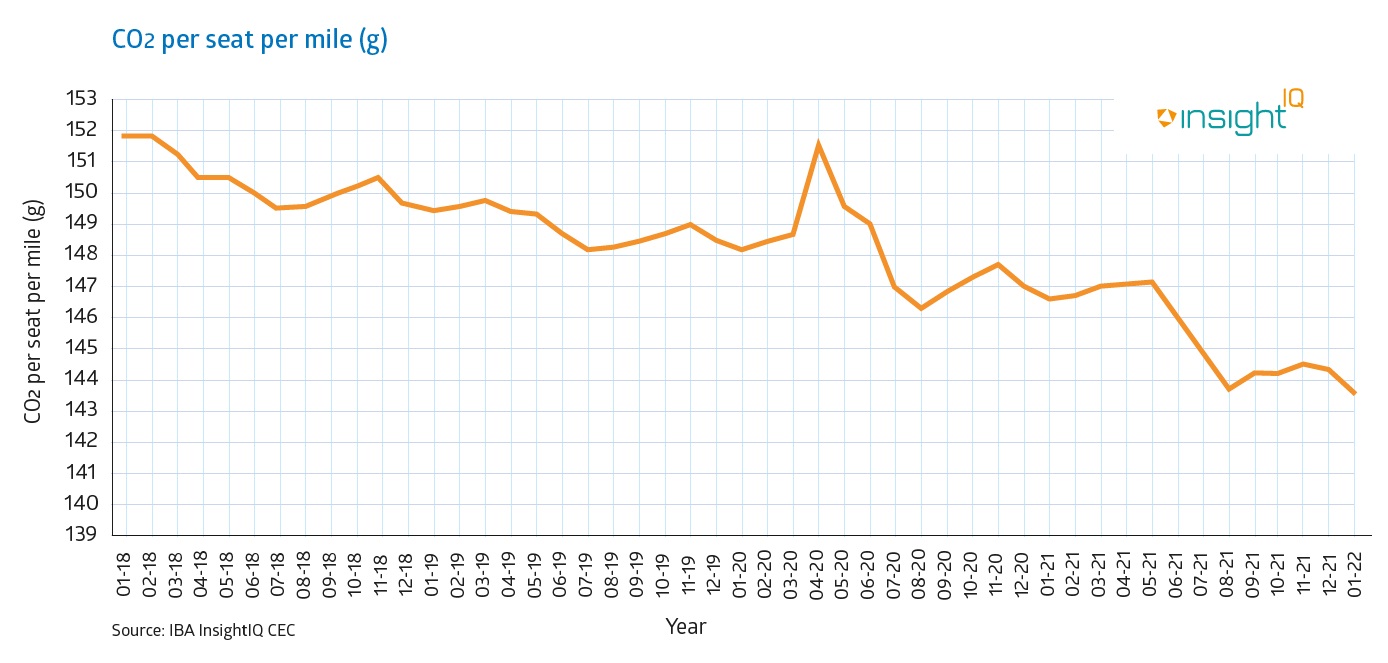
Image courtesy IBA
Aircraft Efficiency Spotlight
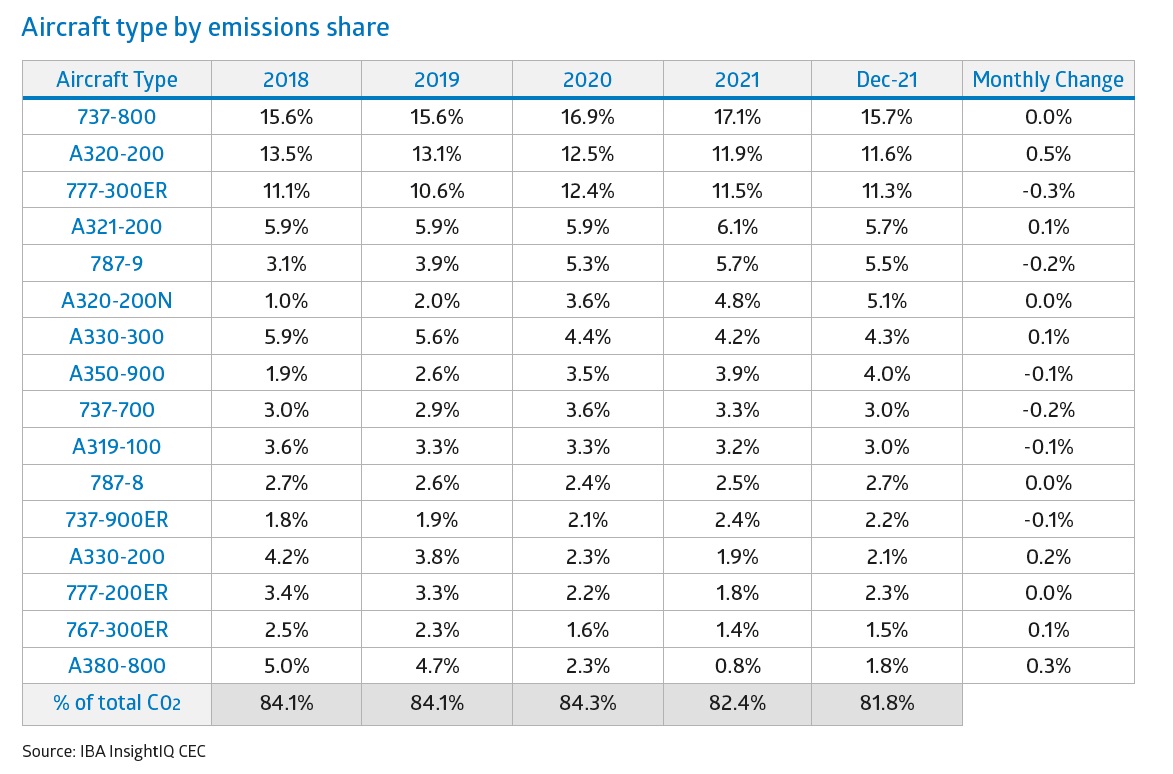
The global share of emissions remains relatively unchanged for December with a broad increase of flights growing linearly for most types. This is with the exception of some newer generation narrowbodies such as the Boeing 737 MAX 200 that show a sharp uptick in month-on-month utilisation in December 2021 of 27%. However, the types overall contribution towards global emissions stands at less than 0.5%.
Looking ahead, there will likely be significant evolution of the fleet emissions share, with some of the biggest losers being the Airbus A319 (in favour of the Airbus A220-300) and the Boeing 777-200ER, which is likely to be phased out faster than expected.
The share in emissions for the Boeing 787 family is likely to stall for at least the next six months as Boeing indicates deliveries are unlikely to resume until deep into Q1 2022. This picture will change significantly over the coming years with the Boeing order book for the type standing at over 500 aircraft.
Lessor Efficiency Spotlight
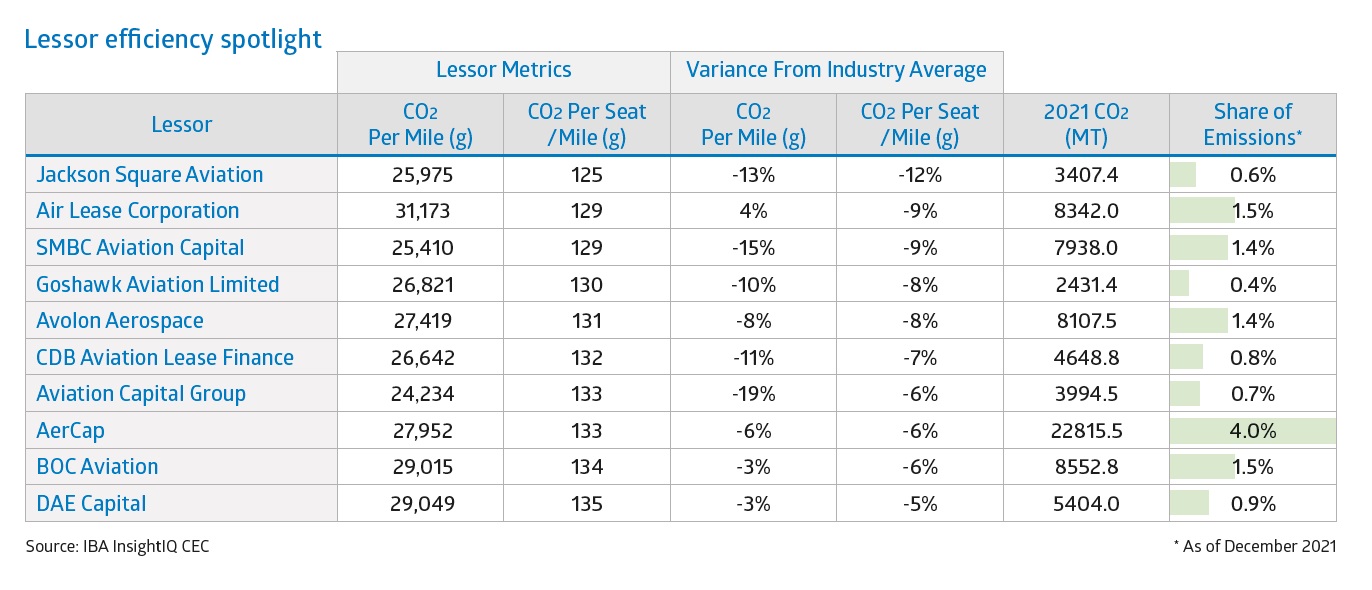
Jackson Square Aviation ranked at the top of the lessor efficiency index with an average of 125g CO2 per-seat per-mile in December 2021. This was helped by a large portion of their portfolio consisting of Airbus A320-200neo and Boeing 737 MAX 8 aircraft at an average fleet age of just 5.7 years. However, with only just over 24 aircraft on the order books, Jackson Square Aviation may gradually slip down the ranking as Avolon Aerospace as an order book exceeding 220 aircraft.
Air Lease Corporation will experience a similar shift on an already positive efficiency figure, with over 300 aircraft currently on order consisting of predominantly Boeing MAX jets and Airbus A220-300s.
Airline Efficiency Spotlight
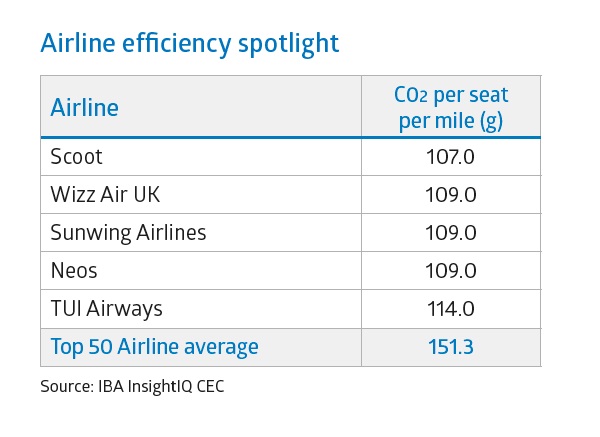
December 2021 sees the exit of Air Transat and the addition of TUI Airways to our airline efficiency ranking. TUI joins the ranking largely due to an uptick in 737 MAX 8 utilisation. As per our previous index release, Scoot remains high in the ranking due to a large portion of its Airbus A320-200ceo fleet remaining stored throughout 2020 and 2021.
IBA expects to see Wizz Air UK and its parent company remain at the top of the rankings in the coming years as Wizz Air gradually takes delivery of more Airbus A320neo family aircraft. The table below spotlights airline efficiency in the month of December 2021.
IBA Forecasts Major US Carriers’ CO2 Emissions for 2025
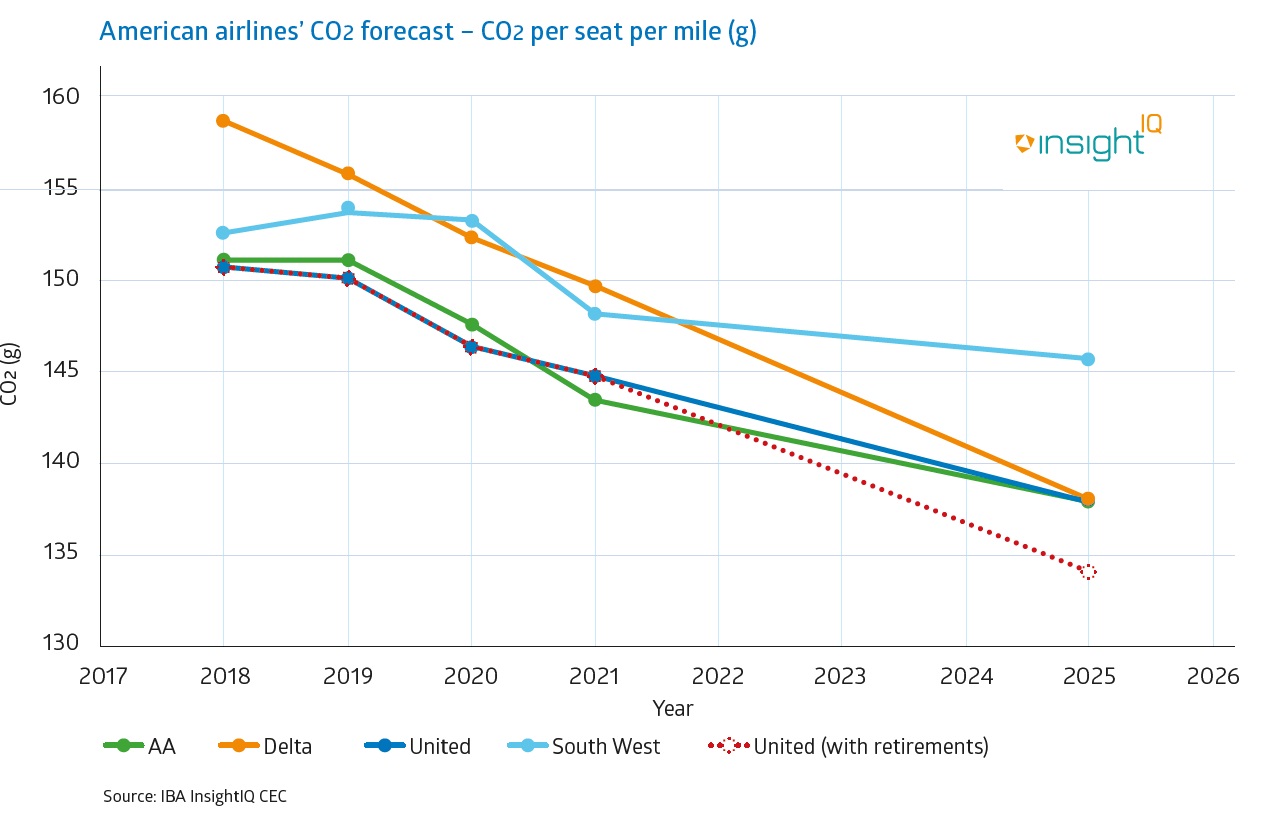
IBA used the unique scenario modelling capabilities of our Carbon Emissions Calculator to forecast the future CO2 emissions of these major US carriers. This exclusive feature allows users to compare the performance of portfolios, lessors and operators to provide actionable insights on current and future fleet composition and route improvements.
IBA predicts the top four largest airlines in the United States (also the top four largest airlines globally) will experience a significant downward shift in carbon intensity over the next three years.
Delta Air Lines
Delta has earmarked their Boeing 717-200 and Boeing 767-300ER fleets for retirement by 2025. They have already made progress with this commitment by reducing their fleets of these types by 40% and 53% respectively. Many Delta aircraft are of older vintage and approaching the end of their useful economic life such as the Boeing 757 fleet and the Airbus A319-100ceo fleet with average fleet ages of 24.5 and 19.9 years respectively. Whilst IBA has modelled a strong downward trend in CO2 emissions at Delta, their performance over the next decade is likely to improve even further thanks to their fleet renewal strategy. Delta’s commitment to introducing the Airbus A220 and A320neo family to replace Boeing 717 and Boeing 757 types is likely to make a significant contribution.
American Airlines
American Airlines is also going through a fleet renewal cycle. Driven largely by the Covid-19 pandemic, numerous Airbus A330-200 & -300 aircraft have been retired from active service alongside almost 40 Boeing 737-800 aircraft. The retirement of McDonnell Douglas MD-80, Embraer E190 and Boeing 767 types continues and a blend of Airbus A321-200 and Boeing 757-200 aircraft are being placed into long term storage. American Airlines has a sizeable orderbook of Boeing 737 MAX 8, Boeing 787-9 and Airbus A321neo variants. Thanks to this, American Airlines can expect to see a considerable reduction in carbon intensity going forward.
United Airlines
United Airlines is well placed to reduce its overall carbon intensity in the future but has made no firm public commitments to retire older portions of its mainline fleet. As such, IBA has modelled two scenarios; one showing fleet expansion without retirements, the other showing the exit of United’s stored Boeing 777-200 / ER, Boeing 757-200, Airbus A319-100ceo and Airbus A320-200ceo types. These aircraft have a combined average age of 21.4 years. United Airlines has, however, committed to over 200 retirements of its United Express regional fleet by 2026 but these figures are not included within this analysis whose purpose is to compare against other mainline carriers.
Southwest Airlines
Southwest Airlines has recently accelerated the retirement of its Boeing 737-700 aircraft as it prepares to take delivery of the new Boeing 737 MAX 7 jets from 2022. Southwest is making the most of being a single type operator, utilising Boeing 737 NG and Boeing 737 MAX family aircraft. IBA expects more Boeing 737-700 aircraft to gradually exit the fleet in the coming years as they are replaced by the MAX. The average age of Southwest’s 429 Boeing 737-700 aircraft is 17.2 years old. Comparatively, Southwest’s 200 plus Boeing 737-800 aircraft average 6.5 years-old and are expected to remain in the fleet long-term. Many of these are aircraft fitted with the CFM56-7B27E engine, offering efficient performance when compared to early delivery 737 NGs.
Kieran O’Brien, Partner in Management Consulting and Lead Advisory Partner in the Aviation Finance and Leasing Practice at KPMG Ireland, affirms the importance of this month’s index and what it means for the future of the industry:
“With 2% expected annual reduction with incremental engine improvements and their gradual roll-out through the global fleet, as opposed to the 5%+ type CAGRs needed to achieve the 2050 net neutral targets. This points to the need for SAF in short to mid-term and then wider portfolio definitions long-term.
In terms of ESG and industry we expect 2022 to bring increased scrutiny over ‘greenwashing’. SEC has not released any mandatory climate risk disclosure rules but we expect to anticipate further developments in early 2022. It is crucial any ESG strategy is underpinned by data and analytics, which is why we expect external data sources to develop significantly with ESG scoring tools and international standardisation leading the way - similar to the IBA's platform.”
Established in 1988, IBA has over 30 years’ experience in delivering independent, expert business analysis and intelligence on the aviation sector. Established in 1988, it provides a wide range of services including InsightIQ, a one-stop intelligence platform combining speed, accuracy, visual analytics and intuitive navigation.
IBA advises prominent investment funds and banks, aircraft leasing companies, operators, manufacturers and MROs. In March 2021, IBA was named ‘Appraiser of the Year’ by Airline Economics for the fourth time.