ICAO adjusts CORSIA
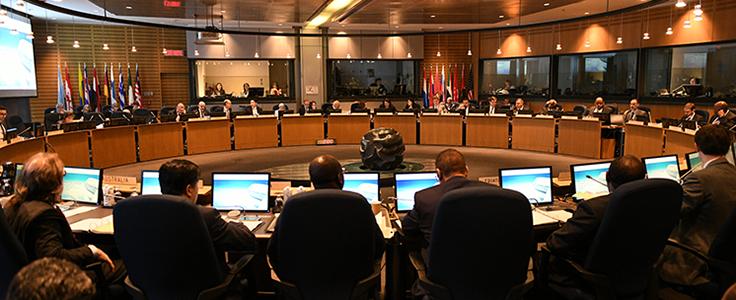
Image courtesy ICAO
The CORSIA was designed to address gaps in aviation’s ability to reduce and eliminate its CO2 emissions through ongoing innovations in aircraft design, propulsion, operational procedures, fuels and other more sustainable means, to achieve the sector’s aspirational goal of carbon neutral growth from 2020.

ICAO Assembly Resolution A40-19, which defines the CORSIA, includes modalities to adjust the CORSIA both in case of an unforeseen circumstance that affects the sustainability of the scheme or an inappropriate economic burden such as that caused by COVID-19, as well as for reviewing the need for adjusting the design elements of the scheme through periodic reviews every three years.
The impact of the COVID-19, significantly lowering international aviation operations, traffic and emissions in 2020, would lead to a consequential reduction in the CORSIA baseline, calculated as the average of 2019 and 2020 emissions from the sector. This, in turn, would create an inappropriate economic burden to aeroplane operators, due to the need to offset more emissions although they are flying less and generating less emissions.
As the safeguard in light of paragraph 16 of Resolution A40-19, the Council determined that the value of 2019 emissions shall be used for 2020 emissions to avoid inappropriate economic burden on the aviation industry, for the CORSIA implementation during the pilot phase from 2021 to 2023.
The decision of the ICAO Council acknowledged that making use of the significantly unexpected traffic and emissions results being experienced this year due to COVID-19, will disrespect the originally-agreed intention and objectives of ICAO’s 193 Member States when they adopted CORSIA in October 2016.
“Council States today have made a measured assessment and have come to the most reasonable solution available given our current and very extraordinary circumstances,” remarked ICAO Council President Salvatore Sciacchitano.
Additional points were raised by Council States on the impacts of lower 2020 traffic and CO2 emissions to other CORSIA design elements, such as an emission threshold for CORSIA new entrants, and the selection of an operators’ emission basis for offset calculation during the pilot phase, and it was confirmed to use the value of 2019 emissions for these design elements.
In addition to the safeguard during the pilot phase, there could be implications to the subsequent phases of CORSIA in light of how the sector’s recovery would take place, and more data and analysis of the situation and impacts on CORSIA will be needed. In light of paragraph 17 of Resolution A40-19 on the CORSIA periodic review beginning in 2022, which coincides with the next session of the ICAO Assembly, States are expected to undertake a review of CORSIA for its possible adjustments to be applied from subsequent phases.
In moving forward to take actions for supporting the aviation recovery from COVID-19, the Organization is considering the need and means to facilitate the green and resilient recovery for sustainable aviation from a longer-term perspective, which is aligned with the ambition of the Paris Agreement and also with the recent ICAO CART recommendations on sustainability. Together with the review of CORSIA, a strong process is in place to accelerate innovative in-sector CO2 reduction measures, including the ongoing ICAO CO2 reduction stocktaking process as part of exploring the feasibility for a long-term aspirational goal.