Launch of Space to Innovate Campaign Bravo Drop
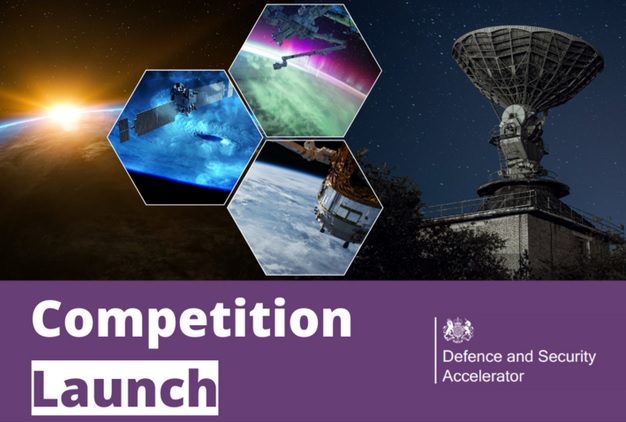
Image courtesy DASA
Contracts worth up to £400,000 are now available for innovations that enhance intelligence, surveillance and reconnaissance in the space domain.
Submit a proposal: Bravo Drop
The Bravo Drop of the Space to Innovate Campaign is now open for proposals. This Drop focuses on solving two challenge sets:

Challenge 1: Novel sensing and Intelligence, Surveillance & Reconnaissance (ISR) technologies
This challenge seeks to develop technologies and demonstrations of novel sensing modes for the space domain for military and intelligence applications; both space-to-ground and space-to-space. Novel modes in this context could include, but are not limited to:
- non-traditional space sensing bands (e.g. ultraviolet)
- gravimetric imaging of the space environment
- sparse aperture imaging technologies and processing
- use of novel materials (e.g. meta-materials or graphene) for space sensing applications
DASA are looking to develop enabling technologies for future sensing satellites. These could include:
- large aperture (optical and Radio Frequency) deployment and development
- precision timing technologies
- technologies for increasing satellite agility and pointing accuracy for military requirements
- improved assurance of ISR satellites
- technologies to improve data flow (tasking, collection, processing, exploitation and dissemination)
Challenge 2: Novel approaches to significantly improve signal-to-noise performance of space-related communications, sensing, identification or tracking capabilities for use in Defence and/or Security applications.
This challenge seeks to identify novel technologies, techniques, processes or algorithms that offer improvements to the overall signal-to-noise characteristics of electromagnetic systems used for Defence and/or Security space domain applications.
DASA is interested in such methods for enhancing the performance of systems such as electro-optical, infra-red or radio frequency systems for communications, Earth Observation or space domain awareness (SDA) applications. Areas for consideration may include (as examples, but are not limited to) the following areas:
- novel technologies to support, or be applied to, either ground-based or on-orbit capabilities: these could apply to space-to-space, ground-to-space and / or space-to-ground segments
- exploration of novel signal processing algorithms and techniques to acquire (and exploit) improved signal response or a reduction in noise performance
- novel hardware and / or software technologies and processes to enhance signal detection and / or data collection performance of imaging, sensing or communications
- exploration of novel radio frequency (RF) systems to detect, monitor or communicate with space objects in any / all orbital regimes
Bravo Drop: Key dates and funding available
The Bravo Drop is now open for proposals until 9th November 2021. The value of funded contracts will vary from £125k to £400k, with durations of 6, 12 or 18 months. Bravo Drop projects are expected to reach TRL 3-6 at the end of the contract. DASA expects to fund up to 5 projects within this drop. The total amount of funding available for the Alpha and Bravo Drops is expected to be £2m.
What is the Space to Innovate Campaign?
The Space to Innovate Campaign seeks proposals that can maintain the UK’s freedom of action in the space domain by developing future space technologies that enhance and protect space military and civil potential.
The campaign format is unique from other DASA competitions and comprises space-related challenges that will be released in “drops” throughout 2021 and 2022. The Bravo Drop follows the output of the Alpha Drop, which focused on space visualisation and Space Situational Awareness, and builds on new areas of innovation.
What are the benefits of the DASA campaign and Drop format?
This campaign approach enables greater variation of contract values and durations to be issued by DASA, which provides larger and longer contracts for more mature technologies, whilst also enabling less mature innovations to be explored.
The campaign and drop concept enables a cycle of innovative ideas to be contracted as well as maturing existing technologies to a higher level. It also encourages proposals from a range of innovators, start-ups to established companies to universities – all ideas are welcome.
For more information, and to submit you proposal ahead of the 9th November deadline
, click
here
.