Leonardo contracts next stage of Tempest FTA
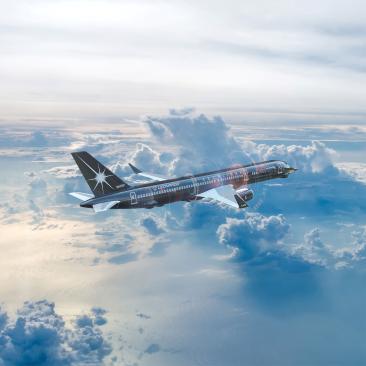
Image courtesy Leonardo
The programme will see the partners completely overhaul a commercial airliner, turning it into a flying laboratory for combat air technology. On-board, scientists and engineers will test futuristic sensors and communications for the Future Combat Air System that the UK and its international partners are developing to fly into service in 2035.

Named ‘Excalibur’ after the legendary sword of King Arthur, the aircraft is being modified to supplement the transformational ‘digital-first’ approach the Team Tempest partners are taking with regard to the testing and evaluation of Tempest’s next-generation electronics. Excalibur will provide the real-world environment necessary for the latter stages of development of the complex, integrated sensors, non-kinetic effects and communications Leonardo is developing. Excalibur will be available to the international partners to de-risk technology being developed for the Future Combat Air System and the aircraft could also be used to complement the development of uncrewed technology, including acting as a control hub for uncrewed platforms undergoing test.
This latest contract builds on two years of work by Leonardo and 2Excel on the FTA concept and design phase. That phase saw the partners evaluate the suitability of a commercial airliner as a testbed and digitally model some of the proposed modifications, including significant changes to the nose section. The new contract covers preparatory work on the real aircraft procured by 2Excel and will allow development work to continue at-pace.
Leonardo, a founding member of Team Tempest, is the lead for integrated sensing and non-kinetic effects as well as its integrated communication system. The company has successfully worked with 2Excel for many years, employing the aviation specialist’s philosophy of ‘doing difficult things well’ to test-fly advanced electronics such as radar and electronic warfare equipment. That close working relationship has allowed Leonardo and 2Excel to progress the FTA in line with the more agile, transformational approach of the broader programme, which aims to cut by half the cost and time needed to build a combat aircraft.
In addition to its primary role, acting as a testbed for equipment and significantly de-risking the programme, Excalibur is also expected to see use under other UK and international flight test programmes.
The FTA concept and design phase proposed the initial outline design solutions for Excalibur, incorporating Leonardo’s requirements for the placement of sensors and supporting equipment both internally and externally on the aircraft.
The activity considered the size, weight and power requirements of the high-tech technology which would fly on Excalibur and identified appropriate locations and the provision of necessary services e.g. power, cooling, racking, observer stations, computing and data recording.
Candidate external modifications, including a significantly modified nose section, have been modelled to allow analysis of the aerodynamic and structural impact on the aircraft whilst meeting the Leonardo equipment installation requirements.
Over the next 12 months, more detailed design activities will continue on the installation of Tempest equipment and detailing the flight test schedule. Leonardo and 2Excel will survey, inspect and confirm the proposed installation solutions. In addition, Excalibur will have a significant fit of equipment under test, including a ‘representative cockpit’ in the passenger cabin. Flight test instrumentation will be fitted in advance of baseline flight tests required for future certification of the modified aircraft.
Excalibur has already been procured by 2Excel and they are preparing the aircraft for modification at the company’s large aircraft engineering facilities at Lasham, Hampshire. The existing aircraft can carry a payload of 28 tonnes (or over 14.5 tonnes when full of fuel) at 42,000 feet at up to Mach 0.86, cruising at 0.8 Mach. Its range carrying a full payload is 3,900 nm and it can fly for eight hours.