

NASA launches SPHEREx and PUNCH missions


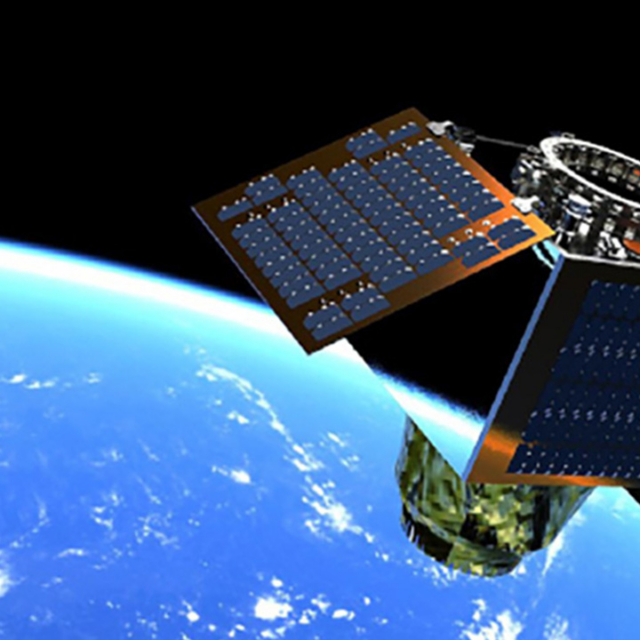
Above: NASA’s SPHEREx Observatory successfully launched with a BAE Systems-built spacecraft bus and telescope from Vandenberg Space Force Base in California.
Credit: NASA
NASA’s newest astrophysics observatory, SPHEREx, is on its way to study the origins of our universe and the history of galaxies and to search for the ingredients of life in our galaxy. Short for Spectro-Photometer for the History of the Universe, Epoch of Reionization and Ices Explorer, SPHEREx lifted off at 8:10 p.m. PDT on March 11 aboard a SpaceX Falcon 9 rocket from Space Launch Complex 4 East at Vandenberg Space Force Base in California.
Riding with SPHEREx aboard the Falcon 9 were four small satellites that make up the agency’s PUNCH (Polarimeter to Unify the Corona and Heliosphere) mission, which will study how the Sun’s outer atmosphere becomes the solar wind.
“Everything in NASA science is interconnected, and sending both SPHEREx and PUNCH up on a single rocket doubles the opportunities to do incredible science in space,” said Nicky Fox, associate administrator, Science Mission Directorate at NASA Headquarters in Washington. “Congratulations to both mission teams as they explore the cosmos from far-out galaxies to our neighborhood star. I am excited to see the data returned in the years to come.”
Ground controllers at NASA’s Jet Propulsion Laboratory in Southern California, which manages SPHEREx, established communications with the space observatory at 9:31 p.m. PDT. The observatory will begin its two-year prime mission after a roughly one-month checkout period, during which engineers and scientists will make sure the spacecraft is working properly.
“The fact our amazing SPHEREx team kept this mission on track even as the Southern California wildfires swept through our community is a testament to their remarkable commitment to deepening humanity’s understanding of our universe,” said Laurie Leshin, director, NASA JPL. “We now eagerly await the scientific breakthroughs from SPHEREx’s all-sky survey — including insights into how the universe began and where the ingredients of life reside.”
The PUNCH satellites successfully separated about 53 minutes after launch, and ground controllers have established communication with all four PUNCH spacecraft. Now, PUNCH begins a 90-day commissioning period where the four satellites will enter the correct orbital formation, and the instruments will be calibrated as a single ‘virtual instrument’ before the scientists start to analyse images of the solar wind.
The two missions are designed to operate in a low Earth, Sun-synchronous orbit over the day-night line (also known as the terminator) so the Sun always remains in the same position relative to the spacecraft. This is essential for SPHEREx to keep its telescope shielded from the Sun’s light and heat (both would inhibit its observations) and for PUNCH to have a clear view in all directions around the Sun.
To achieve its wide-ranging science goals, SPHEREx will create a 3D map of the entire celestial sky every six months, providing a wide perspective to complement the work of space telescopes that observe smaller sections of the sky in more detail, such as NASA’s James Webb Space Telescope and Hubble Space Telescope.
The mission will use a technique called spectroscopy to measure the distance to 450 million galaxies in the nearby universe. Their large-scale distribution was subtly influenced by an event that took place almost 14 billion years ago known as inflation, which caused the universe to expand in size a trillion-trillionfold in a fraction of a second after the big bang. The mission also will measure the total collective glow of all the galaxies in the universe, providing new insights about how galaxies have formed and evolved over cosmic time.
Spectroscopy also can reveal the composition of cosmic objects, and SPHEREx will survey our home galaxy for hidden reservoirs of frozen water ice and other molecules, like carbon dioxide, that are essential to life as we know it.
“Questions like ‘How did we get here?’ and ‘Are we alone?’ have been asked by humans for all of history,” said James Fanson, SPHEREx project manager at JPL. “I think it’s incredible that we are alive at a time when we have the scientific tools to actually start to answer them.”
NASA’s PUNCH will make global, 3D observations of the inner solar system and the Sun’s outer atmosphere, the corona, to learn how its mass and energy become the solar wind, a stream of charged particles blowing outward from the Sun in all directions. The mission will explore the formation and evolution of space weather events such as coronal mass ejections, which can create storms of energetic particle radiation that can endanger spacecraft and astronauts.
“The space between planets is not an empty void. It’s full of turbulent solar wind that washes over Earth,” said Craig DeForest, the mission’s principal investigator, at the Southwest Research Institute. “The PUNCH mission is designed to answer basic questions about how stars like our Sun produce stellar winds, and how they give rise to dangerous space weather events right here on Earth.”
BAE Systems-built spacecraft bus and telescope
BAE Systems built the spacecraft bus and telescope for the mission, along with leading observatory integration and environmental testing. SPHEREx is also equipped with the company’s RAD750 single board computer, the core of the command and data handling subsystem that is used to control the spacecraft and transmit data.
Bonnie Patterson, deputy vice president and general manager of Civil Space for BAE Systems Space & Mission Systems, said: "The launch of SPHEREx is a remarkable achievement. This observatory will help us look back in time to answer significant questions about how the universe formed and the phenomena that continue to evolve it today. We are proud to be part of the team that made this mission possible."
In addition to its primary missions, SPHEREx will also identify targets of interest for additional observations by the James Webb Space Telescope and other observatories. BAE Systems assisted in launch operations and will continue to support spacecraft commissioning over the coming months. NASA’s Jet Propulsion Laboratory, which manages the mission and the California Institute of Technology (Caltech) developed the primary imaging payload. Caltech’s Dr Jamie Bock is the mission’s principal investigator.
SPHEREx continues BAE Systems’ long support of NASA’s astrophysics missions, including contributions to the Hubble Space Telescope, Chandra X-Ray Observatory, James Webb Space Telescope, and the Nancy Grace Roman Space Telescope. The company is also working to mature technologies for NASA’s future Habitable Worlds Observatory.
Sign up for our newsletter and get our latest content in your inbox.
Similar Reads


Sign up for our newsletter. Select all sectors relevant to you.
Related