
General Atomics

NMIS reveals cold spray solution for copper rocket nozzle manufacturing

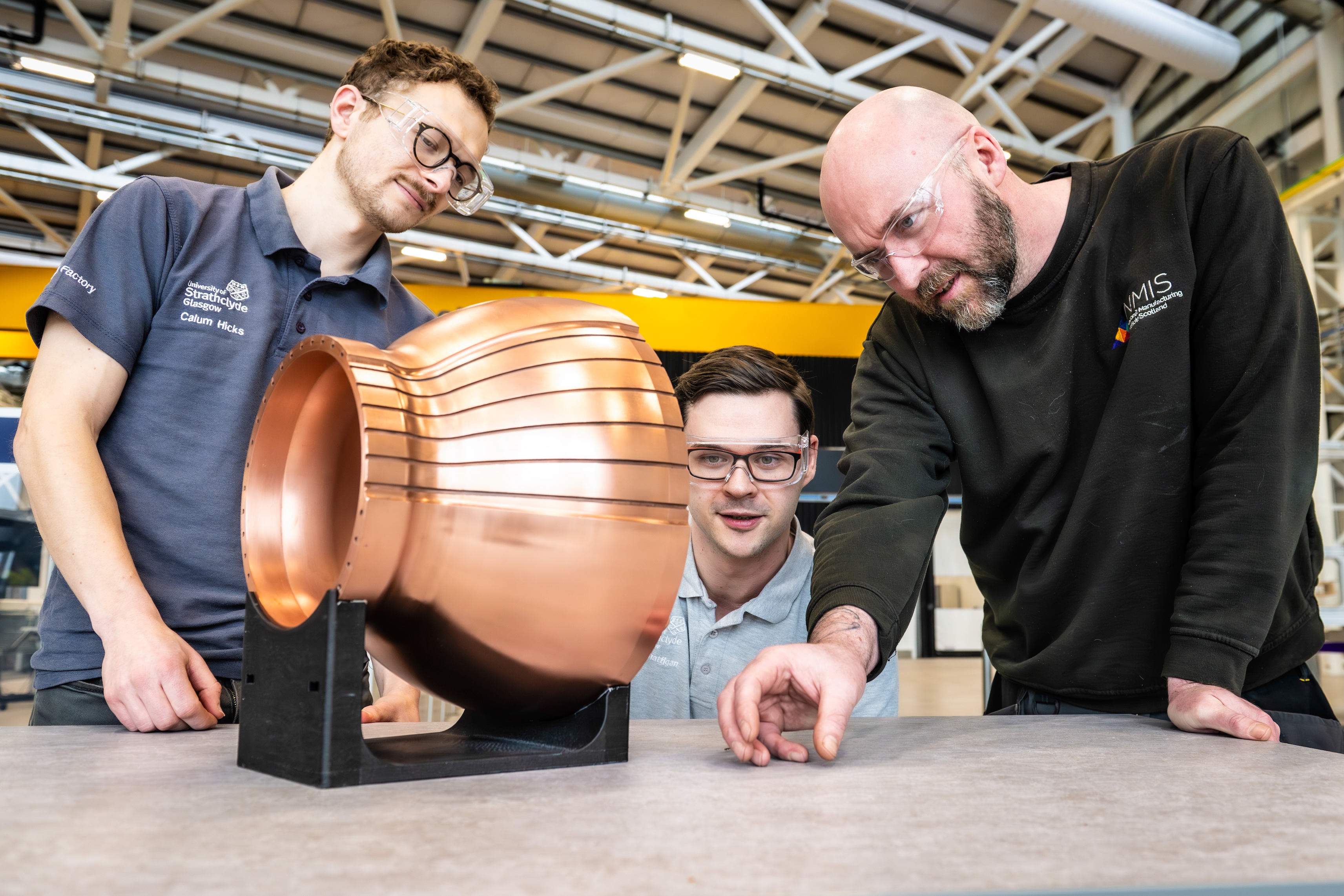
Engineers at the National Manufacturing Institute Scotland (NMIS) have developed a copper rocket nozzle manufacturing route using high-pressure cold spray, showcasing the technology’s potential as a large-scale, rapid additive manufacturing solution for efficiently producing high-performance components.


Image courtesy NMIS

The project explored a new way to manufacture large copper structures with intricate cooling channels – one of the long-standing challenges in rocket engine production. Rocket combustion chambers and nozzles are among the most critical components in spacecraft systems, operating in extreme environments where temperatures exceed the melting point of the structural materials. These conditions place significant demands on manufacturing methods to produce the challenging geometries, whilst retaining the stringent material performance and cost efficiency. 

Traditional production routes are typically slow and labour-intensive, often requiring multiple fabrication stages and extensive machining. Although additive manufacturing approaches such as Powder Bed Fusion (PBF) offer increased design freedom, they are constrained by build size, limiting their suitability for large components. Electroplating is also commonly used to manufacture copper rocket nozzles, but long production lead times remain a significant challenge at the scales required. As a result, production can take several months, with high costs and limited flexibility to adapt or scale designs.

Copper presents an additional challenge. Its thermal and mechanical properties, combined with its highly reflective nature, make it difficult to process using conventional additive manufacturing techniques. This has historically restricted the production of advanced geometries, particularly the complex internal cooling features that are critical to rocket nozzle performance.

To overcome these limitations, engineers at NMIS developed a hybrid manufacturing approach centred on high-pressure cold spray technology. This high rate additive process deposits copper in a solid state, avoiding melting and significantly reducing the risk of thermal distortion or material degradation associated with traditional welding methods.

Using this approach, the main nozzle structure was built up layer by layer through rapid material deposition. The process supports large-scale production while maintaining fine geometric detail, enabling complex internal features to be integrated efficiently within the structure.

The rocket nozzle highlights the potential of high-pressure cold spray to transform how large copper parts are manufactured. With deposition rates of up to 10kg per hour, the process could cut production lead times from months to days, while significantly reducing material waste compared with conventional machining.

While developed for space application, the implications extend far beyond its immediate use. The approach offers a scalable manufacturing route for high-value sectors including aerospace, energy and shipbuilding, where robust and corrosion-resistant materials are critical. The technology can also be applied to repair and remanufacture existing components, extending asset life and supporting more sustainable manufacturing practices. 

Although the method is yet to be validated through full rocket engine testing, the copper rocket nozzle provides clear evidence that large-scale, high-performance copper components can be successfully produced using high-pressure cold spray. As manufacturers seek faster, more adaptable and cost-effective production methods, the technology has growing potential to move from niche application into wider industry use. 

Calum Hicks, senior technologist at the Digital Factory, NMIS, said: “This project marks an important milestone in demonstrating how advanced manufacturing can be applied to complex rocket engine components. Developing the copper rock nozzle allowed us to explore new approaches to producing high performing thermal management structures, reducing development times and improving production efficiency. This work strengthens the UK’s capabilities in the space sector and beyond.”

Ryan Devine, senior research and development engineer at NMIS, said: “The real value of this work is in showing how advanced manufacturing can move beyond experimentation into practical application. By combining engineering expertise with innovative processes such as high-pressure cold spray, we’re enabling manufacturers to rethink how complex components are designed, produced and maintained. Taking these steps allows us to support faster development cycles and more resilient manufacturing systems.”

Related

TT Electronics deepens aerospace and defence ties with Rolls-Royce and MBDA Italia
TT Electronics expands partership with Rolls-Royce
TT Electronics deepens aerospace and defence ties with Rolls-Royce and MBDA Italia
A lifetime Rolls-Royce agreement and a new Letter of Intent with MBDA Italia are putting TT Electronics deeper into the systems that power civil aircraft and defence platforms.
Luton Airport becomes first UK airport to install emergency anaphylaxis kits
Luton Airport rolls out life-saving Allergy Kitts
Luton Airport becomes first UK airport to install emergency anaphylaxis kits
The rollout places anaphylaxis treatment points in key passenger areas, including security, departures and baggage reclaim.
Aerospace

21 Aug 2026

Brace for turbulence as the Met Office predicts the strongest El Niño in living memory
The turbulent North Atlantic, NASA
Brace for turbulence as the Met Office predicts the strongest El Niño in living memory
As the Met Office forecasts the strongest El Niño in living memory, here's what it could mean for flight operations.
Aerospace

21 Aug 2026

TT Electronics deepens aerospace and defence ties with Rolls-Royce and MBDA Italia
TT Electronics expands partership with Rolls-Royce
TT Electronics deepens aerospace and defence ties with Rolls-Royce and MBDA Italia
A lifetime Rolls-Royce agreement and a new Letter of Intent with MBDA Italia are putting TT Electronics deeper into the systems that power civil aircraft and defence platforms.
UK MoD interest could see Vertical’s hybrid defence aircraft in service before Valo
Vertical aerospace vx4 Transition Test Flight
UK MoD interest could see Vertical’s hybrid defence aircraft in service before Valo
Vertical Aerospace could reverse its development order and deliver a hybrid military aircraft before the electric Valo if defence demand intensifies.
Aerospace Defence

21 Aug 2026

UK defence jobs jump by 26,000 as MoD spending supports 274,000 workers
Ministry of Defence spending with UK industry now supports one in every 100 jobs, according to new figures.
Defence Security

21 Aug 2026

Austrian ENPULSION moves to acquire UK space propulsion specialist Lift Me Off
Enpulsion space propulsion manufacturer buys UK company lift me off
Austrian ENPULSION moves to acquire UK space propulsion specialist Lift Me Off
Austrian spacecraft propulsion manufacturer ENPULSION has agreed to acquire British specialist Lift Me Off, bringing together electric and chemical propulsion capabilities in a deal that will require UK Government approval.
Member News Space

21 Aug 2026

Lanarkshire AI Growth Zone gains £300m investment as Dell establishes Scottish base
Lanarkshire’s AI Innovation Park
Lanarkshire AI Growth Zone gains £300m investment as Dell establishes Scottish base
A £202 million guarantee from the UK National Wealth Fund has attracted an investment of £300 million in Lanarkshire's AI Growth Zone, which with Dell Technologies establishing a base there too, is set to support over 3,400 skilled jobs.
UK satellite funding targets connectivity ‘not-spots’ for farmers and remote railways
Young farmer works with a digital tablet in a wheat field, smart farm and quality control
UK satellite funding targets connectivity ‘not-spots’ for farmers and remote railways
British farmers and passengers travelling through remote parts of Scotland could gain better connectivity through a new £13 million package backing 16 UK satellite communications projects.
Space

18 Aug 2026

UK defence jobs jump by 26,000 as MoD spending supports 274,000 workers
Ministry of Defence spending with UK industry now supports one in every 100 jobs, according to new figures.
Defence Security

21 Aug 2026

Darktrace among first cybersecurity firms selected to integrate risk signals into Microsoft Agent 365
Using laptop and mobile phone
Darktrace among first cybersecurity firms selected to integrate risk signals into Microsoft Agent 365
The integration will bring Darktrace's behavioural risk signals into Microsoft Agent 365, enabling customers to view organisation-specific insights alongside Microsoft signals in a single interface.
Security

20 Aug 2026

Lanarkshire AI Growth Zone gains £300m investment as Dell establishes Scottish base
Lanarkshire’s AI Innovation Park
Lanarkshire AI Growth Zone gains £300m investment as Dell establishes Scottish base
A £202 million guarantee from the UK National Wealth Fund has attracted an investment of £300 million in Lanarkshire's AI Growth Zone, which with Dell Technologies establishing a base there too, is set to support over 3,400 skilled jobs.