Poseidon conducts first torpedo test
At just under 3m long and 32cm in diameter, the Mk 54 torpedo is small and light enough that five can be carried in the Poseidon’s internal weapons bay. The high-explosive warheads on the live torpedoes pack a devastating punch sufficient to destroy enemy submarines that the Poseidon crew can locate and track using state-of-the-art equipment.

The successful release of a torpedo is the latest milestone in the rapid development of the Poseidon in RAF service.
It is the first time the American-built aircraft – a militarised version of Boeing’s 737/800 airliner – has tested its primary weapon system.
As Poseidon is of US stock, she drops the Mk54, rather than the UK’s standard lightweight torpedo Sting Ray (used extensively by the Fleet Air Arm and Royal Navy surface fleet).
It is 9ft long, a little over 12in in diameter and races through the water at speeds in excess of 40 knots, delivering a blow of 108kg TNT to its target.
However it was not on this occasion. The ZP805 – known as Fulmar in a nod to Lossiemouth’s 26-year spell as a Fleet Air Arm base, HMS Fulmar – launched a REXTORP: Recovering Exercise TORPedo.
With no propulsion and no warhead, it landed safely in the water and floated there until it was recovered.
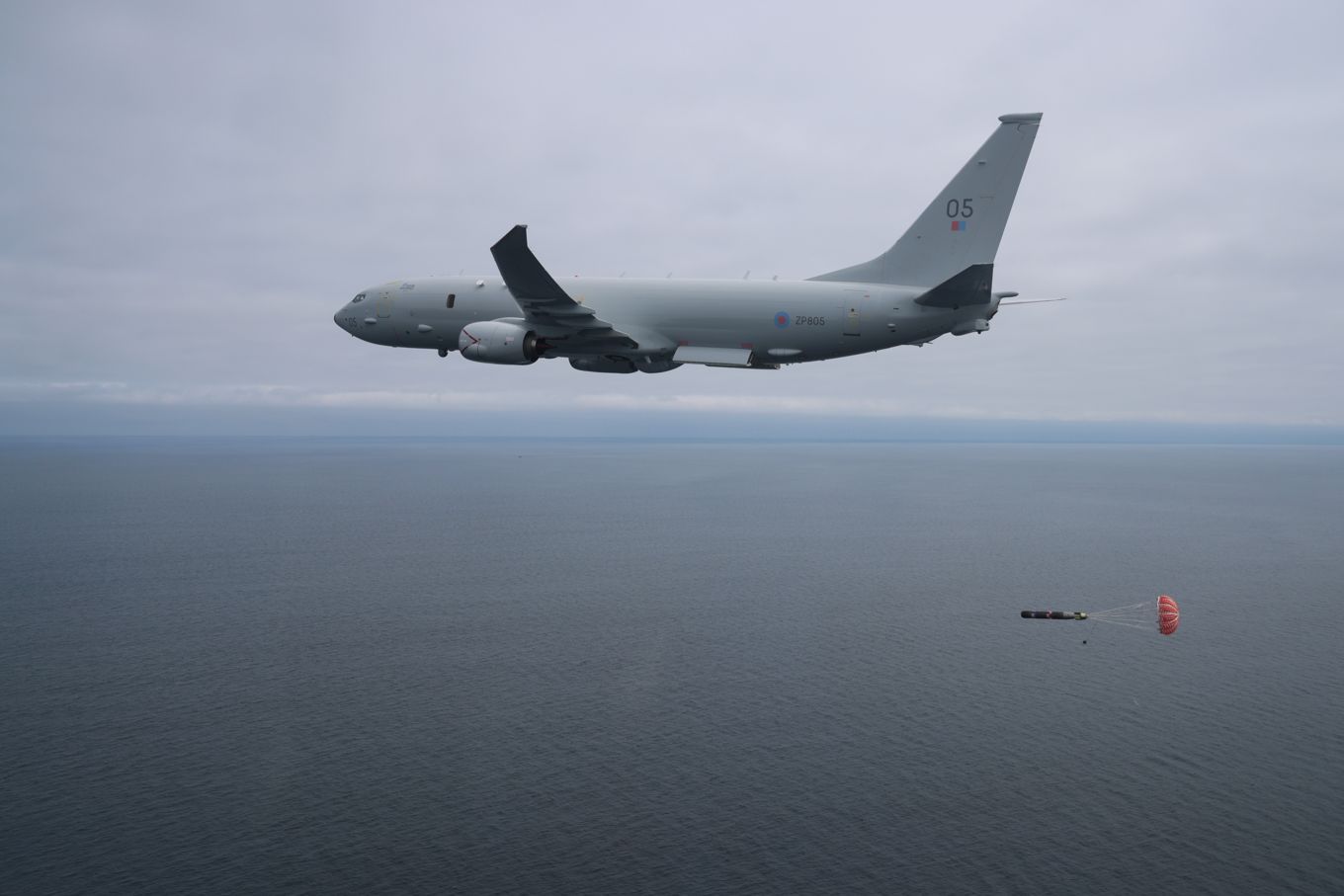
Above:
Poseidon in flight dropping torpedo.
Courtesy RAF
Wing Commander James Hanson was at the controls of Fulmar for the drop and hailed it as a “major milestone in the Poseidon programme”.
He continued: “This event was very significant for the anti-submarine warfare capability of the UK, proving the lethality of Poseidon.
“On the whole, we are going from strength to strength here at Lossiemouth, working with our partners in the Royal Navy and across NATO.”
Poseidon is just one layer of the defensive ring around the Royal Navy’s V-boat fleet, which also includes Merlin Mk2 helicopters from Culdrose, Type 23 submarine-hunting frigates from Portsmouth and Plymouth and A and T-boat hunter-killers beneath the waves.
By the end of the year, the Poseidon fleet at Lossiemouth will be complete with the delivery of the final four aircraft.
Although owned and flown by the RAF, the Poseidons are a strategic asset given their mission, with RN personnel among the crew.
RAF 120 Squadron Leader Dave Higgins, Torpedo Project lead, said: “It’s been a great privilege to witness the hard work of so many talented individuals across the Royal Air Force, civil service and industry partners come together to enable us to launch and recover this torpedo.
"This exercise has proved everything is in place for our weapon technicians to rapidly get these torpedoes onto our aircraft, so we can deliver them wherever and whenever they are needed.”
Five Poseidon MRA1s are based at RAF Lossiemouth with a further four set to be delivered by the end of this year. The station, which is situated in close proximity to one of the aircraft’s most frequent area of operations, is benefitting from a multi-million pound investment programme bringing significant economic benefits to the Highlands & Islands and Morayshire communities.
The Poseidon is fitted with advanced, state-of-the-art, Anti-Submarine Warfare and Anti-Surface Warfare sensors which will provide global protection to UK, NATO and our Allies’ submarines and warships in an increasingly dangerous world.