Research shows effective crew resource management vital to police air support
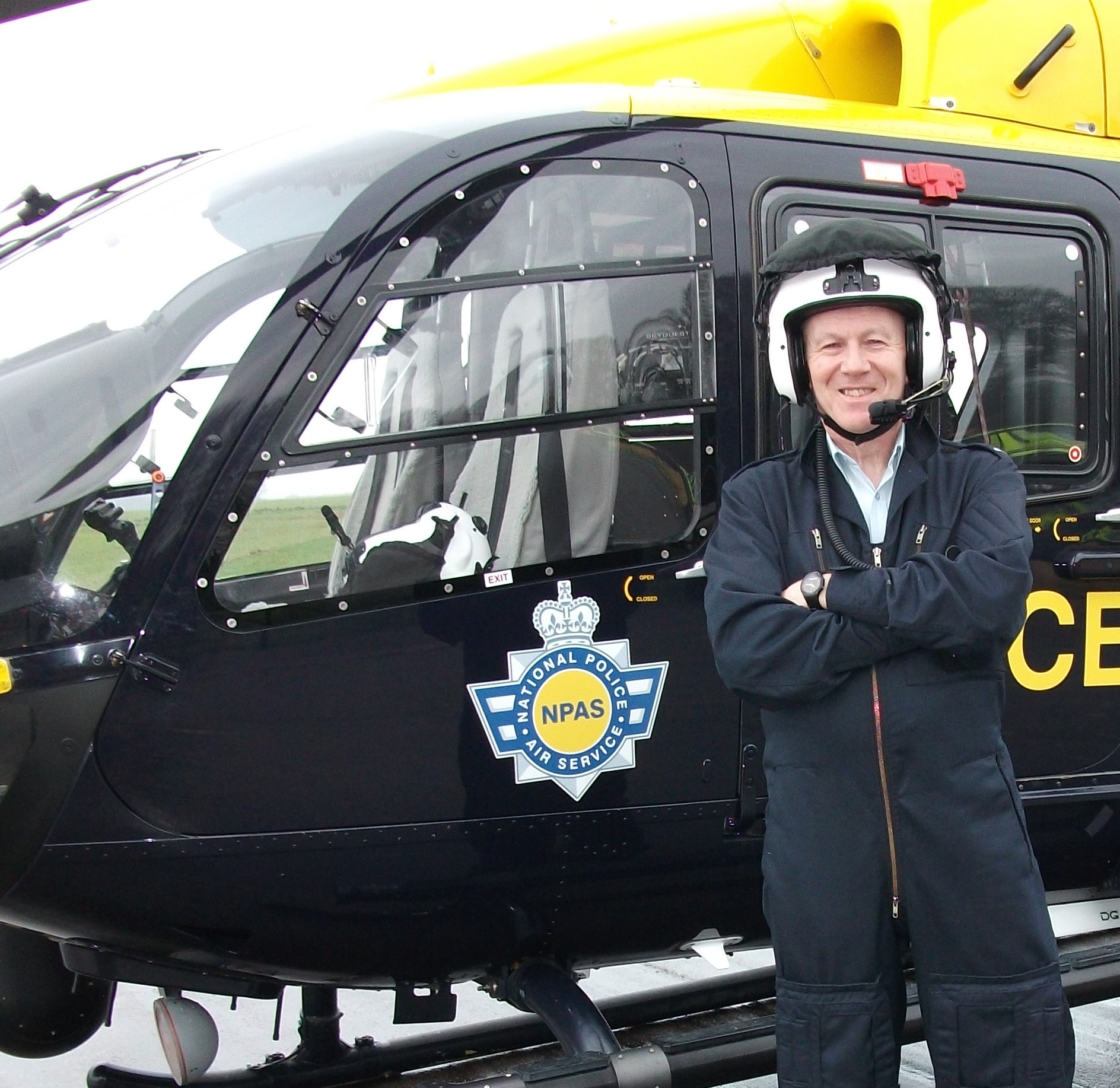
Above:
Dr Simon Bennett, pictured here at NPAS’ base at Husband’s Bosworth (Leicestershire, UK), accompanied police air crews for more than two years to assess operational safety and efficiency.
Image courtesy Simon Bennett / University of Leicester
Dr Simon Bennett, Director of the Civil Safety and Security Unit at the University of Leicester, accompanied crews from the National Police Air Service (NPAS) for more than two years to assess operational safety and efficiency.

NPAS operates 19 helicopters and four fixed-wing aircraft in support of 46 individual police forces across the UK.
Through interviews with pilots, tactical flight officers (TFOs) and support staff, plus first-hand experience of the challenges that crews face on operations, Dr Bennett has produced an in-depth analysis of NPAS operations and their successful use of crew resource management (CRM).
CRM is a series of training procedures proposed in the late 1970s, primarily for improving aviation safety. Techniques can also be applied to other environments where the possibility for human error is likely to have devastating effects.
One such episode analysed as part of the research involved a harrowing incident in North London, where a man decapitated a pensioner and threatened the helicopter crew before heading towards a group of children. The crew used CRM techniques both during the incident and once the man was taken into custody to preserve the safety of the aircraft, mission and people on the ground.
The CRM framework has been applied to NPAS training and operations for many years but Dr Bennett’s project was the first time the organisation’s application of CRM techniques has been studied sociologically, specifically through in-vivo ethnographic research. He said: “I interviewed one of the TFOs who had witnessed the Edmonton beheading. His testimony confirmed that CRM improves safety margins and helps flight crew land their aircraft safely, even in challenging circumstances.
“Had the three Edmonton crewmembers not been able to fall back on the skills they acquired during CRM training, it is possible that, with crewmembers distracted and emotional, the aircraft might have been lost and persons on the ground killed or injured. This episode proves CRM works.
“Rarely has the theory of CRM faced a stiffer test. These findings validate every claim made about CRM.”
Further findings and recommendations made by the report include:
- that the NPAS achieves much on an inadequate budget
- that pilots and TFOs are able, through creative thinking, to develop effective work-arounds. For example, when downlinking fails, relaying messages to ground units via the NPAS HQ in Wakefield
- that the NPAS could do more with larger, more capable helicopters, equipped with better, more reliable sensors and communications
- that operating a helicopter with just one TFO plus pilot creates more latent errors (accidents waiting to happen) than with two TFOs
- that widening the constituency for CRM training and ensuring that force officers understand the NPAS tactical air support offering would improve operational safety and efficiency
- that the co-training of pilots and TFOs in CRM improves teamwork and resilience and, therefore, operational safety and efficiency.
Dr Bennett has published a summary of his NPAS study with the Royal Aeronautical Society. He is also an Associate Member of the RAeS Flight Operations Group.