Advancing UK Aerospace, Defence, Security & Space Solutions Worldwide
  • Home
  • /
  • Aerospace
  • /
  • Rolls-Royce conducts first tests of 100% SAF for business jets

Aerospace

Rolls-Royce conducts first tests of 100% SAF for business jets
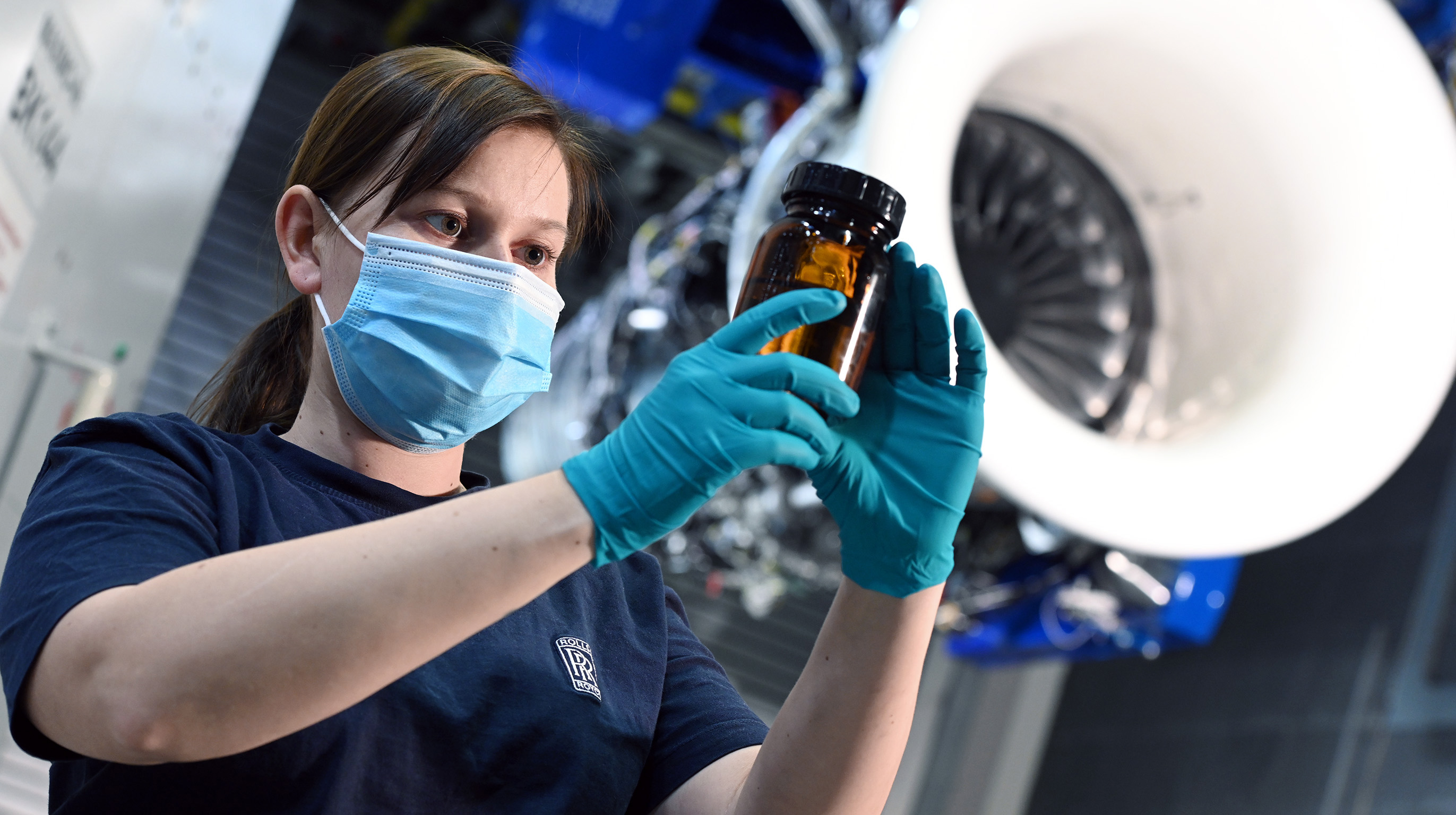
Rolls-Royce has conducted the first tests of 100% Sustainable Aviation Fuel (SAF) in a business jet engine, as part of its ongoing ambition to play a leading role in enabling the sectors in which it operates, reach net zero carbon by 2050.

Image courtesy Rolls-Royce

The tests on itslatest business aviation engine in development, the Pearl 700, in Dahlewitz, Germany, come just weeks after unblended SAF was successfully used for the first time in engine ground tests on a Trent 1000 engine in Derby, UK.

This test demonstrates once again that Rolls-Royce's current engines for large civil and business jet applications can operate with 100% SAF as a full 'drop-in' option, laying the groundwork for moving this type of fuel towards certification. At present, SAF is only certified for blends of up to 50% with conventional jet fuel and can be used on all current Rolls-Royce engines.

Advertisement
Security & Policing Rectangle

The SAF that was used in the tests was produced by low-carbon fuel specialist World Energy in Paramount, California, sourced by Shell Aviation and delivered by SkyNRG. This unblended fuel has the potential to reduce net CO2 lifecycle emissions by more than 75% compared to conventional jet fuel, with the possibility of further reductions in future.

Dr Joerg Au, Chief Engineer – Business Aviation and Engineering Director Rolls-Royce Deutschland, said: “Sustainable aviation fuels have the potential to significantly reduce the carbon emissions of our engines and combining this potential with the extraordinary performance of our Pearl engine family brings us another important step closer to enabling our customers to achieve net zero carbon emissions.”

Advertisement
ODU RT

The highly efficient Pearl 700 combines the Advance2 engine core, the most efficient core available across the business aviation sector, with a brand-new low-pressure system, resulting in an 8% increase in take-off thrust at 18,250lb compared to the BR725 engine. The engine offers a 12% better thrust-to-weight ratio and 5% higher efficiency, while maintaining its class-leading low noise and emissions performance.

It brings together innovative technologies derived from the Rolls-Royce Advance2 technology demonstrator programmes with our experience from the Rolls-Royce BR700, today’s leading engine family in business aviation. This includes a highly-efficient 51.8” blisked fan, a high pressure compressor with a market-leading pressure ratio of 24:1 and six blisked stages, an ultralow emissions combustor, a two-stage shroudless high pressure turbine and an enhanced four-stage low pressure turbine that is one of the most efficient and compact in the industry.


Advertisement
Babcock LB Babcock LB
UK hydrogen airport trial sets out roadmap for further studies

Aerospace

UK hydrogen airport trial sets out roadmap for further studies

18 February 2026

A new report into the UK’s first airside trial of multiple hydrogen-powered ground support equipment (GSE) has confirmed that hydrogen can be safely and effectively integrated into airport ground operations, whilst setting out a series of essential next steps needed to accelerate hydrogen adoption and decarbonisation across the aviation sector.

Kent collaborates on Pre-FEED study for Eq.flight SAF demo plant

Aerospace

Kent collaborates on Pre-FEED study for Eq.flight SAF demo plant

18 February 2026

Integrated energy services partner, Kent, has collaborated with Equilibrion during a successful bid for funding from the UK Department for Transport’s Advanced Fuels Fund (AFF) and with that funding for Equilibrion and its partners, Kent is delivering the Pre-Front-End Engineering Design (Pre-FEED) for Eq.flight, an advanced power-to-liquids ...

TEKEVER launches UAS Training School at West Wales Airport

Aerospace

TEKEVER launches UAS Training School at West Wales Airport

18 February 2026

Today, provider of AI-centred uncrewed aerial systems, TEKEVER, has announced the official opening of its new Training School at West Wales Airport.

UK

Aerospace

UK's January air traffic soars into 2026

17 February 2026

January’s UK air traffic increased by 1,725 flights in 2026 versus the previous year, equivalent to a 1% uptick in flights flying in UK airspace.

Advertisement
PTC rectangle
Responsive Engineering unveils apprentice-built Welding Academy

Aerospace

Responsive Engineering unveils apprentice-built Welding Academy

17 February 2026

Responsive Engineering, the daughter company of Pearson Engineering, marked National Apprenticeship Week with the unveiling of its new Welding Academy, a unique training space built almost entirely by its apprentices using repurposed and recycled materials.

UK pioneers 3D printing of aircraft parts using recycled titanium

Aerospace Defence

UK pioneers 3D printing of aircraft parts using recycled titanium

17 February 2026

QinetiQ, in partnership with Additive Manufacturing Solutions Limited (AMS Ltd.), has completed the maiden flight of an aircraft containing a 3D printed structural component, made from recycled titanium.

Advertisement
Security & Policing Rectangle
Advertisement
ECS leaderboard banner