Rolls-Royce introduces mtu propulsion concepts for military vehicles
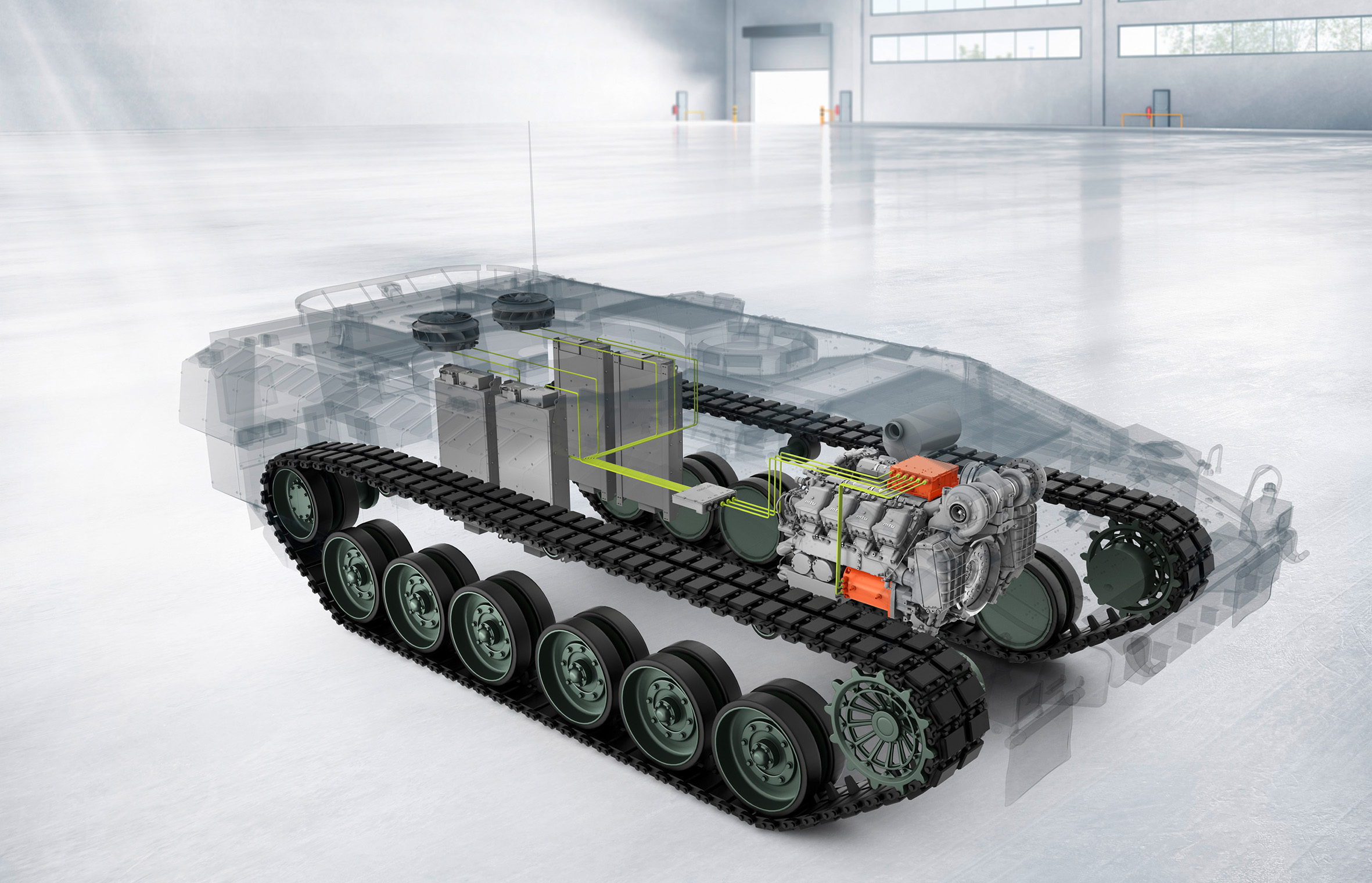
Above: Concept for new 10-cylinder variant of the 199 series with over 1.100 kW output for tanks weighing up to 70 tons.
Courtesy Rolls-Royce / mtu
Both concepts premiered at the Eurosatory defence trade fair in Paris last week. Dr Jörg Stratmann, CEO of Rolls-Royce Power Systems said: "This underlines the importance we attach to our partnership with NATO countries and their allies in safeguarding their security interests. Because cooperation with the security authorities is one of Rolls-Royce's strategic initiatives, we will continue to be a reliable partner as a supplier of propulsion systems for military vehicles with our decades of technological expertise.”

Last year, at its Capital Markets Day, Rolls-Royce highlighted the governmental business within Power Systems as an area of future near-term growth through investment and expanding the scope of its products, including providing more integrated solutions.
Knut Müller, Senior Vice President Global Governmental Business at Rolls-Royce Power Systems said: "Future armoured military land vehicles will require more power for propulsion and on-board power supply for the electronic systems. At the same time, they will be designed for a different tactical approach in the field. Our future mtu propulsion solutions for this application take both of these requirements into account.”
Electrification and hybridisation will give tactical vehicles new capabilities in the field. To this end, Rolls-Royce’s new mtu hybrid drive combines the advantages of a high-performance diesel engine with those of a battery-electric drive. The highly integrated propulsion system requires comparatively little installation space in the vehicle in order to maximise the volume available for equipment and crew. The core of the solution is a highly mobile and extremely compact drive solution, taking into account increasing cost pressure, tight budgets and the need for significantly larger vehicle fleets.
For quiet operation, for example in a concealed position, the high-performance batteries previously charged in diesel mode, supply the vehicle’s electrical and electronic systems. This is done without the noise and thermal footprint of the diesel engine - and over a longer period of time. This makes the vehicle more difficult to locate for enemy reconnaissance. The so-called 'anti-idling' mode not only ensures better camouflage of the vehicle but also significantly reduces fuel consumption when the vehicle is on standby. The range of the vehicles and the downstream logistics chain for refuelling the vehicles are optimised.
The advantages of 'mild' hybridisation are demonstrated by the combined drive on slow journeys, when the vehicle tracks generate little noise. The noise generated by the drive is reduced to a minimum, making it considerably more difficult to detect the vehicle. Rolls-Royce uses a specially developed and customised silencer in combination with the hybrid main propulsion. In combined operation, the electric propulsion also serves as a booster for highly dynamic acceleration, noise-reduced low-speed driving or even high-speed driving. “This allows us to utilise the advantages of hybridisation in all operating modes,” said Müller.
Christian Wolf, Head of Development for Military Engines and Systems at Rolls-Royce Power Systems said: "This propulsion concept will expand the operational possibilities of future tracked armoured vehicles in a way that was previously hardly imaginable. We are convinced that we are making an important contribution to the further development of the defence capabilities of NATO and its allies. For the first time, vehicle manufacturers will be able to realise completely new vehicle concepts, whereby the hybrid concept can in principle be implemented with any engine series from the mtu military propulsion programme.”
10V 199 with over 1.100 kW power
An engine series that has proven itself in the field is getting a new generation. The mtu Series 199 with outputs from 260 to 800 kW is well known in many military land defence programmes and has proven itself in all extreme climatic conditions in more than 15 countries. With the future 10-cylinder variant, the concept of which is being presented at the Eurosatory defence trade fair, the 199 series will cover a power range of up to 1.100 kW and will also be able to power vehicles weighing 50 to 70 tonnes. The logistical uniformity, with identical components within this engine family from the six cylinder to the 10-cylinder variants, will help the armed forces to significantly reduce their logistics costs.
Christian Wolf said: "In the next step, we have set our sights on a further increase in output to 1,200 kW.”
Thanks to the modular design principle of the mtu Series 199 and its compact dimensions, the 10-cylinder engine can be used not only for new vehicles but also for the repowering of existing vehicles. The 10-cylinder version will set new standards in terms of power density, compact design and, above all, already available add-on parts such as hydraulic units, air compressors and generators for power generation. This will significantly simplify vehicle integration into a Powerpack.
The 10-cylinder engine has numerous product features in common with the six and eight cylinder models of the mtu Series 199, which have made the Series 199 the best-selling engine series for military vehicles in its class: high power density with a small design volume; fast response behaviour, configurable according to vehicle requirements, for example with a generator or other add-ons, a wide range of options for power take-offs (so-called PTOs) and low lifecycle costs due to long maintenance intervals.
Knut Müller said: "With this engine, which is based on a commercial basic engine, we are helping to meet the increased requirements for national and alliance defence in a cost-efficient manner.”
The mtu Series 199 has written an unrivalled success story with around 4000 units produced since 2000. The six and eight cylinder variants are used, for example, in the Boxer 8x8 wheeled vehicle, the tracked vehicles based on the ASCOD platform, the Ajax family vehicles, the next generation of US combat vehicles such as the M10 Booker and the Borsuk infantry fighting vehicle.