Rolls-Royce runs UltraFan tech to the max
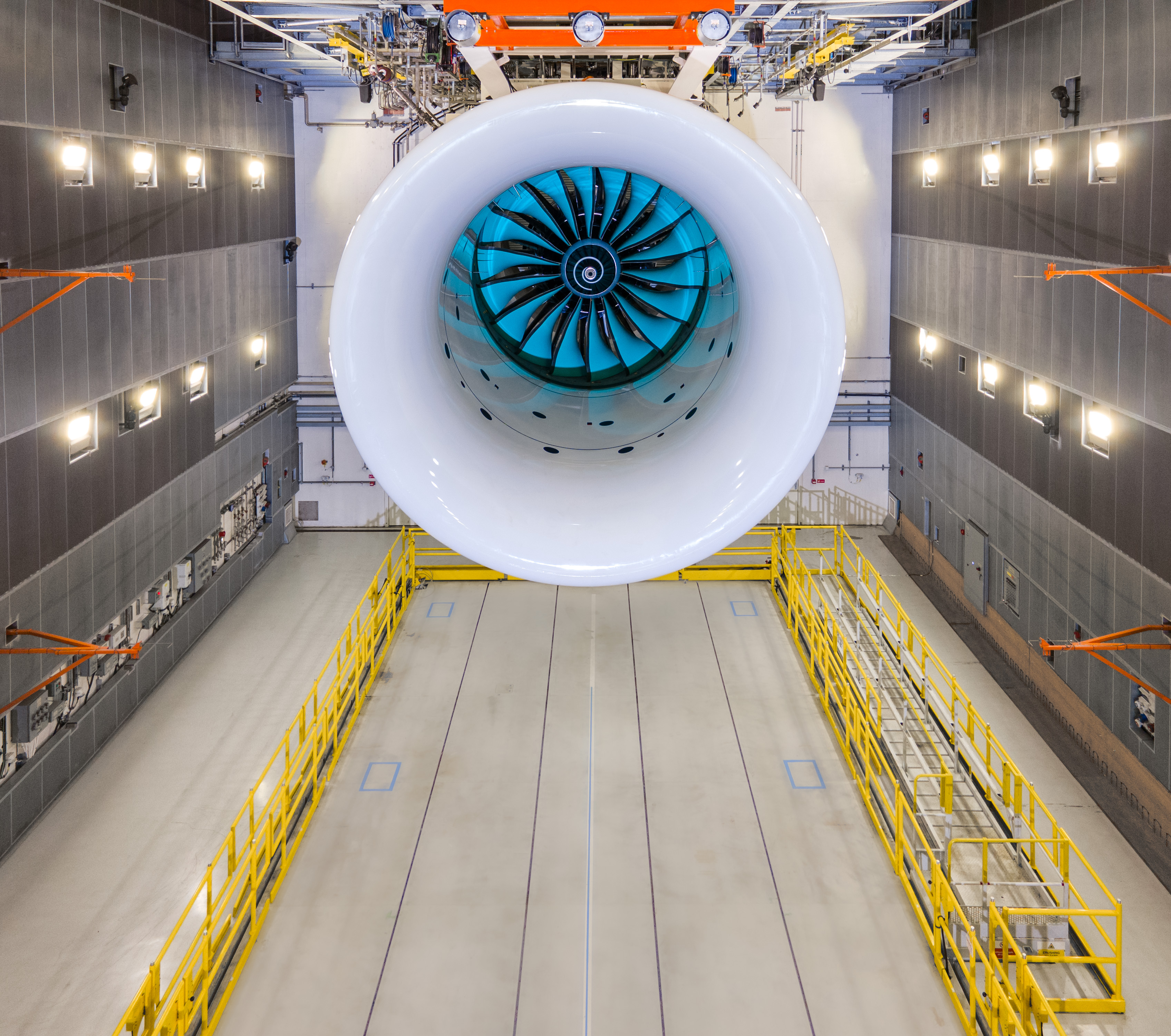
Image copyright Rolls-Royce
The initial stage of the test was conducted using 100% Sustainable Aviation Fuel (SAF).
This is an important milestone for the UltraFan demonstrator, which was successfully tested for the first time earlier this year. Since then, the UltraFan team has been gradually increasing the power as part of the rigorous testing regime and the demonstrator has performed in line with our expectations. The results of the test will provide us with valuable learning and data, which our teams will now take away and continue
to analyse.

This achievement reinforces our confidence in the suite of technologies that has been developed as part of the UltraFan programme. Confirming this capability is a big step towards improving the efficiency of current and future aero-engines as UltraFan delivers a 10% efficiency improvement over our Trent XWB, which is already the world’s most efficient large aero-engine in service. In total that’s a 25% efficiency gain since the launch of the first Trent engine.
UltraFan’s scalable technology from ~25,000-110,000lb thrust also offers the potential to power the new narrowbody and widebody aircraft anticipated in the 2030s.
As part of the UltraFan development programme we have identified a number of technologies that are potentially transferable to our current Trent engines, which will provide our customers with even greater availability, reliability and efficiency.
Tufan Erginbilgic, CEO, Rolls-Royce plc, said: “Hitting full power with our UltraFan demonstrator sends a strong message that Rolls-Royce is at the cutting-edge of innovation and technology, leading the way in the transition to more efficient and sustainable aviation. This fantastic milestone puts us in a strong position to support the plans of our customers as they develop the next generation of super-efficient aircraft.”
Simon Burr, Group Director of Engineering, Technology and Safety, Rolls-Royce plc, added: “We estimate that to reach Net Zero flying by 2050, a combination of highly-efficient, latest-generation gas turbines such as UltraFan operating on 100% SAF are likely to contribute around 80% of the total solution, which is why today’s announcement is such an important milestone for Rolls-Royce and the wider industry.”
The UltraFan demonstrator run to full power took place in the world’s largest and smartest indoor aero-engine testing facility – Testbed 80, in Derby, UK.
Testing the demonstrator is the culmination of many years work, which has been supported by the UK Government through the Aerospace Technology Institute (ATI), Innovate UK; the EU’s Clean Sky programmes plus LuFo and the State of Brandenburg in Germany.
UltraFan has been a decade in the making, with the concept unveiled publicly in 2014. It is a fundamentally different design architecture to that within the approximately 4,200 Rolls-Royce Civil large engines currently in service, as it incorporates a geared design that no other industry player has produced at this size before.
Demonstrating at this scale gives us the flexibility to scale down as required by our customers. It also puts us in the unique position of being able to offer a portfolio of two-shaft, three-shaft, direct drive and geared propulsion solutions to power future aircraft.