Advancing UK Aerospace, Defence, Security & Space Solutions Worldwide
  • Home
  • /
  • Aerospace
  • /
  • Rolls-Royce starts manufacturing world’s largest fan blades

Aerospace

Rolls-Royce starts manufacturing world’s largest fan blades
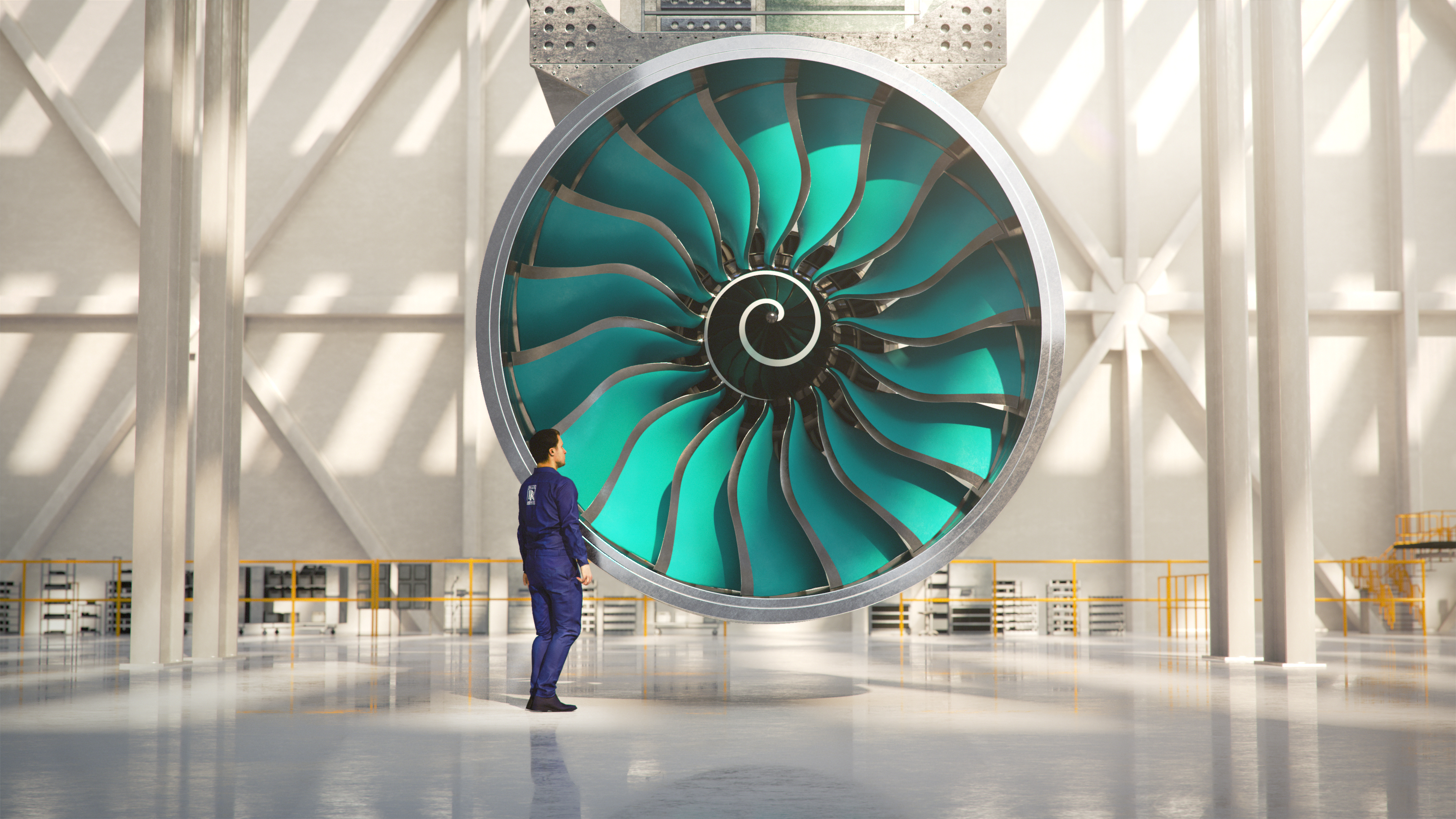
Rolls-Royce has started manufacture of the world’s largest fan blades, for its UltraFan demonstrator engine that will set new standards in efficiency and sustainability.

Above: An artist’s impression of the UltraFan demonstrator.
Courtesy Rolls-Royce

As a set the composite blades have a 140-inch diameter, which is almost the size of a current narrowbody fuselage, and are being made at the company’s technology hub in Bristol, UK. The milestone also marks the official start of production of parts for the demonstrator.

Advertisement
ODU RT

UltraFan will set new standards in efficiency and sustainability, offering a 25% fuel reduction compared to the first generation of Trent engine, and deliver the same percentage reduction in emissions.

Part of that efficiency improvement comes from UltraFan’s composite fan blades and fan case, which reduce weight on a twin-engine aircraft by 700kg, the equivalent of seven people travelling “weight free”.

Chris Cholerton, Rolls-Royce, President – Civil Aerospace, said: “This is the decade of UltraFan and it’s exciting to enter the 2020s with the start of production of the demonstrator engine. We have got all the building blocks in place, the design, the technologies, a brand-new testbed, and now we are actually seeing the engine come together.”

UltraFan, which will start ground tests in 2021 and be available towards the end of this decade, is a scalable design from 25,000lb all the way up to 100,000lb. It also features:

  • A new engine core architecture – to deliver maximum fuel burn efficiency and low emissions
  • Advanced ceramic matrix composites – heat resistant components that operate more effectively in high turbine temperatures
  • A geared design to maximise high-thrust, high-bypass ratio engine efficiency

UltraFan is a key element of Rolls-Royce’s sustainability strategy, which involves continual research to improve gas turbine performance as well as pioneering electrification and working with industrial partners to accelerate the incorporation of Sustainable Aviation Fuels.

Advertisement
Security & Policing Rectangle

It is also part of the Rolls-Royce IntelligentEngine vision, which brings together its products, services and digital technology.

The fan blades are created through the build-up of hundreds of layers of carbon-fibre materials, pre-filled with state-of-the-art, toughness-enhanced, resin material. Heat and pressure are then applied, and each blade is finished with a thin titanium leading edge, which offers extreme protection against erosion, foreign objects and bird strikes.

Composite blades have already been extensively tested on an Advanced Low Pressure System development engine, including in-flight testing on the Rolls-Royce Flying Test Bed.

ALPS is a partnership between Rolls-Royce, Clean Sky, Innovate UK, BEIS, ATI, ITP Aero and GKN. The portfolio of technologies being developed to enable UltraFan is supported by ATI, Innovate UK, LuFo and Clean Sky 2.




Advertisement
Babcock LB Babcock LB
Heathrow boosts 2026 SAF incentive

Aerospace

Heathrow boosts 2026 SAF incentive

23 February 2026

Heathrow is increasing its Sustainable Aviation Fuel (SAF) incentive scheme in 2026, setting a new target going 2% above the UK mandate - aiming for 5.6% SAF uplift in 2026.

Wales to be UK launchpad for advanced autonomous tech

Aerospace Defence Security

Wales to be UK launchpad for advanced autonomous tech

20 February 2026

Thousands of skilled workers in Wales will be involved in the design, testing and manufacture of advanced autonomous technologies and unmanned systems, as a landmark £50 million Defence Growth Deal positions the nation at the forefront of Britain’s defence future.

NPAS increases aircraft available for deployment

Aerospace Security

NPAS increases aircraft available for deployment

19 February 2026

In January this year, the National Police Air Service (NPAS) was able to increase the number of aircraft that were available for operational deployment.

Alloyed secures ATI Programme funding to develop ABD-1000AM

Aerospace

Alloyed secures ATI Programme funding to develop ABD-1000AM

19 February 2026

Developer and manufacturer of advanced metallic components, Alloyed Ltd, has secured funding from the ATI Programme for an ambitious £1 million project to accelerate the development of ABD-1000AM, a next-generation nickel-based superalloy designed for additive manufacturing.

Advertisement
PTC rectangle
Birmingham Airport publishes new sustainability strategy

Aerospace

Birmingham Airport publishes new sustainability strategy

19 February 2026

Birmingham Airport (BHX) has published its new sustainability strategy for 2026 to 2030, outlining the next strategic steps on its journey to becoming a more sustainable and socially responsible business.

UK hydrogen airport trial sets out roadmap for further studies

Aerospace

UK hydrogen airport trial sets out roadmap for further studies

18 February 2026

A new report into the UK’s first airside trial of multiple hydrogen-powered ground support equipment (GSE) has confirmed that hydrogen can be safely and effectively integrated into airport ground operations, whilst setting out a series of essential next steps needed to accelerate hydrogen adoption and decarbonisation across the aviation sector.

Advertisement
PTC rectangle
Advertisement
General Atomics LB