Advancing UK Aerospace, Defence, Security & Space Solutions Worldwide
  • Home
  • /
  • Aerospace
  • /
  • Smiths Detection sees tech as key to airport screening in Covid-19 environment

Aerospace

Smiths Detection sees tech as key to airport screening in Covid-19 environment
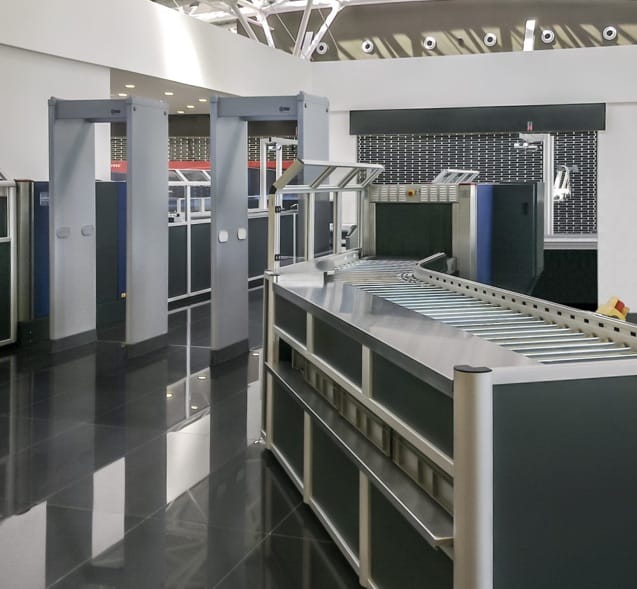
The COVID-19 pandemic has no historic parallels in terms of impact on aviation and the roadmap to recovery is not yet entirely clear but what is clear is that airports will not be able to return to usual operations when restrictions are lifted.

Image courtesy Smiths Detection

The end-to-end airport experience will have to be adapted to accommodate new procedures across luggage check-in, security clearance and boarding. Protecting passengers and airport staff from the transmission of the virus will be paramount, however the safe and effective security screening of passengers can never be compromised.

Advertisement
PTC rectangle

Richard Thompson, Global Market Director Aviation, Smiths Detection has provided insights into the solutions that will enable new health and hygiene standards whilst enhancing security at the checkpoint - a typical bottleneck in the airport journey.

The use of UV-C to disinfect trays
“Smiths Detection recently launched UVC kits which automatically disinfect baggage trays, capable of killing up to 99.9% microorganisms present on the trays as they are transported from the reclaim area back to the divest station. This proven technology has been successfully used for the disinfection of surfaces in industries with high hygiene requirements, such as the food and health sectors, for many years.”

The implementation of CT systems
“Computer tomography (CT) based cabin baggage scanners allow for liquids and laptops to be left inside passenger bags for screening. This means fewer trays need to be touched, reducing contact points and cross-contamination. CT systems also deliver very low false alarm rates, requiring far fewer rechecks by operators.”

Remote screening
“Remote screening, enabled by centralised image processing, allows operators to work in separate rooms, reducing passenger and operator interaction as well as queue times through increased operator efficiency.”

Queue management and people tracking technology
“Queue management strategies and technology can help to identify bottlenecks and prevent passenger build up, by providing real-time data on passenger numbers and flow.” 

AI automation
“Algorithms are readily available to be used at the checkpoint to support security operators’ decision making. AI could also enable alarm-only viewing of x-ray images to create a more seamless passenger flow, reduce unnecessary interaction between operators and passengers and enhance security. The current need for this type of automation could accelerate the regulatory approval for alarm-resolution only inspection.”

Advertisement
ODU RT

Risk-based health screening
“AI and biometrics could be used to gather, combine and analyse comprehensive passenger risk profiles to allow for the more targeted screening of passengers for coronavirus, by identifying passengers with a higher risk - for example, those who have recently been in a location known to have an outbreak.”




Advertisement
ECS leaderboard banner
Cranfield steps up in 2026 QS Sustainability Rankings

Aerospace

Cranfield steps up in 2026 QS Sustainability Rankings

3 February 2026

Cranfield University has strengthened its global position in the QS World University Rankings: Sustainability 2026 – now ranking in the top 10% of universities worldwide.

Global aircraft deliveries in 2025 highest in seven years

Aerospace

Global aircraft deliveries in 2025 highest in seven years

3 February 2026

More aircraft were delivered in 2025 than in the previous seven years, with 25% more aircraft delivered in 2025 than in 2024 – at 1,411 compared with 1,128 the previous year – according to ADS, the trade association for the UK’s aerospace, defence, security and space sectors.

ABT sets framework for OEM battery development

Aerospace Defence Security

ABT sets framework for OEM battery development

2 February 2026

UK battery pack manufacturer Alexander Battery Technologies (ABT), has set out a clearer framework for how OEMs can approach battery development.

AGS secures £745m refinancing package

Aerospace

AGS secures £745m refinancing package

2 February 2026

AGS Airports (AGS) - which operates Aberdeen, Glasgow and Southampton airports and collectively handles over 11 million passengers annually - has completed a £745 million refinancing package, with support from Allied Irish Bank (AIB).

Advertisement
Security & Policing Rectangle
Helen Hardy appointed CEO of CILT (UK)

Aerospace

Helen Hardy appointed CEO of CILT (UK)

2 February 2026

The Board of Trustees of The Chartered Institute of Logistics and Transport (UK) is pleased to confirm the appointment of Helen Hardy as Chief Executive Officer (CEO), following a successful seven-month period as Interim CEO.

Report exposes airports’ long term investment and financial viability challenge

Aerospace

Report exposes airports’ long term investment and financial viability challenge

2 February 2026

ACI EUROPE recently released a landmark report on the future viability of the airport industry, based on research conducted by the Boston Consulting Group (BCG): 'Decoupling Financial Viability from Volume Growth: Charting the Way Forward for Europe’s Airports'.

Advertisement
ODU RT
Advertisement
General Atomics LB