Spirit of Innovation officially world's fastest all-electric plane
At 15.45 (GMT) on 16 November 2021, the aircraft reached a top speed of 555.9 km/h (345.4 mph) over three kilometres, smashing the existing record by 213.04 km/h (132mph).
In further runs at the UK Ministry of Defence’s Boscombe Down experimental aircraft testing site, the aircraft achieved 532.1km/h (330 mph) over 15 kilometres – 292.8km/h (182 mph) faster than the previous record.

Both records have been officially verified by the Fédération Aéronautique Internationale (FAI), the World Air Sports Federation that controls and certifies world aeronautical and astronautical records.
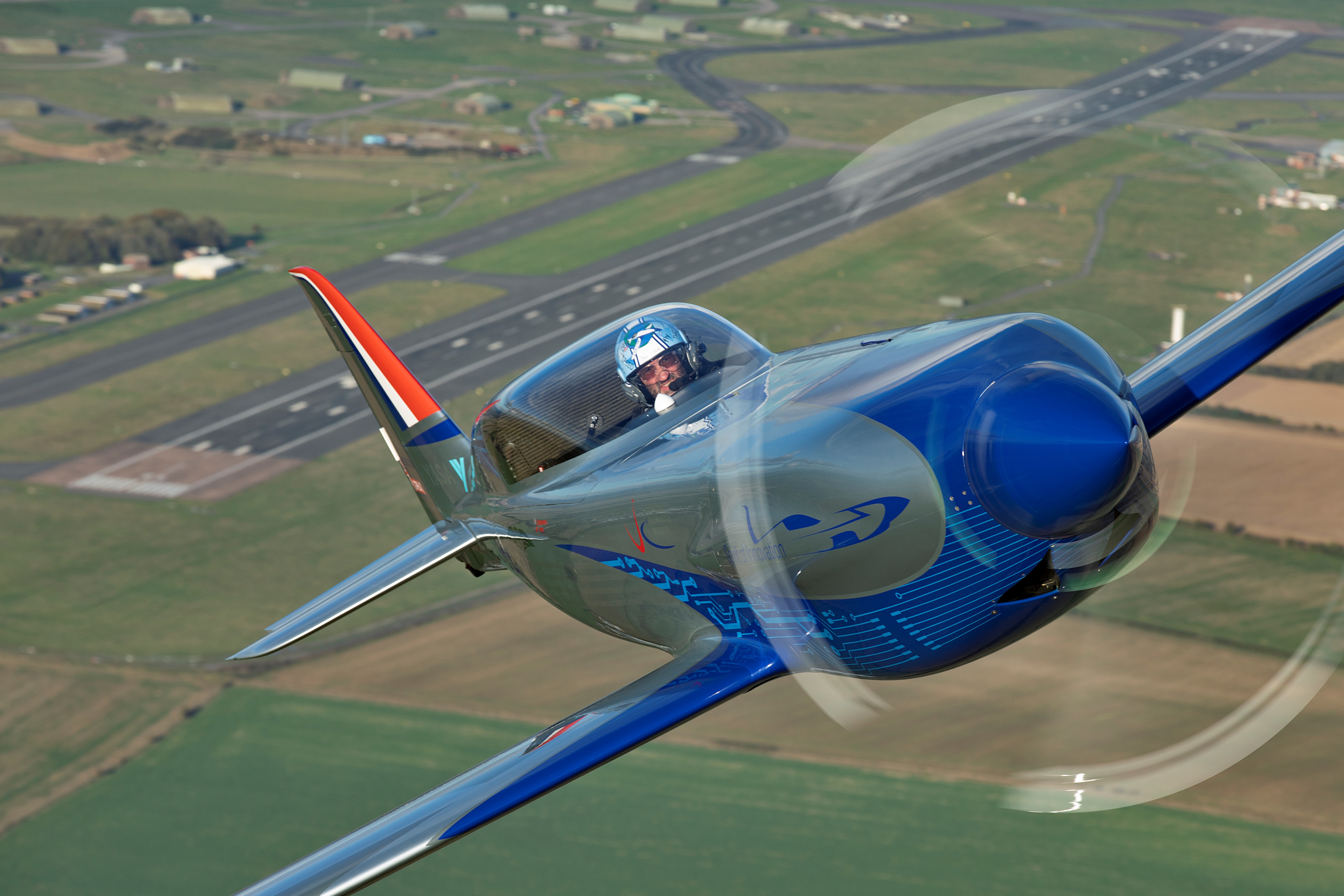
Above:
Phill O’Dell, Rolls-Royce Director of Flight Operations flying the Rolls-Royce’s ACCEL project Spirit of Innovation all-electric aircraft at Boscombe Down during world record runs, November 2021.
Copyright Rolls-Royce
During its record-breaking runs, the aircraft, which is part of the UK Government-backed ACCEL or ‘Accelerating the Electrification of Flight’ project, also clocked up a maximum top speed of 623km/h (387.4mph) making it the world’s fastest all-electric vehicle.
Warren East, CEO, Rolls-Royce, said: “Achieving the all-electric world-speed record is a fantastic achievement for the ACCEL team and Rolls-Royce. I would like to thank our partners and especially aviation start-up Electroflight, for their collaboration in achieving this pioneering breakthrough.
"The advanced battery and propulsion technology developed for this programme has exciting applications for the Advanced Air Mobility market. This is another milestone that will help make ‘jet zero’ a reality and supports our ambitions to deliver the technology breakthroughs society needs to decarbonise transport across air, land and sea.”
Half of the ACCEL project’s funding is provided by the Aerospace Technology Institute (ATI), in partnership with the Department for Business, Energy & Industrial Strategy and Innovate UK.
Business Secretary Kwasi Kwarteng said: “Rolls-Royce’s revolutionary Spirit of Innovation aircraft is yet more proof of the UK’s enviable credentials when it comes to innovation. This record will show the potential of electric flight and help to unlock the technologies that could make it part of everyday life. The government is proud to back projects like this to leverage the private investment necessary to unlock cleaner, greener aircraft which will allow people to fly as they do now, but in a way that cuts emissions.”
Gary Elliott, CEO of the Aerospace Technology Institute (ATI), said: “The ACCEL project demonstrates that strategic investment in UK technology and innovation can achieve extraordinary world-beating results and sets us firmly on the path to decarbonising passenger flight in the future. This achievement of Rolls-Royce, Electroflight and YASA will resonate for many years to come and inspire the next generation of aerospace engineers. They deserve their place in the record books and the ATI is proud to have played our part in that. Congratulations to the whole team.”
The aircraft was propelled on its record breaking runs by 400kW (500+hp) electric powertrain and the most power-dense propulsion battery pack ever assembled in aerospace. Rolls-Royce worked in partnership with aviation energy storage start-up Electroflight and automotive powertrain supplier YASA. As well as a stunning technical achievement, the project and world record runs provided important data for our future electric power and propulsion systems for all-electric urban air mobility (UAM) and hybrid-electric commuter aircraft. The characteristics that ‘air-taxis’ require from batteries, for instance, are very similar to what was developed for the ‘Spirit of Innovation’.
Rolls-Royce has an incredible history of flying speed record attempts and breaking records, dating back to the Schneider Trophies of the early 1930s. The speed achieved by test pilot and Rolls-Royce Director of Flight Operations Phill O’Dell in the ‘Spirit of Innovation’ was more than 213.04 km/h (132 mph) faster than the previous record set by the Siemens eAircraft powered Extra 330 LE Aerobatic aircraft in 2017. Never before in the history of the World Air Sports Federation (FAI) record attempts has there been such a significant increase in speed over such a short timeframe, highlighting the rapid pace at which the electrification of aerospace is advancing. Electroflight Pilot Steve Jones flew the ‘Spirit of Innovation’ aircraft for the 15km record run.
Phill O’Dell said: “Breaking the world-record for all-electric flight is a momentous occasion. This is the highlight of my career and is an incredible achievement for the whole team. The opportunity to be at the forefront of another pioneering chapter of Rolls-Royce’s story, as we look to deliver the future of aviation, is what dreams are made of.”
All three organisations involved in the ‘Spirit of Innovation’ – Rolls-Royce, Electroflight and YASA – share a passion for innovation and through the development process we have learned from the motorsport background of both our partners and from Electroflight’s pace as a start-up. We have also shared our aerospace expertise, including the rigorous safety and testing methods needed by the civil aviation industry. This combination has helped turn a concept into a world record breaker.
Stjohn Youngman, Managing Director, Electroflight commented: “We are delighted to have played an integral role in this landmark project. Its success is a fitting tribute to the dedication and innovation of the Electroflight team and our suppliers. Developing the propulsion and battery system, in collaboration with experienced programme partners, has resulted in a world class engineering capability that will lead the way towards the decarbonisation of air travel. Our next step is to adapt this pioneering technology so it can be applied across the wider aerospace industry to deliver a more sustainable way to fly.”
Dr Tim Woolmer, YASA’s Chief Technology Officer and Founder said: “Electric flight is set to be as transformative for mobility as the jet engine was 70 years ago. It’s thrilling to see our ultra-high performance, super-low weight electric motors powering the ‘Spirit of Innovation’ to these great speeds and to know that collaborative projects like ACCEL take us one step closer to emissions-free electric flight becoming a commercial reality for all.”
The ACCEL programme has also been supported by two further great British pioneers, Jaguar Land Rover, who have loaned all-electric zero emission Jaguar I-PACE cars as towing and support vehicles and Bremont, the luxury watchmaker, who were the official timing partner for the record attempt. The aircraft took off from the MoD’s Boscombe Down site, which is managed by QinetiQ and flew profiles according to the FAI guidelines for record attempts in the Powered Aeroplane C-1C Electric class.
Rolls-Royce involvement in the ACCEL project is just one of the ways in which the company is looking to make aviation more sustainable. In June last year, Rolls-Royce announced its pathway to net zero carbon emissions – a year on from joining the UN Race to Zero campaign.
The third record of Rolls-Royce's all-electric aircraft for the fastest time to climb to 3,000 metres in a time of 202 seconds, breaking the current record by 60 seconds, is still going through the verification process.