Advancing UK Aerospace, Defence, Security & Space Solutions Worldwide
  • Home
  • /
  • Space
  • /
  • SSTL helps support in service Galileo Satellites 29 & 30

Space

SSTL helps support in service Galileo Satellites 29 & 30
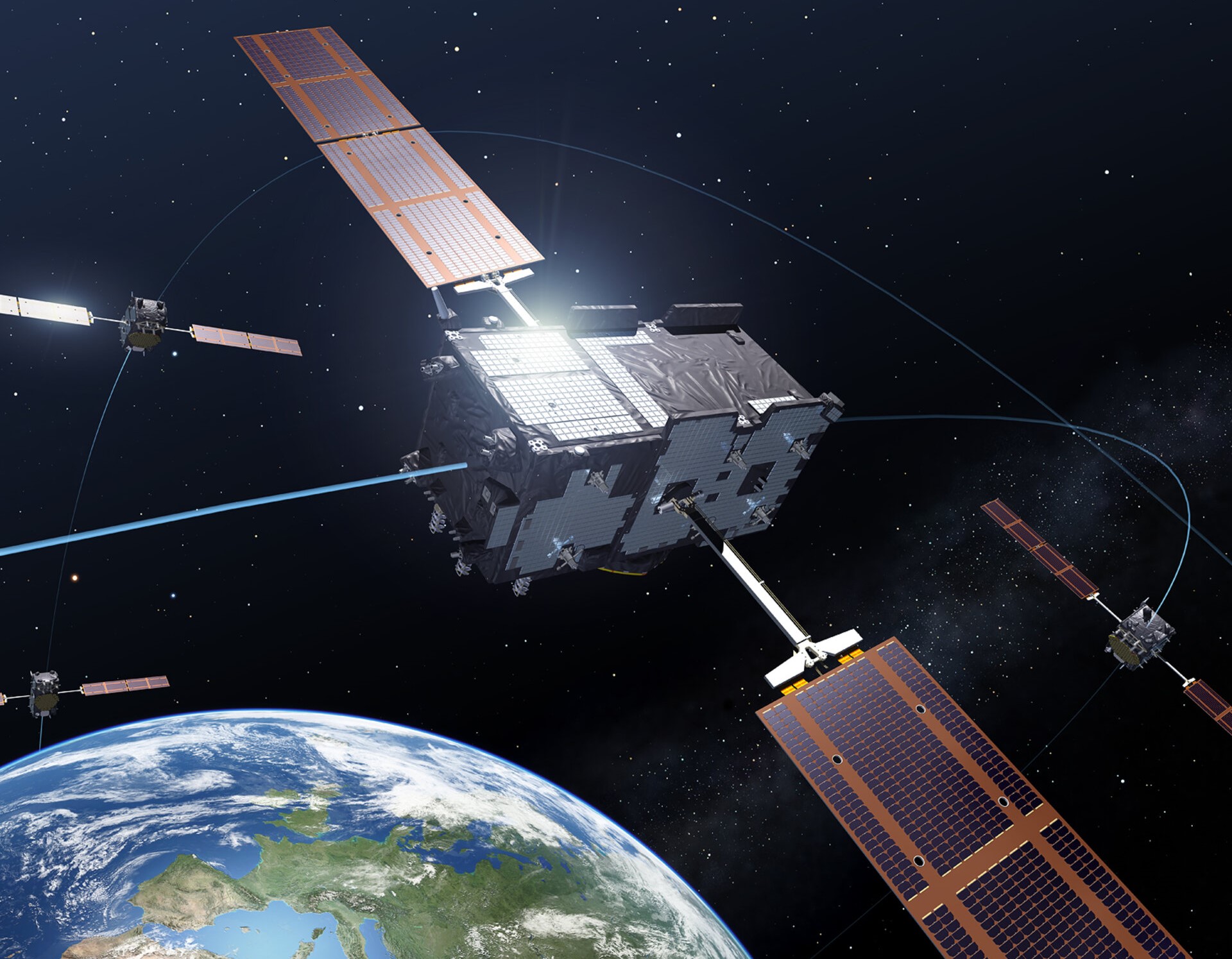
Surrey Satellite Technology Ltd (SSTL) are supporting the operations of the two new Galileo Satellites which have completed the second of the three constellation planes and are now in service.


Image courtesy SSTL

Carrying payloads assembled by SSTL, Galileo Satellites 29 & 30 were launched on a Falcon 9 SpaceX rocket earlier this year into a medium earth orbit close to their final on-station position 23,222 km above earth. This was reached at the end of June after a drift phase and over the subsequent months the Mission Control Team instigated the commissioning and in-orbit testing protocols necessary to ensure the satellites had survived intact from the severe launch conditions. Satellite manufacturer OHB then assessed the platform and antenna’s and SSTL analysed the clocks.

Advertisement
ODU RT

Towards the end of August ESA, OHB and SSTL concluded the satellites were fit and the ultimate green light was given by the EU SAB (Security Accreditation Board) to commence service.
 
The completion of the second of Galileo’s three orbital planes and the addition of every satellite to the system further improves the precision, availability and robustness of the Galileo signal. The next two satellites are planned for launch in the coming weeks, also from Kennedy Space Centre in Florida and the entire system is only a launch away from final completion of all three orbital planes.

Andrew Cawthorne – Managing Director, SSTL said: “It is always satisfying for us at SSTL when additional Galileo payloads manufactured here in Guildford are brought into service. Especially so for our core team who support the navigation payloads through commissioning and in-orbit operations. Galileo – still SSTL’s largest ever single contract – remains an important part of both our legacy and current operations.”

Advertisement
PTC rectangle

Galileo is currently the world’s most precise satellite navigation system, serving over four billion smartphone users around the globe since entering Open Service in 2017.

Headquartered in Guildford, Surrey Satellite Technology Limited (SSTL) delivers customisable complete mission solutions for Earth observation, science, communications, navigation, in-orbit debris removal and servicing and exploration beyond Earth infrastructure. Since 1981, SSTL has built and launched 74 satellites for 20 international customers, as well as providing training and development programmes, consultancy services and mission studies for ESA, NASA, international governments and commercial customers. SSTL is well known for innovative missions such as the CARBONITE satellites, the NovaSAR S-band radar imaging satellite and the RemoveDEBRIS space debris removal technology demonstrator. SSTL's latest launch (number 74) was in August this year of TYCHE - an ISR Earth Observation satellite for UK Space Command.

Advertisement
FIA2026 animated banner
Viasat

Aerospace Space

Viasat's advanced in-flight connectivity selected by National Airlines

17 March 2026

Viasat today announced that its advanced in-flight connectivity has been selected by charter operator National Airlines to enhance the passenger experience onboard a new fleet of three Airbus A330 aircraft.

ODU joins the UN Global Compact

Aerospace Defence Security Space

ODU joins the UN Global Compact

17 March 2026

Manufacturer of connector systems, ODU, has joined the United Nations Global Compact (UNGC), the world’s largest sustainability and corporate responsibility initiative.

UK–South Africa partnership using AI to make telescopes smarter

Space

UK–South Africa partnership using AI to make telescopes smarter

16 March 2026

AI is set to transform how South Africa’s astronomical observatories operate, as the Science and Technology Facilities Council (STFC) Hartree Centre is working with the South African Astronomical Observatory (SAAO), a centre for optical and infrared astronomy, to deliver the ‘Intelligent Observatory’ programme.

Cranfield University unveils wind-powered WANDER-bot

Space

Cranfield University unveils wind-powered WANDER-bot

13 March 2026

Researchers at Cranfield University have created WANDER-bot, a low-cost, 3D-printed robot that is powered by wind energy.

Advertisement
PTC rectangle
Orbit Fab and Airbus collaborate on satellite refuelling

Space Events

Orbit Fab and Airbus collaborate on satellite refuelling

12 March 2026

Orbit Fab are working with Airbus Defence and Space to assess the feasibility of incorporating Orbit Fab’s RAFTI refuelling valve into possible future Airbus geostationary satellites, as part of a project within the European Space Agency’s programme of Advanced Research in Telecommunications Systems, named RADICAL, funded by the UK Space ...

BAE Systems completes preliminary design review of USSF missile tracking system

Defence Space

BAE Systems completes preliminary design review of USSF missile tracking system

12 March 2026

BAE Systems has completed the Preliminary Design Review for the $1.2 billion US Space Force (USSF) Space Systems Command (SSC) Resilient Missile Warning & Tracking (RMWT) – Medium Earth Orbit (MEO) Epoch 2 programme to provide missile warning and tracking of advanced missile threats.

Advertisement
ODU RT
Advertisement
Gulfstream banner