Swansea Uni and Faradair Aerospace expand their UK aerospace revival efforts
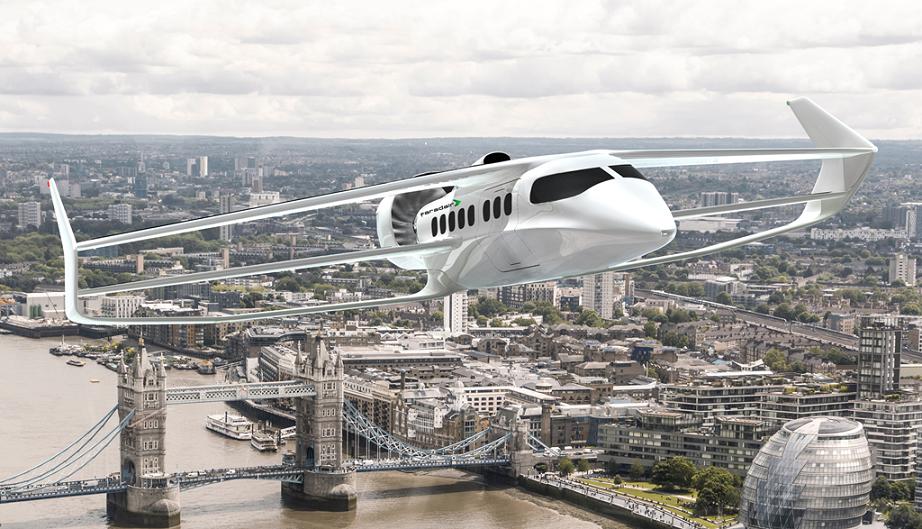
Above:
Artists impression of the Faradair BEHA over London.
Courtesy Faradair Aerospace
The enhanced collaboration will see the University’s Bay Campus become a training ground for engineers and interns as Faradair develops new technologies for use on its clean-sheet Bio Electric Hybrid Aircraft (BEHA).

Neil Cloughley, Founder and CEO of Faradair said. “Swansea has been part of this programme for four years now and we are delighted to reinforce our position in making Swansea a long-term partner of this world-leading aviation initiative, and thus Wales, a long-term partner in BEHA’s success. We plan to have 30 engineers based at the Bay Campus working on BEHA developments by the end of 2021 and there will be opportunities for undergraduate and postgraduate students also.”
Dr Ben Evans, Associate Professor in Aerospace Engineering at Swansea University, said: “The partnership we have established, providing aerodynamic design support to Faradair for their BEHA aircraft, is an exciting opportunity for Swansea University. It will allow us to use our world-leading aerodynamic modelling, high performance computing and design optimisation technologies on an aircraft set to transform the world of civil aviation.”
“The BEHA will be a clean and quiet aircraft for the 21st century that could have a major impact to help reduce greenhouse gas emissions from aviation whilst better connecting smaller, regional airfields across the UK and beyond. It also provides Swansea University’s students with an amazing chance to work alongside an innovative company and great graduate employment opportunities,” he added.
The widened partnership with Swansea University follows Faradair’s announcement in December that it had attracted a strong consortium of global partners for the BEHA*, an aircraft specifically designed for low cost, quiet, environmentally friendly flight - qualities that enable it to deliver Air Mobility as a Service (AMaaS) for all.
In line with UK Government ambitions for sustainable air transport, the British-designed and built BEHA will emerge in hybrid electric/ turbine configuration, but engineered for evolution into a fully electric net zero commercial aircraft when power generation technology delivers the power density levels required for an 18-seat utility aircraft.
The ambition is to deliver an initial portfolio of 300 Faradair-owned BEHAs between year 2026 and 2030. Of these, 150 aircraft will be built in firefighting configuration, 75 as quick change (QC, passenger to cargo) aircraft, deployed at general aviation airfields globally, and 50 as pure freighters. The final 25 aircraft will be demonstrated in non-civilian government roles, including logistics, border and fisheries patrol, and drug interdiction.
Talks are now advancing at pace with investors and aircraft finance organisations to enable the full programme of development to scale up and meet the target objectives.
Meanwhile, Faradair is building its executive and engineering team, and expects to make further announcements early in 2021.
*New Consortium partners - Honeywell, magniX, Cambridge Consultants and Nova Systems