Thales awarded DE&S contract to enhance Royal Navy MCM capability
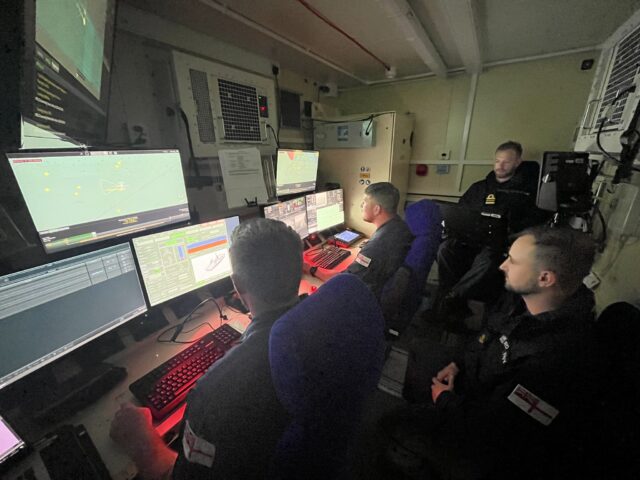
Image courtesy DE&S
More Royal Navy sailors will be kept out of harm’s way when detecting and clearing sea mines thanks to new technology giving them greater control than ever over autonomous equipment.
To tackle the issue of remotely controlling underwater mine detection and neutralising the threat from a safe distance, DE&S has awarded a £10 million contract to Thales UK for Remote Control Centres (RCCs) which will allow personnel to quickly deploy command centres and control autonomous Mine Hunting Systems anywhere in the world.

The contract is a major step forward in delivering the 2025 Strategic Defence Review’s vision for greater use of autonomous systems.
Thales’ significant overall investment in UK mine countermeasures has sustained more than 200 highly skilled jobs – particularly at its Somerset, Stockport and Plymouth sites – making defence an engine for growth. The Thales M-Cube Mission Management System will be at the heart of the command centres. This combat-proven software suite is already used by multiple navies worldwide for planning, execution and evaluation of both conventional and autonomous MCM missions.
Mi-Map planning and evaluation software lies at the heart of the Royal Navy’s new RCCs. Featuring advanced AI-powered automatic target recognition, it empowers operators by intelligently filtering and refining raw data, streamlining and expediting the mine hunting process. Leveraging machine learning, Mi-Map continually enhances its database and processes vast quantities of information beyond human capability. Not only does it accelerate target identification but also delivers superior accuracy and effectiveness compared to traditional systems.
This sophisticated AI is developed with the support of cortAIx, Thales AI accelerator with a global workforce of 800 experts in AI within the Group serving the performance of sovereign advanced systems and sensors in critical environments.
Andy Lapsley, MHC Team Leader at DE&S, said: “These next-generation Remote Command Centres will transform how the Royal Navy conducts mine countermeasures operations.
“This contract demonstrates the potential that can be released by harnessing the combined strengths of DE&S, the Royal Navy and our UK supply chain that is envisaged by the Defence Industrial Strategy.
“Delivering the flexibility, speed and operational advantage our sailors need is a crucial step on our journey towards the hybrid Navy and demonstrates the UK’s world-leading position in both Mine Counter Measures and maritime autonomous systems (MAS).”
The programme follows the announcement of the UK’s Atlantic Bastion initiative, which was central to the Strategic Defence Review and combines autonomous vessels and artificial intelligence (AI) with warships and aircraft to create a highly advanced hybrid force to protect undersea cables and pipelines from Russian undersea threats in the North Atlantic.
This latest development will assist the Royal Navy’s Mine Counter Measures capability transformation, which is critical to national security and builds on the Mine Hunting Capability (MHC) programme.
The RCC contract expands on the existing Thales Portable Operations Centre (POC) already delivered to the Royal Navy, which are compact and rapidly deployable command systems for naval mine hunting operations, using AI-powered software to plan, control and analyse drone missions from ship to shore.
The new Thales UK system takes this capability a step further, enabling the command and control of multiple autonomous platforms simultaneously to detect the initial threat of a mine in the sea and either neutralising that threat from a safe distance or avoiding it altogether.
Minister for Defence Readiness and Industry, Luke Pollard MP, said: “The threat to the UK is growing, driven by global instability, Russian aggression, and a greater willingness of states and hostile actors to target our critical infrastructure.
“By embracing autonomous maritime technology, the Royal Navy is pioneering innovation to help keep our sailors safe at sea. This is backed by a UK defence industry delivering world-class capabilities that exemplify how defence acts as an engine for growth.”
Jon Reed-Beviere, Navy Command Programme Director, said: “The new Remote Command Centres will give Royal Navy personnel unprecedented command and control over our autonomous mine hunting systems.
“This integrated approach allows us to operate multiple unmanned platforms simultaneously and integrate new capability in the future, dramatically increasing our effectiveness whilst reducing risk to our sailors. It represents a paradigm shift in how we deliver mine countermeasures capability.”
Thales will work collaboratively with other MHC suppliers, including TKMS Atlas UK, SeeByte and QinetiQ, under MoD direction to integrate current and future MAS and software into the new RCCs.
Paul Armstrong, Managing Director for Underwater Systems activities, Thales in the UK, said: “Thales is honoured to continue its central role in delivering mine countermeasures capability to the Royal Navy, building on our proven heritage. This next-generation of autonomous command centres is part of a flexible suite of autonomous C2 from containerised solutions to vessel operations centres or large, shore operations centres. By collaborating across the supply chain, we are committed to supporting the UK with world-class technology and fostering growth and high-value skilled jobs across our UK operations.”