UK and Canada enhance cooperation in space
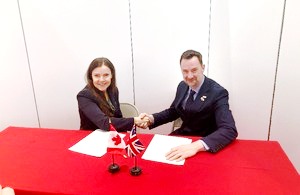
Above: UK Space Agency CEO Paul Bate and Canadian Space Agency President Lisa Campbell signed the MoU during the 39th Space Symposium.
Courtesy UKSA
The agreement, signed by UK Space Agency CEO Paul Bate and Canadian Space Agency President Lisa Campbell, builds on the initial Memorandum of Understanding (MoU) between the two agencies signed in 2021: a framework for collaborative activities and the exchange of information, technology and personnel between both nations.

The signing took place during the 39th Space Symposium, an annual event in Colorado Springs that brings together space leaders from around the globe to discuss, address and plan for the future.
UK Space Agency Chief Executive, Dr Paul Bate, said: "The renewal of the MoU with our Canadian colleagues will bring further significant benefits to the thriving space industries of the UK and Canada, allowing us to continue achieving our goals in space through collaborative efforts in research and innovation.
"Canada is a key partner for us, and we are keen to bolster this relationship in ways that will strengthen both countries’ space sectors - enabling us to harness the power of space to bring benefits to our planet and its people."
The MoU provides a more detailed framework for enhanced bilateral collaboration between the UK and Canada on space activities This includes collaboration on regulation, facilitating the exchange of ideas and information on areas such as space policy, standards and regulations, helping to ensure free and fair access to space for all.
The agreement also boosts collaboration in exploration and space science by identifying areas where both nations can leverage their world-class space academic and technology capabilities. This bilateral cooperation aims to support future exploration endeavours, including potential lunar habitats, and to advance our understanding of the Universe.
There are significant opportunities for future collaborations through initiatives such as the UK Space Agency’s International Bilateral Fund (IBF) and the Science & Exploration Bilateral Programme.
The IBF is already funding a collaboration between UK start-up Physical Mind London and Canadian tech company Baune. The project incorporates Physical Mind London’s pioneering HIFIm multi-exercise countermeasure unit into the Canadian Space Agency’s Connected Care Medical Module.
The HIFIm device is designed to provide a full menu of exercise options in a confined space, helping to advance understanding of health and wellness interventions for astronauts.
The IBF has also funded the joint UK-Canada £1.2 million Aqualunar Challenge. The new international challenge prize - delivered by Challenge Works on behalf of the UK Space Agency and in collaboration with the Canadian Space Agency and Impact Canada - is rewarding the design of innovative technologies to make human habitation on the Moon viable, by finding ways to purify water buried beneath the lunar surface.
The Science & Exploration Bilateral Programme is supporting a potential UK-Canada partnership on CASTOR. An astronomy mission currently under study by the Canadian Space Agency, CASTOR will fill a gap in current observing capabilities, by providing state of the art imaging and spectroscopy in ultraviolet and optical-blue wavelengths.
The UK has begun work on the development and space qualification programme for advanced imaging technology from Teledyne e2v and the associated electronics, along with contributions to the scientific data processing. This is carried out by a UK consortium led by UKRI-STFC’s Astronomy Technology Centre (Edinburgh), with the UK Space Agency providing £3.3 million to fund UK participation in this early phase work.
The programme is also funding the early study phase for a proposed space science collaboration, between The Open University and Canada – the International Mars Ice Mapper (I-MIM). This is to study high performance detectors for use on an instrument, which would map accessible water ice deposits on the Martian surface.