UK aviation industry launches first interim decarbonisation targets
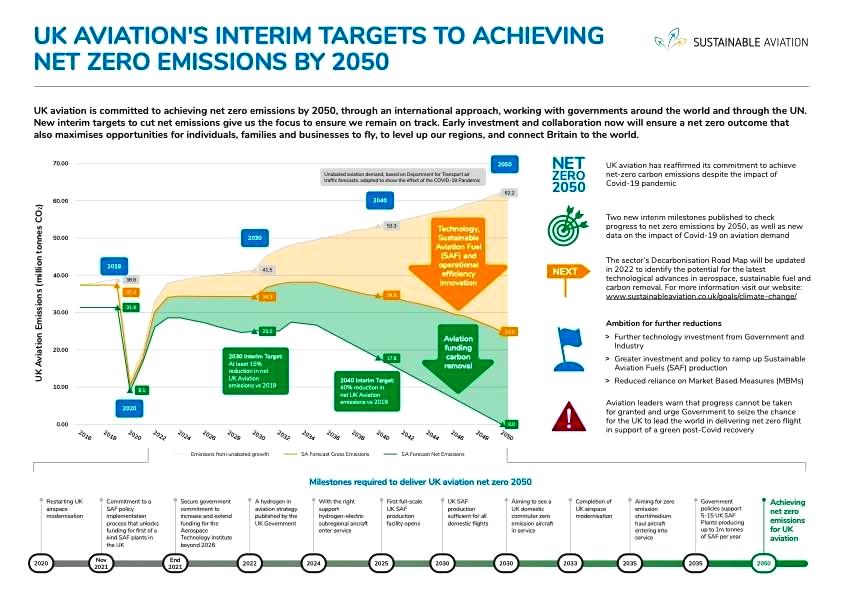
Image courtesy Sustainable Aviation
Industry is targeting at least an overall 15% reduction in net emissions relative to 2019 by 2030, and a 40% net reduction by 2040, with the pace of decarbonisation ramping up as game-changing sustainable aviation fuels (SAF), permanent carbon removal, and new low and zero carbon technologies – such as electric and hydrogen powered aircraft – become mainstream in the 2030s.

These milestones are reflected on a new chart taking account of the effects of Covid-19 on aviation demand, and complement an ever-growing set of voluntary industry pledges to drive down emissions fast. Importantly, today’s announcement also kickstarts detailed work to update by the middle of next year the sector’s Decarbonisation Road Map, first published in 2020, that is expected to demonstrate even faster potential to decarbonise aviation through technology innovation.
Decarbonising aviation is a huge challenge, with significant technology and policy barriers that need to be overcome this decade. With the right support, it can and will be achieved, maintaining the major economic and social benefits of the UK’s air links to the world, and generating new opportunities for tomorrow’s engineers through highly skilled green aviation jobs. However, the UK risks falling behind as other countries including the United States put in place enhanced policies to support innovation and new fuel technologies.
To make sure UK aviation continues to lead the world in aviation decarbonisation, further support is needed in five areas critical to realising net-zero flight:
- Key policies this year to deliver a UK SAF industry and commercialise SAF, most urgently by providing a demand signal and price support – the primer for up to 14 UK plants generating sustainable fuel from household and industrial waste by the middle 2030s, supporting at least a 32% reduction in emissions from UK aviation by 2050;
- A positive, long-term signal for investment in aerospace technology and the development of hybrid, electric and hydrogen-powered aircraft through increased and extended funding for the Aerospace Technology Institute;
- The completion of vital airspace modernisation generating significant carbon savings through more efficient flying and shorter journey times;
- Policies that incentivise the commercialisation of carbon removal technologies that enable carbon neutral or carbon negative aviation fuel, allowing the aviation industry to address any remaining residual emissions;
- UK Government to seek a more robust international commitment for aviation carbon reduction at the ICAO Assembly in 2022, ensuring emissions are reduced across the globe and not exported from the UK.
Secretary of State for Transport Grant Shapps MP said in response: “As the first major economy in the world to commit to net zero by 2050, we are leading the charge to cut aviation emissions through the Jet Zero Council.
“The commitment shown here by industry today builds on that work, embodying the forward thinking attitude we need to decarbonise the sector and put the UK at the forefront of green aviation.”
Commenting on the launch of these targets, Secretary of State for Business, Energy, and Industry Strategy Kwasi Kwarteng MP said: “These targets are an important milestone for the British aviation industry and show that airports, aerospace manufacturers and airlines share in our ambition to adopt the new and emerging technologies necessary to fight climate change.
“Working with industry through our Jet Zero Council, we are putting the decarbonisation of the aviation sector at the centre of our plans to build back greener from the pandemic and this industry roadmap complements our vision perfectly.”
Chair of Sustainable Aviation Adam Morton said: “UK aviation led the world last year by being the first national aviation body in the world to commit to net zero by 2050. We are now raising the bar by committing to additional interim milestones to hold ourselves accountable on this journey to Jet Zero.
“This is ambitious but achievable, and requires meaningful cooperation between industry and Government, as well as the necessary policies and funding to ensure the UK can build a world-leading SAF industry, create new clean aircraft, and modernise British airspace.”
Sean Doyle, CEO, British Airways, said: "We fully support this important commitment to 2030 and 2040 carbon reduction targets demonstrating that as an industry we are taking action now to reduce our carbon emissions and put us on the pathway to our ultimate ambition of Net Zero Emissions by 2050"
Kevin Craven, Chief Executive, ADS said: “The UK’s aerospace manufacturers are deeply committed to achieving net zero aviation and being world leaders in delivering the advanced green technologies that will make this ambition a reality.
Our members are investing heavily in innovative R&D projects focussed on driving down carbon emissions, by boosting fuel efficiency in the aircraft of today and creating the radical new propulsion systems and components that will drive the aircraft of tomorrow.
We are working closely with Government and the Jet Zero Council to make sure UK industry plays a major role in delivering net zero aviation by 2050, meeting our national environmental commitments and enhancing our prosperity.”
Karen Dee, Chief Executive, Airport Operators Association, said: “Despite the impact of the Covid-19 crisis, airports remain committed to tackling the climate crisis. As the AOA set out in our Airport Recovery Plan, we can and must return to 2019 passenger levels without 2019 environmental impacts. Airports will play their part in achieving the goals set out by Sustainable Aviation today, including by modernising UK airspace to reduce noise and climate impacts, ensuring airport infrastructure is ready for sustainable aviation fuels and reducing ground-based emissions of buildings and vehicles operating on and around airports.”
Stewart Wingate, CEO, Gatwick Airport, said: “Achieving Net Zero emissions by 2050 is both a great challenge and an opportunity for our industry. Sustainable Aviation’s decarbonisation roadmap and interim goals set out clear milestones and we’re ready to play our part at Gatwick, through implementing the roadmap’s first decade milestones and by keeping the roadmap updated to incorporate additional technology solutions for the 2030s.”
John Holland-Kaye, CEO, Heathrow Airport, said: “Today’s announcement demonstrates the sector’s commitment to delivering Net Zero emissions by 2050 despite the impacts COVID has had on our industry. We know that flying is not the enemy – carbon is - and this roadmap illustrates how it can be removed. Our goal should be that 2019 is the peak year for carbon emissions from aviation, and that from now on, we are adapting our industry so that future generations can enjoy the many benefits of flying, in a world without carbon.”
Charlie Cornish, CEO, Manchester Airport Group, said: “Today’s announcement reinforces the strength of the UK aviation industry’s commitment to achieving net zero emissions by 2050. Despite the deeply damaging impact of the pandemic on the sector, our commitment to a greener future stands firm and working collaboratively as an industry on this roadmap means we are united in meeting the targets now ahead of us.
"MAG has long demonstrated its commitment to sustainability and last year we published our new CSR Strategy, where we set our own target for reaching net zero by 2038 and launched an incentive for our airlines to operate the first emission free flight from one of our airports. By bringing together individual commitments like this, and the collective commitments that we have announced today, the aviation industry can move forward together towards net zero.”
Henrik Wareborn, CEO, Velocys, said: “Velocys goes hand in hand with the aviation industry, fuel producers and third-party developers by providing a technology solution for climate change mitigation, and helping to meet net zero targets. I, therefore, welcome and support the aviation industry’s commitment to its interim decarbonisation targets, which Velocys is well positioned to enable its delivery with our unique proprietary technology. The UK is at a pivotal point where UK Government support is crucial to the success of the decarbonisation of the aviation industry with price certainty combined with demand mandates. This in turn will accelerate the deployment of the technology required to decarbonise the aviation sector ahead of 2050. However, as Sir David Attenborough points out: “It is what we do in this decade that really matters.”’
Steve Oldham, CEO, Carbon Engineering, said: “For aviation to achieve net zero, we need solutions that can scale to meet the needs of a growing sector. Establishing interim targets will help solutions like permanent carbon removal and synthetic fuels made from the air to start deployment - reducing costs and demonstrating a clear path to achieve net zero aviation.”
Shai Weiss, Virgin Atlantic CEO said: “Virgin Atlantic is fully committed to becoming Net Zero by 2050 and the release of these interim targets sets out a pathway for the UK aviation industry to achieve this goal. Since 2007, we have improved our carbon efficiency by 20%, having embarked on the largest fleet transformation programme in our 37 year history. We now operate a purely twin engine fleet, further reducing our carbon emissions by 10% CO2 per flight compared to pre-pandemic levels.
“Now is the time for determined action from Government to lead the way in the decarbonisation of the UK airline sector. By harnessing the innovation, appetite and demand from the our world-leading aviation industry, UK Government can accelerate towards a UK Sustainable Aviation Fuel industry as part of its Green Industrial Revolution. This should include a commitment to build sustainable aviation fuel plants in the UK in this decade, supported by appropriate incentives and investment guarantees to drive technology innovation, SAF production and to bring down costs.”