UK commits new funding to combat space debris
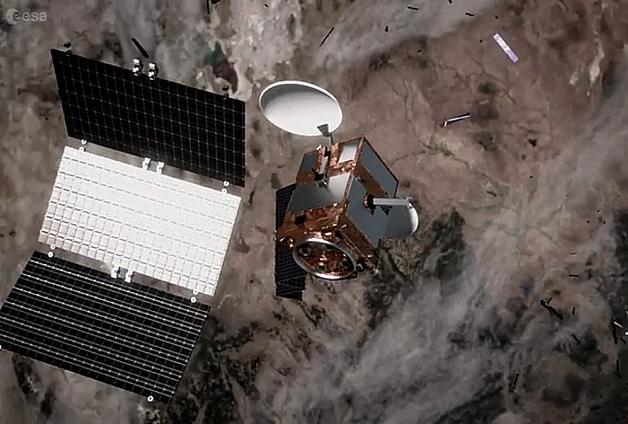
Above:
Artist impression of a satellite breaking in space causing space debris.
Courtesy ESA
There are an estimated 900,000 pieces of space debris larger than 1 cm orbiting the Earth, with only a small proportion of them tracked.
The UK Space Agency is providing up to £1 million for organisations to come up with smart solutions to this problem by using cost effective ways to monitor objects in low Earth Orbit, or applying artificial intelligence to make better use of existing orbital data.

Tracking debris allows satellite operators to predict possible collisions so that they can manoeuvre them out of harm’s way. One collision could create thousands of small, fast-moving fragments which can damage the satellites that provide everyday services such as communications, weather forecasting or satellite navigation.
Science Minister Amanda Solloway said: "From artificial intelligence to advanced tracking systems, the UK space industry is leading the way in developing ground-breaking solutions to worldwide problems.
"Today’s funding will enable businesses to develop cutting-edge innovations to combat the growing amount of space debris orbiting the Earth – helping protect vital services like communications, weather forecasting and satellite navigation."
The UK is committed to the international effort to clean up space debris as the largest investor in space safety for the European Space Agency, including a substantial £10 million commitment to the ADRIOS (Active Debris Removal/In orbit servicing) programme. Later this year, Harwell, Oxfordshire, will host the operations centre for the ELSA-d satellite clean-up and decommissioning programme led by Astroscale.
Dr Alice Bunn, International Director, UK Space Agency, said: "We want the UK to be at the forefront of a new era of space where we continue to push boundaries while ensuring the growth is sustainable for all.
"Space debris is a global problem and this funding will enable UK companies to develop new methods to help tackle the issue. Growing our space surveillance and tracking capabilities will be crucial for UK space businesses to innovate safely and sustainably in the future."
The new funding is part of the UK Space Agency’s plans to grow its national space surveillance and tracking (SST) capability and, working with international partners, become a global leader in space sustainability.
Organisations will be able to bid for a maximum grant award of £250,000, out of a £1 million funding pot. Space surveillance and tracking is a growing international market, forecast to potentially reach over £100 million by 2035. With the demand for SST increasing, this provides an opportunity for the UK space industry to take a leading role in the sector.
The UK Space Agency is leading work across government to develop a comprehensive UK Space Strategy and to launch a new National Space Innovation Programme, which will fund transformative technologies and generate high-skilled jobs across the country.
The call for applications is open from 26th May 2020 and will close on 10th July 2020.