
General Atomics

UK Defence Training Estate receives £4.4m investment for added realism

More than £4.4 million has been invested in new trench training infrastructure across the Defence Training Estate, enhancing the UK armed forces’ ability to train in realistic and contemporary battlefield environments.

DIO-courtesyLandmarcSupportServices-GOV.UK
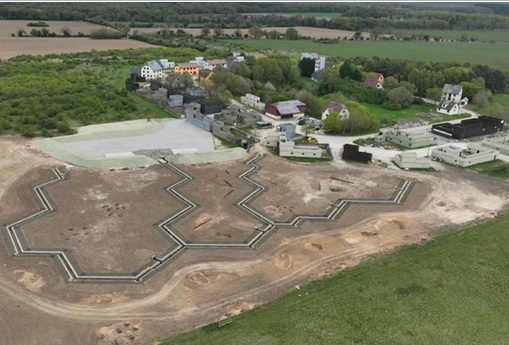
New trench system at Eastmere Village, Stanford Training Area (STANTA), strengthening integrated urban and rural training capability. Photo: Landmarc Support Services

Delivered through a partnership between the Defence Infrastructure Organisation (DIO), the British Army and Landmarc Support Services, the investment includes new trench systems at Copehill Down Training Village on Salisbury Plain and Eastern European-style trench networks at Eastmere Village within Stanford Training Area (STANTA) in Norfolk.

The projects improve training facilities and support the Army’s wider modernisation programme, providing soldiers with realistic environments in which to develop and refine the skills required for contemporary operations.

Realistic training environment

Designed to reflect the realities of modern conflict, the new facilities replicate the complexity of contemporary battlefields and include extensive trench networks, fighting positions, covered command posts, protected shelters, bunkers, observation points, firing platforms and vehicle positions. Integrated into existing training areas, the infrastructure creates challenging and representative environments for military personnel to train in realistic operational scenarios.

Brigadier Gavin Hatcher CBE, Head of Overseas and Training Region at the Defence Infrastructure Organisation said: “These projects demonstrate our continued investment in the Defence Training Estate and our commitment to ensuring the armed forces have access to the infrastructure they need to train effectively.

“Working closely with Landmarc and the British Army, we have delivered facilities that reflect the changing character of warfare and support realistic, demanding training. This investment will help ensure that our training estate continues to provide world-class facilities that enable soldiers to prepare for the challenges of modern operations.”

Developing tactical skills

Colonel William Robinson, Deputy Chief of Staff at the Land Warfare Centre added: “The character of conflict continues to evolve, and it is essential that our training environments evolve alongside it. These new trench systems provide soldiers with realistic facilities that support the development of tactical skills, decision-making and battlefield awareness in representative conditions. Investment in infrastructure such as this helps ensure the Defence Training Estate continues to deliver world-class training in support of operational readiness.”

David Morgan, Programme Director at Landmarc, said: “The Defence Training Estate is a national asset and maintaining its relevance requires continual investment and innovation. These projects demonstrate how customer insight, engineering expertise and collaborative delivery can come together to transform emerging requirements into realistic and enduring training capability, supporting the evolving needs of modern military training. The enhanced facilities will provide lasting value to the armed forces and help ensure the estate remains fit for the future.”

Meeting future requirements

The projects were delivered with support from specialist supply chain partners, drawing on expertise in military infrastructure, construction and estate development. The Stanford Training Area project was supported by Knights Brown Construction, 5C Consulting and Land Sculpture Civils.

By investing in modern training infrastructure, the Ministry of Defence is ensuring that the Defence Training Estate continues to evolve alongside the changing character of warfare, providing Service personnel with the environments they need to develop and maintain operational advantage. These projects form part of defence’s wider programme of estate investment and modernisation, helping ensure the estate remains fit for purpose for current and future generations, in line with the ambitions of the Defence Investment Plan.

Related

HAV and Defentia enter strategic collaboration
Airlander
HAV and Defentia enter strategic collaboration
Bedford based Hybrid Air Vehicles (HAV), developer of lighter-than-air dual-use hybrid aircraft Airlander, is exploring new opportunities in Spain with Defentia, a systems integrator of civilian and military applications.
UK airports improve accessibility as assistance demand hits record high
CAA passengers at airport
UK airports improve accessibility as assistance demand hits record high
UK airports achieved their best-ever accessibility ratings as 5.9 million passengers requested assistance in 2025, the UK Civil Aviation Authority reports.
CAA explores future for BVLOS drone ops
Amazon PrimeAir MK30 drone
CAA explores future for BVLOS drone ops
A new report from the UK Civil Aviation Authority (CAA) outlines a vision for enabling routine Beyond Visual Line of Sight (BVLOS) commercial drone operations alongside existing UK airspace users.
Aerospace Security

3 Aug 2026

MoD selects CORVUS for British Army’s surveillance capability
The UK Ministry of Defence (MoD) has chosen TEKEVER's CORVUS to deliver the British Army's new surveillance capability.
Defence Member News

4 Aug 2026

Royal Marines host first UK special forces drills with South Korean commandos
42 Commando during Op Highmast
Royal Marines host first UK special forces drills with South Korean commandos
How the Royal Navy is carrying on from 2025's Op Highmast and training with their Korean counterparts in England.
Defence Most Read

4 Aug 2026

HAV and Defentia enter strategic collaboration
Airlander
HAV and Defentia enter strategic collaboration
Bedford based Hybrid Air Vehicles (HAV), developer of lighter-than-air dual-use hybrid aircraft Airlander, is exploring new opportunities in Spain with Defentia, a systems integrator of civilian and military applications.
Seraphim Space deploys first capital from £137m C share raise
The investments have been made in businesses involved in key areas that are driving the next phase of growth within the space sector.
Member News Space

4 Aug 2026

AccelerComm underpins Eclipse Space’s 5G physical layer for satellite constellations
UK From Space-Telecom
AccelerComm underpins Eclipse Space’s 5G physical layer for satellite constellations
Flight-proven 5G non-terrestrial network (NTN) tech from Southampton based AccelerComm, is supporting a scalable direct-to-device and broadband architecture from Starlink veterans behind Eclipse Space.
Member News Space

31 Jul 2026

ALL.SPACE releases Hydra MAX wideband platform for multi-orbit ops
Hydra on Defender
ALL.SPACE releases Hydra MAX wideband platform for multi-orbit ops
ALL.SPACE has released Hydra MAX, designed to unlock next-generation wideband Ka networks with multi-orbit connectivity.
Defence Space

28 Jul 2026

CAA explores future for BVLOS drone ops
Amazon PrimeAir MK30 drone
CAA explores future for BVLOS drone ops
A new report from the UK Civil Aviation Authority (CAA) outlines a vision for enabling routine Beyond Visual Line of Sight (BVLOS) commercial drone operations alongside existing UK airspace users.
Aerospace Security

3 Aug 2026

UK SMEs given support to commercialise proven solutions
Connected Places Catapult
UK SMEs given support to commercialise proven solutions
A new programme of tailored support is set to help UK small and medium-sized enterprises (SMEs) with proven transport and construction solutions, to commercialise at scale.
Aerospace Security

3 Aug 2026

QinetiQ equips young people with cyber skills
CyberFirst Advanced at Lancaster University
QinetiQ equips young people with cyber skills
Hundreds of youngsters have been given the opportunity to equip themselves with real-world cyber skills.