UK Minister for Defence Procurement starts Skynet 6A satellite production at Airbus
Jeremy Quin MP, the UK’s Minister for Defence Procurement, visited Airbus in Stevenage today and pushed the button to start production of the first panel skin for the UK MOD’s next generation military communications satellite Skynet 6A.
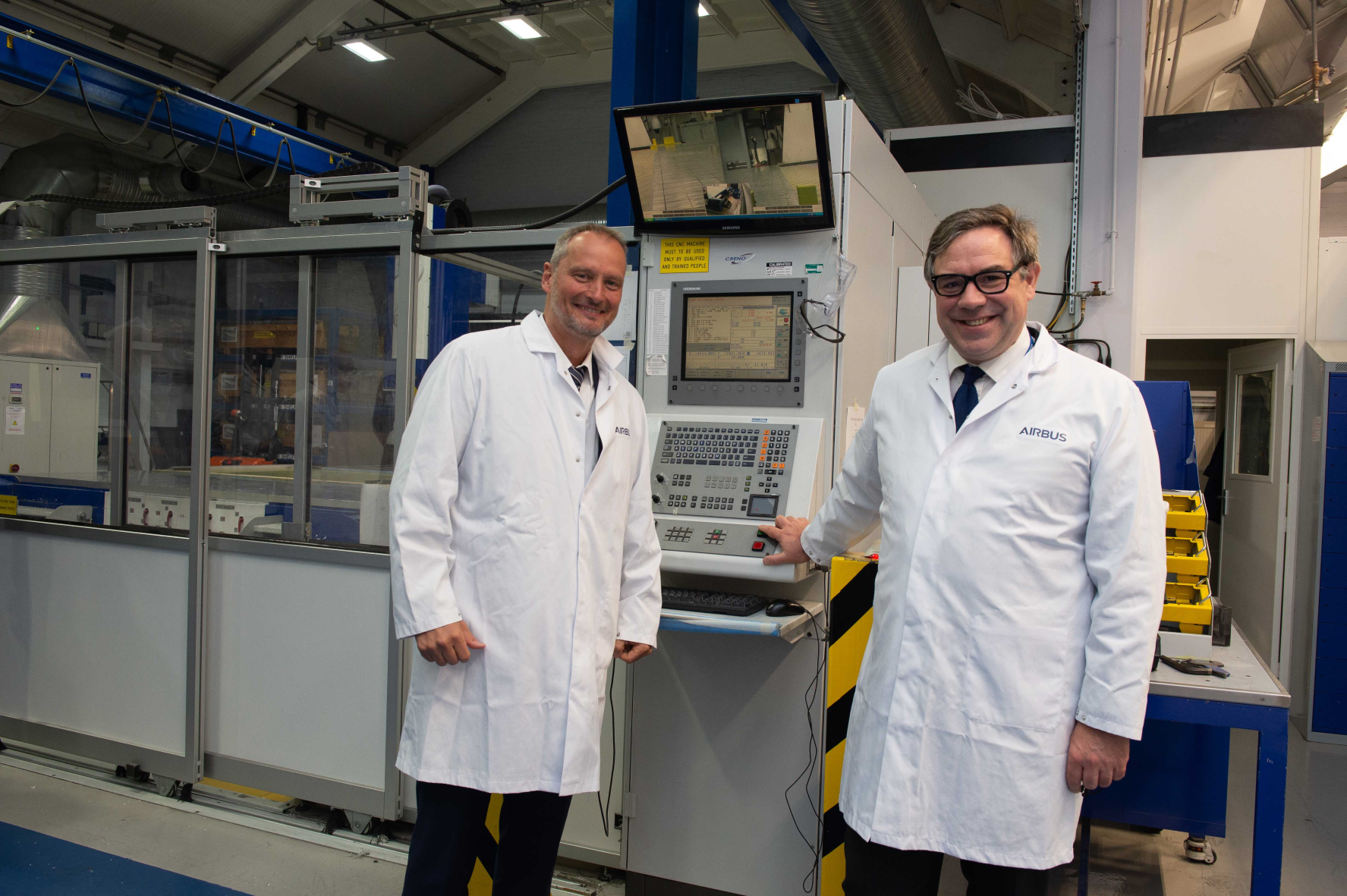
Image courtesy of Airbus
The Defence Minister started the high precision cutting machine to profile the first aluminium panels of the near six ton Skynet 6A satellite which is based on Airbus’ Eurostar Neo telecommunications spacecraft and visited the extensive cleanroom facilities on site. Airbus was awarded the more than £500m contract to design and build Skynet 6A in July 2020 and the programme achieved its Preliminary Design Review in December 2020.

Defence Minister Jeremy Quin said: “Secure military satellite communications are vital for our ability to conduct operations on a global scale. Seeing the first hardware for the next generation Skynet 6A satellite shows we are on track for launch in 2025 and ready to upgrade and enhance the UK’s global military communications network.”
Richard Franklin, Managing Director of Airbus Defence and Space said: “Airbus in the UK is a world leader in the design and manufacture of military and commercial telecommunications satellites, and working hand in hand with the Defence Digital team we have overcome the challenges of Covid and are on track with the programme. We also look to future export opportunities which will benefit the wider space ecosystem and are actively engaged with bringing on board a wider spread of UK SMEs to deliver this essential sovereign capability. ”
Skynet 6A will extend and enhance the Skynet fleet. The contract signed with the UK involves the development, manufacture, cyber protection, assembly, integration, test and launch, of the military communications satellite, Skynet 6A.The contract also covers technology development programmes, new secure telemetry, tracking and command systems, launch, in-orbit testing and ground segment updates.
The Skynet 6A satellite is based on Airbus’ Eurostar Neo telecommunications satellite platform. It will utilise more of the radio frequency spectrum available for satellite communications and the latest digital processing to provide both more capacity and greater versatility than Skynet 5 satellites. The satellite will feature electric orbit raising propulsion as well as electric station keeping systems for maximum cost effectiveness. Complete satellite integration will take place at Airbus facilities in the UK followed by testing using National Satellite Test Facility (NSTF) at Harwell in Oxfordshire supporting the UK Space Agency initiative for sovereign UK end-to-end satellite production and support.
The Skynet 5 programme, provided by Airbus as a full service outsource contract, has provided the UK MOD with a suite of highly robust, reliable and secure military communications services, supporting global operations since 2003. Airbus has been involved in all Skynet phases since 1974 and this phase builds on a strong UK commitment to space manufacturing in the UK. The programme commenced by using the legacy Skynet 4 satellites and then augmenting them with a fully refurbished ground network before launching the Skynet 5A, 5B, 5C and 5D satellites between 2007 and 2012.
The Skynet 5 programme has reduced or removed many of the technical and service risks for the MOD, whilst ensuring unrivalled secure satcoms and innovation to UK forces.