General Atomics

UK SMEs risk falling behind in AI race, NatWest warns

Larger businesses are adopting AI at nearly twice the rate of smaller firms, with NatWest warning that skills and investment barriers could leave many SMEs struggling to keep pace.

Engineer male advance robotic machine designer team talking with electronic component part supplier business consulting in heavy machinery industry concept.
Photo: stock.adobe.com

Smaller UK businesses risk being left behind as larger companies move more quickly to embed artificial intelligence across their operations, new NatWest research suggests.

The study of 1,400 UK SMEs and mid-market businesses found 44% are already using AI, with another 41% expecting to adopt it within the next five years.

Yet only 6% of current users have reached the most advanced stage of adoption where AI is transforming operations, decision-making and customer experience.

Size, not location, drives UK AI adoption gap

According to the report, size appears to matter considerably more than location. AI is being used by 67% of businesses with more than 100 employees, compared with 36% of smaller firms.

NatWest’s analysis found headcount accounted for 39% of the variation in AI adoption, compared with just 8% for geography.

The potential gains also increase sharply as businesses make greater use of the technology. Companies at the earliest stage typically report saving between 1% and 10% of working time. At the most advanced stage, reported average savings rise to between 61% and 70%.

Some 95% of businesses in the most advanced group also reported increased revenue, compared with fewer than 29% of those at the earliest stage.

Skills and investment remain key barriers

For smaller businesses, NatWest identifies cost and skills among the main obstacles.

Its research highlights five barriers to wider adoption: skills gaps, cost pressures, uncertainty over which tools to use, limited in-house expertise and readiness, and concerns around security and governance.

The findings suggest many smaller firms could risk missing out on AI’s potential because they lack the specialist knowledge and resources that larger organisations have.

Smaller firms are also often constrained by budgets and rely on free or low-cost AI tools, the research found, while larger organisations are more likely to have dedicated investment.

Robert Begbie, CEO, Commercial & Institutional Banking at NatWest, said: “There is a real risk of an AI adoption divide, with smaller businesses facing greater barriers, including limited specialist expertise, skills and investment.”

NatWest says it is creating a package of support, including 5,000 AI learning and adoption engagements through its Accelerator community over the next 12 months.

It is also extending its partnership with Google Cloud, giving SMEs access to Google Cloud credits alongside AI tools and training, and launching a University of Lancashire pilot aimed at around 350 mid-sized businesses.

The initiatives are aimed to help SMEs overcome the skills, confidence and investment barriers that slow AI adoption across the UK.

Related

Why skilled returners can help meet defence job targets
Natalie Destry
Why skilled returners can help meet defence job targets
A new white paper published by STEM Returners and backed by Vice Admiral (Retd) Sir Martin Connell KCB CBE, is urging the UK Government to help bring experienced professionals back into the workforce and meet defence recruitment targets.
Royal Navy demonstrates ship-busting firepower with Naval Strike Missile and Sea Venom
Image: MOD Crown Copyright/Royal Navy
Royal Navy demonstrates ship-busting firepower with Naval Strike Missile and Sea Venom
HMS Portland and her embarked Wildcat HMA2 demonstrated the Royal Navy’s evolving maritime strike capabilities during the sinking of the former-USS Krakring off the coast of Scotland as part of Exercise Atlantic Thunder 2026.
Aerospace Defence

30 Sep 2026

Bristol Airport funds three new projects to cut aviation emissions
Bristol Airport
Bristol Airport funds three new projects to cut aviation emissions
Chosen from a record number of applications, the projects target some of aviation's toughest decarbonisation challenges, from energy generation to alternative fuels.
Aerospace

30 Sep 2026

More than 25% of UK defence firms plan to invest £100m+ over the next year
UK Prime Minister Andy Burnham and Defence Secretary Wes Streeting visit BAE Systems' facility in Barrow-in-Furness, Scotland, on 30 July 2026. Image: MOD Crown Copyright/Lauren Hurley
More than 25% of UK defence firms plan to invest £100m+ over the next year
Over a quarter of UK defence firms will invest over £100 million in the next year, with air defence, counter-drone systems and cybersecurity as priorities.
Defence

1 Oct 2026

UK defence growth reshapes property market as demand for specialist space surges
An aerial image of the Appledore Shipyard in North Devon. Image: MOD Crown Copyright/Charlie Perham
UK defence growth reshapes property market as demand for specialist space surges
The UK’s ongoing defence expansion is creating a major demand for industrial, logistics, office and research and development space as property firms target defence occupiers.
Defence

1 Oct 2026

Why skilled returners can help meet defence job targets
Natalie Destry
Why skilled returners can help meet defence job targets
A new white paper published by STEM Returners and backed by Vice Admiral (Retd) Sir Martin Connell KCB CBE, is urging the UK Government to help bring experienced professionals back into the workforce and meet defence recruitment targets.
Why skilled returners can help meet defence job targets
Natalie Destry
Why skilled returners can help meet defence job targets
A new white paper published by STEM Returners and backed by Vice Admiral (Retd) Sir Martin Connell KCB CBE, is urging the UK Government to help bring experienced professionals back into the workforce and meet defence recruitment targets.
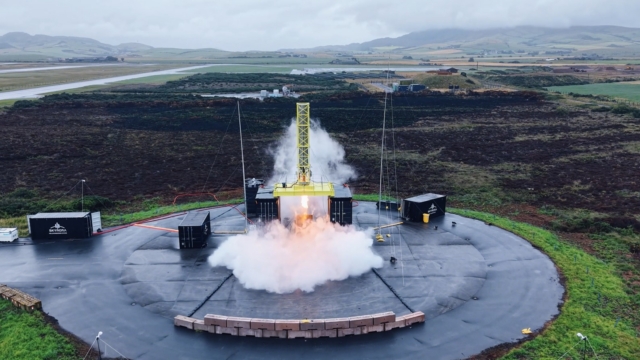
Skyrora completes hot-fire test of scaled-down orbital vehicle systems
Skyrora-hot-fire test of scaled-down orbital vehicle systems
Skyrora completes hot-fire test of scaled-down orbital vehicle systems
With its static hot-fire testing of a smaller scale version of its orbital launch vehicle, Skyrora is addressing engineering challenges and reducing technical risk, before scaling up the development of its Skyrora XL rocket programme.
Member News Space

30 Sep 2026

How Astroscale plans to remove a dead satellite from orbit
ELSA-M satellite removal spacecraft
How Astroscale plans to remove a dead satellite from orbit
Astroscale UK's ELSA-M mission will capture a retired Eutelsat OneWeb satellite and pull it towards atmospheric re-entry.
Space

30 Sep 2026

New tools to tackle prison drones, drugs and help offenders into work
National Police Chiefs Council photo of police on duty
New tools to tackle prison drones, drugs and help offenders into work
Lord Chancellor Alex Norris has announced a series of new measures aimed at tackling prison drones, curbing substance abuse and assisting offenders in securing work and accommodation.
Security

1 Oct 2026

UK policing’s first AI crime reporting system goes live in Cambridgeshire
AI online crime reporting test goes live in Cambridgeshire
UK policing’s first AI crime reporting system goes live in Cambridgeshire
The pilot uses conversational AI to gather crime reports, ask follow-up questions and submit a structured crime report directly into police systems.
Security

1 Oct 2026

British Transport Police extends facial recognition trial despite zero direct arrests
Operational Testing of Facial Recognition Technology
British Transport Police extends facial recognition trial despite zero direct arrests
BTP has extended its live facial recognition trial to the London Underground after more than 500,000 scans produced one false match and no direct arrests.
Security

1 Oct 2026